NorrChemica™
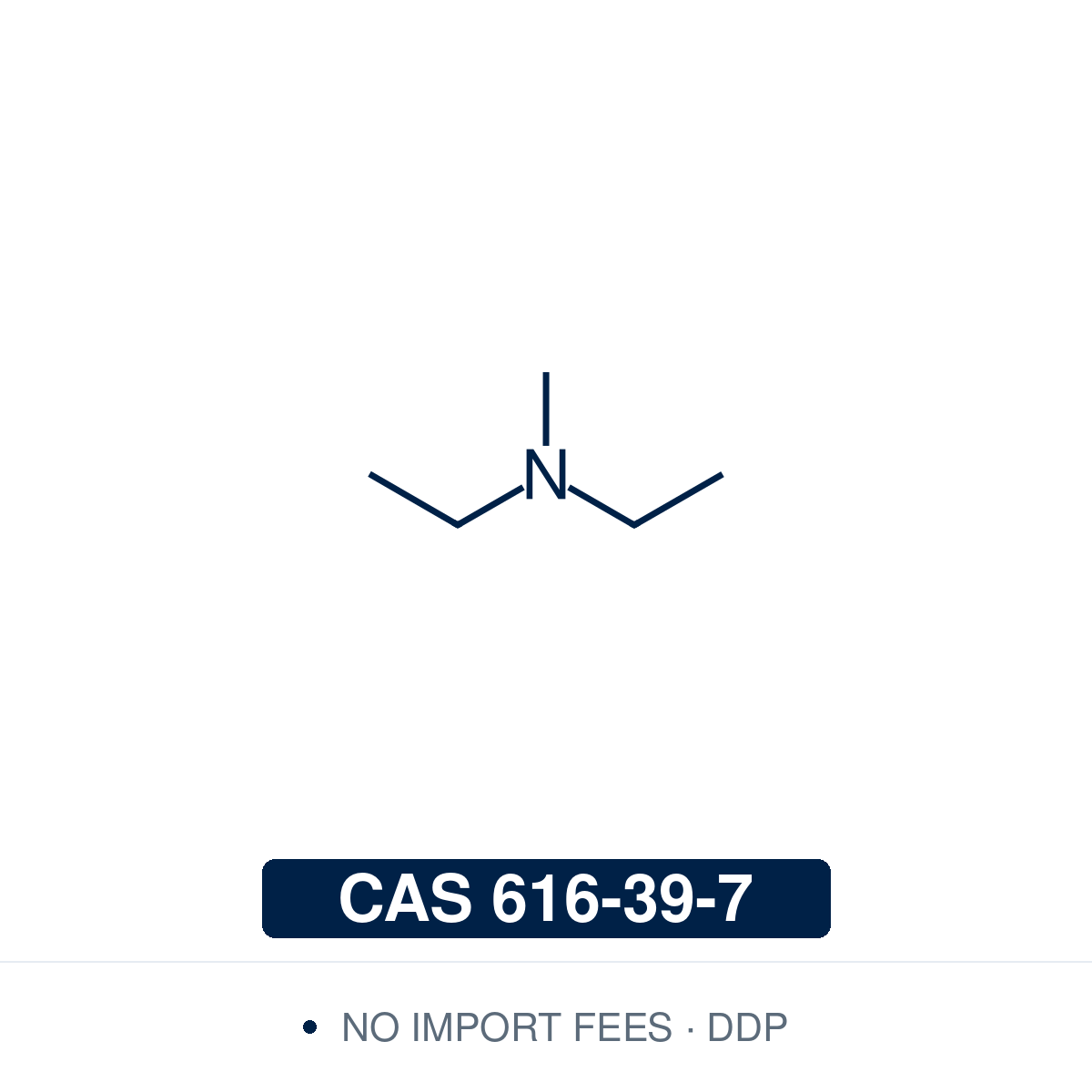
N,N-Diethylmethylamine
N,N-Diethylmethylamine | CAS 616-39-7 | ≥98%
| Pack size | Excl. VAT | Incl. VAT | Add to cart |
|---|---|---|---|
| 5.0 g | €64,20 | ||
| 25 g | €98,20 |
Taxes and fees, e.g. VAT, included in the price. Shipping calculated at checkout.Free shipping on EU, UK and EFTA orders above €250, and above €400 to the rest of the world.
Technical Specifications
| CAS Number | 616-39-7 |
| EC / EINECS Number | 210-480-5 |
| MDL Number | MFCD00009049 |
| SMILES | CCN(C)CC |
| InChI | InChI=1S/C5H13N/c1-4-6(3)5-2/h4-5H2,1-3H3 |
| InChIKey | GNVRJGIVDSQCOP-UHFFFAOYSA-N |
| PubChem CID | 12022 |
| Molecular Formula | C₅H₁₃N |
| Molecular Weight | 87.16 g/mol |
| Solubility | Soluble in water. |
| Purity | ≥98% |
| Physical Form | Colourless to light yellow clear liquid |
| HS Code | 2921.19 |
| Shelf Life | Retest period: 36 months from date of manufacture |
| Storage Conditions | Store under inert gas in a tightly closed container, in a cool, dry and well-ventilated place, away from heat and sources of ignition. Sensitive to carbon dioxide. |
Product Description & Scientific Applications
N,N-Diethylmethylamine (DEMA) is a tertiary amine. It is a liquid at standard temperature and pressure.
Protic ionic liquids. DEMA-based protic ionic liquids (PILs) have been prepared by protonating DEMA with a series of acids that span a large range of acidities. In this series, the gas-phase proton affinity of the acid was a better predictor of the extent of proton transfer than the aqueous ΔpKa. One example is the protic ionic liquid obtained from DEMA and trifluoromethanesulfonic acid, diethylmethylammonium trifluoromethanesulfonate ([dema][TfO]). Another example is the protic ionic liquid diethylmethylammonium methanesulfonate ([DEMA][OMs]).
DEMA + CF₃SO₃H → diethylmethylammonium trifluoromethanesulfonate, [dema][TfO]. DEMA forms protic ionic liquids with a range of acids, and the extent of proton transfer depends on the acid.
Fuel cell electrolytes. [dema][TfO] has been studied as a medium-temperature fuel cell electrolyte under non-humidifying conditions. It shows high activity for the hydrogen oxidation and oxygen reduction reactions at a platinum electrode. Proton conduction in [dema][TfO] occurs mainly by the vehicle mechanism. Six-membered sulfonated polyimides in the diethylmethylammonium form are highly compatible with [dema][TfO], and H₂/O₂ fuel cells made with the resulting composite membranes can operate under non-humidified conditions. [dema][TfO] has also been combined with poly(benzimidazole) in proton-conducting membranes for anhydrous H₂/Cl₂ fuel cells. A polymerised protic ionic liquid with the same cation, [DEMA][PSTFSI], has been designed as a polymer electrolyte for non-humidified polymer electrolyte membrane fuel cells.
LC/MS of PEG and PEGylated proteins. In LC/MS of poly(ethylene glycol) (PEG) and PEGylated peptides and proteins, DEMA can be mixed into the HPLC stream after the column, before the mass spectrometer. PEG is then diethylmethylammoniated instead of protonated, while the protein or peptide remains protonated. The charges of PEG and of the PEGylated compounds are greatly reduced, and the spectra can be deconvoluted with commercially available software to obtain accurate masses.
Acylation chemistry. Amine-catalysed ester formation from benzoyl chloride and phenol has been studied by stopped-flow FT-IR spectroscopy. The rate of phenyl benzoate formation was very sensitive to small structural changes in the amine, such as diethylmethylamine compared with triethylamine.
Reaction studied: benzoyl chloride + phenol → phenyl benzoate, catalysed by amines such as DEMA or triethylamine.
Enzymology. DEMA has been used as a substrate to study the reductive half-reaction of trimethylamine dehydrogenase. It is a slow substrate of this enzyme. Its reaction shows three distinct kinetic phases, which are fully resolved under most conditions.
NMR lineshape standard. DEMA is a useful compound for shimming the magnetic field in NMR experiments at room temperature and near the low temperature used in many dynamic nuclear polarisation (DNP) experiments.
Shipping Destinations
- EU only: 3–7 business days.
Safety Information
| GHS Pictograms |


|
| Signal Word | Danger |
| Hazard Class | UN 2733 — Amines, flammable, corrosive, n.o.s. (Diethylmethylamine) (Class 3 (8), PG II) |
| Transport Category | Class 3 (8), PG II (ADR/IATA/IMDG) |
| H-Statements | H225 - H301 - H314 - H332 |
| P-Statements | P210 - P233 - P240 - P241 - P242 - P243 - P260 - P261 - P264 - P264+P265 - P270 - P271 - P280 - P301+P316 - P301+P330+P331 - P302+P361+P354 - P303+P361+P353 - P304+P340 - P305+P354+P338 - P316 - P317 - P321 - P330 - P363 - P370+P378 - P403+P235 - P405 - P501 |
Documentation
| Safety Data Sheet | Download PDF |