NorrChemica™
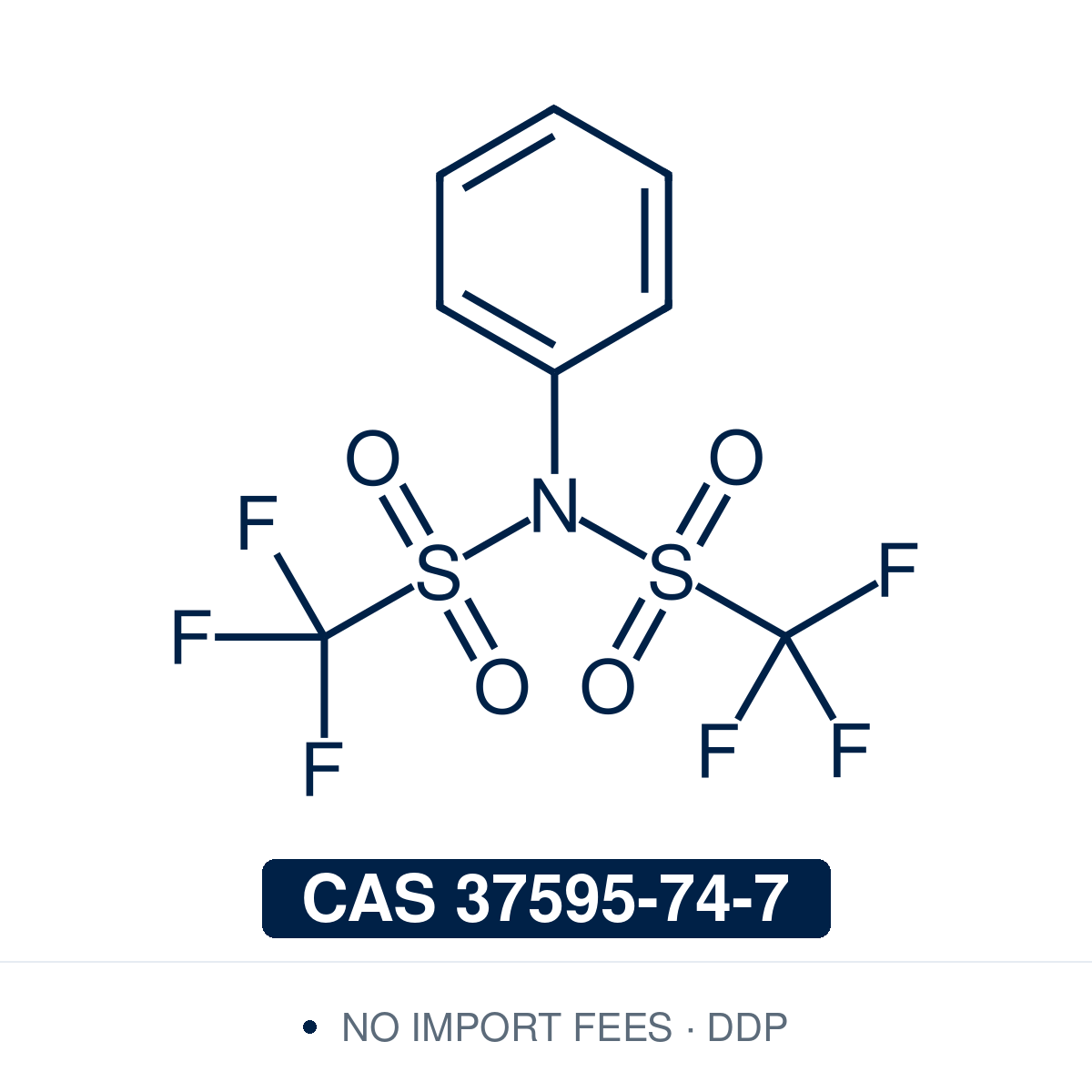
N-Phenyltriflimide (PhNTf2)
N-Phenyltriflimide (PhNTf2) | CAS 37595-74-7 | ≥98%
Couldn't load pickup availability
Technical Specifications
| CAS Number | 37595-74-7 |
| EC / EINECS Number | 609-445-0 |
| MDL Number | MFCD00000404 |
| SMILES | C1=CC=C(C=C1)N(S(=O)(=O)C(F)(F)F)S(=O)(=O)C(F)(F)F |
| InChI | InChI=1S/C8H5F6NO4S2/c9-7(10,11)20(16,17)15(6-4-2-1-3-5-6)21(18,19)8(12,13)14/h1-5H |
| InChIKey | DIOHEXPTUTVCNX-UHFFFAOYSA-N |
| PubChem CID | 142176 |
| Molecular Formula | C₈H₅F₆NO₄S₂ |
| Molecular Weight | 357.3 g/mol |
| Melting Point | 100-102 °C (lit.) |
| Solubility | Soluble in most organic solvents |
| Purity | ≥98% |
| Physical Form | White to pale cream crystalline solid |
| HS Code | 2935.90 |
| Shelf Life | Retest period: 36 months from date of manufacture |
| Storage Conditions | Store in a cool place |
Product Description & Scientific Applications
N-Phenyltriflimide (PhNTf2, phenyl triflimide, N,N-bis(trifluoromethanesulfonyl)aniline) is a bench-stable crystalline triflating agent. It converts phenols to aryl triflates at room temperature and ketone enolates to vinyl triflates at low temperature. The value of the triflate is that it acts as a pseudohalide: it makes a phenol or a ketone behave like an aryl or vinyl halide, opening those positions to Suzuki–Miyaura, Stille, Sonogashira and Negishi coupling, to the Heck reaction and to carbonylation, none of which the parent carbon–oxygen bond will undergo. Triflic anhydride, triflyl chloride and triflic acid all triflate more aggressively, but each is a corrosive liquid, whereas this reagent is a storable, non-hygroscopic solid.
Applications and Reactions
- Aryl triflates from phenols: The reagent is used at one equivalent per phenol with 1.3 equivalents of triethylamine. Under controlled microwave heating at 120 °C the aryl triflate forms in six minutes in good yield, and the same protocol transfers to solid phase. Scope extends to naphthols and to heterocyclic phenols, including an unprotected indole.
- Enol triflates from ketones and lactams: A ketone is deprotonated with LiHMDS and the resulting enolate trapped by the reagent, which fixes both the regiochemistry and the double-bond geometry in that step. The same sequence applies to lactam-derived imides, where LiHMDS at low temperature gave the vinyl trifluoromethanesulfonate in 58% yield.
- Choosing between this reagent and Comins': Comins' pyridyl triflimide is the more reactive of the two. It works at cryogenic temperatures, needs less time, and on one shared substrate reached 53% where this reagent gave less. It is also considerably more expensive, so this reagent is the routine choice, and Comins' is kept for hindered enolates and for substrates that will not survive a longer reaction.
- Dehydration to dehydroamino acids: With triethylamine, the reagent dehydrates hydroxy amino acid derivatives to alkylidene amino acids. It also acts on bis(hydroxyalkylated) dipeptides, dehydrating them selectively to dehydroalanine derivatives.
- Two coupling handles on one ring: Installing a triflate on a chlorinated benzene leaves two leaving groups of unequal reactivity, which is what makes modular teraryl assembly possible. Ligand-free palladium salts cleave the triflate at room temperature and leave the chloride intact, and that selectivity is exclusive.
- Limits: Triflation of peptides is restricted. Tyrosine residues have been triflated only where the remaining side chains are simple, and not in the presence of arginine or histidine.
Shipping Destinations
- EU & UK: Priority delivery, 2–5 business days.
- United States (DDP): 3–7 business days, duties and taxes prepaid.
- EFTA Countries (DDP): 3–7 business days, duties and taxes prepaid.
- Worldwide: 7–14 business days, selected locations.
Safety Information
| GHS Pictograms |

|
| Signal Word | Warning |
| Hazard Class | Not regulated for transport |
| Transport Category | Not classified as dangerous goods for transport (ADR/IATA/IMDG) |
| H-Statements | H315 - H319 - H335 |
| P-Statements | P261 - P264 - P271 - P280 - P302+P352 - P304+P340 - P305+P351+P338 - P312 - P321 - P332+P313 - P337+P313 - P362+P364 - P403+P233 - P405 - P501 |
Documentation
| Safety Data Sheet | Download PDF |