NorrChemica™
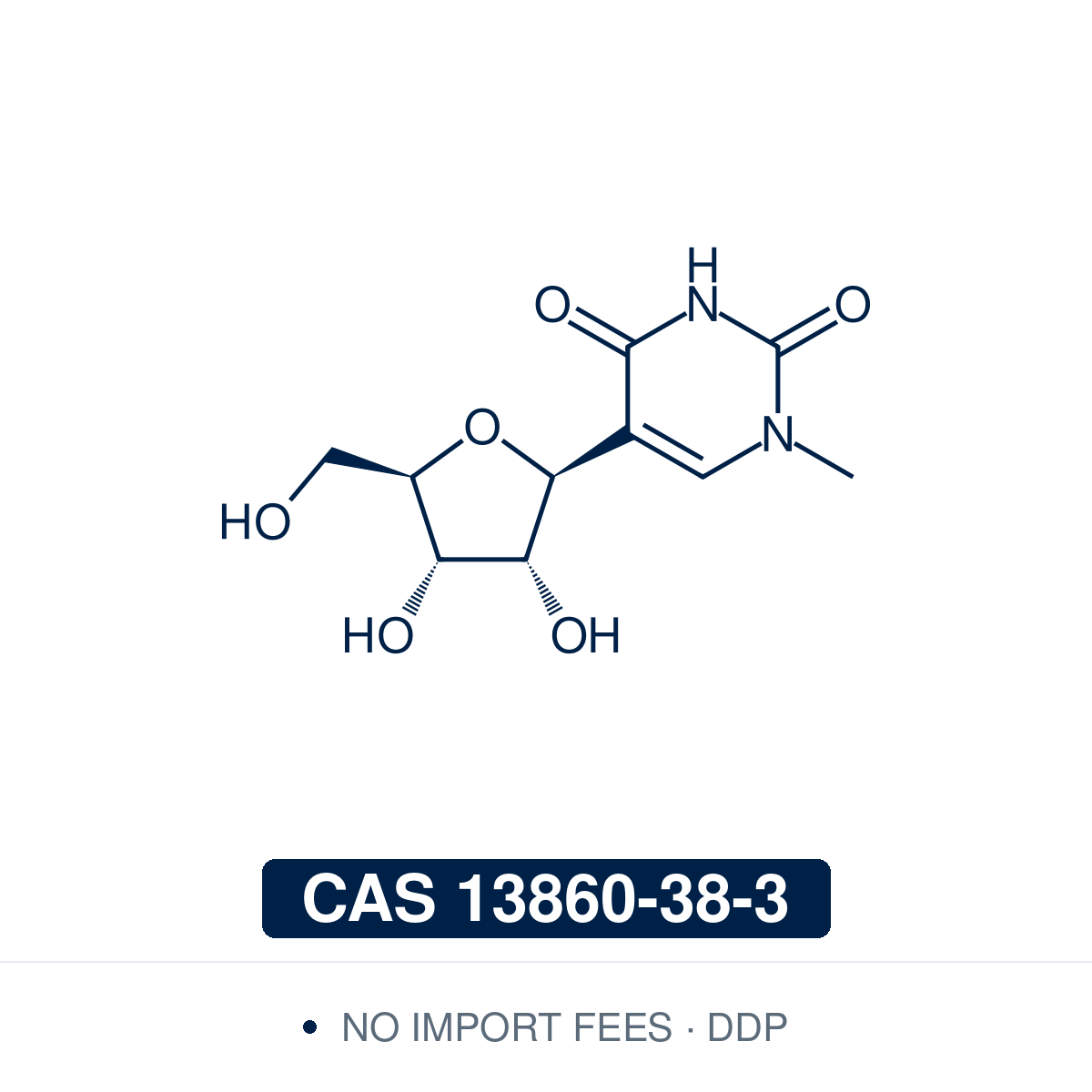
N1-Methylpseudouridine
N1-Methylpseudouridine | CAS 13860-38-3 | ≥97%
Pack sizes & prices
| Pack size | Excl. VAT | Incl. VAT | Add to cart |
|---|---|---|---|
| 50 mg | €45,20 | ||
| 100 mg | €64,20 | ||
| 250 mg | €79,20 | ||
| 1.0 g | €129,20 | ||
| 2.0 g | €229,20 | ||
| 5.0 g | €429,20 | ||
| 10 g | €809,20 | ||
| 25 g | €1.895,00 |
Taxes and fees, e.g. VAT, included in the price. Shipping calculated at checkout.Free shipping on EU, UK and EFTA orders above €250, and above €400 to the rest of the world.
Technical Specifications
| CAS Number | 13860-38-3 |
| EC / EINECS Number | 974-126-8 |
| MDL Number | MFCD10687017 |
| SMILES | CN1C=C(C(=O)NC1=O)[C@H]2[C@@H]([C@@H]([C@H](O2)CO)O)O |
| InChI | InChI=1S/C10H14N2O6/c1-12-2-4(9(16)11-10(12)17)8-7(15)6(14)5(3-13)18-8/h2,5-8,13-15H,3H2,1H3,(H,11,16,17)/t5-,6-,7-,8+/m1/s1 |
| InChIKey | UVBYMVOUBXYSFV-XUTVFYLZSA-N |
| PubChem CID | 99543 |
| Molecular Formula | C₁₀H₁₄N₂O₆ |
| Molecular Weight | 258.23 g/mol |
| Melting Point | 187–191 °C |
| Purity | ≥97% |
| Physical Form | White to light yellow powder or crystals |
| HS Code | 2934.99 |
| Shelf Life | Retest period: 36 months from date of manufacture |
| Storage Conditions | Store at 2–8 °C in a tightly sealed container. |
Product Description & Scientific Applications
N1-Methylpseudouridine (m1Ψ) is pseudouridine carrying a methyl group on N1 of the uracil ring. In nature it occurs in the transfer RNA of many archaea, where it is found at position 54 in the TΨC loop in place of ribothymidine.
Pseudouridine (left) and N1-methylpseudouridine (right), drawn as the free nucleosides. In cells, the methyl group is added to N1 of pseudouridine residues within RNA, for example by TrmY at position 54 of archaeal tRNA, in a reaction that depends on S-adenosylmethionine. Nep1 also methylates N1 of pseudouridine in RNA, and is proposed to do so in eukaryotic 18S ribosomal RNA, where the modified nucleoside is m1acp3Ψ.
Formation in RNA. In archaea, m1Ψ is formed on the tRNA in two steps: the pseudouridine synthase Pus10 forms pseudouridine at position 54, and the methyltransferase TrmY then methylates it. The methylation depends on S-adenosylmethionine. The ribosome assembly factor Nep1 is a methyltransferase specific for N1 of pseudouridine. Its activity is conserved in human Nep1, and Nep1 is proposed to install the N1-methyl group of the hypermodified nucleoside m1acp3Ψ in eukaryotic 18S ribosomal RNA. A mutation in human Nep1 causes Bowen–Conradi syndrome.
Modified mRNA. mRNAs that contain m1Ψ gave higher reporter protein expression than pseudouridine-modified mRNAs in cell lines and in mice, and lower innate immunogenicity in transfected cells. The authors suggest that the higher protein expression may be due, at least in part, to the mRNA being better at avoiding activation of the endosomal Toll-like receptor TLR3. In another study, m1Ψ outperformed several other nucleoside modifications, and combinations of them, in translation capacity. Work in cell-free translation systems showed that m1Ψ in the mRNA switches off the inhibition of translation that is linked to the immune response and to eIF2α phosphorylation, and that it also increases ribosome pausing and ribosome density on the mRNA. The COVID-19 mRNA vaccines of Pfizer-BioNTech (BNT162b2) and Moderna (mRNA-1273) use m1Ψ, and in BNT162b2 every uridine in the mRNA is replaced by m1Ψ. Such mRNAs are made by in vitro transcription with T7 RNA polymerase, with m1Ψ triphosphate in place of UTP. In a study with T7 RNA polymerase and a mixture of UTP and m1Ψ triphosphate, the ratio in which the two were inserted depended strongly on the neighbouring sequence, and UTP was inserted more often in every sequence context tested.
Fidelity of transcription and translation. During in vitro transcription, m1Ψ is incorporated with higher fidelity than pseudouridine. In a reconstituted translation system, m1Ψ did not significantly alter decoding accuracy, and, compared with unmodified mRNA, no increase in miscoded peptides was detected when m1Ψ-containing mRNA was translated in cell culture. However, m1Ψ in mRNA has been shown to cause +1 ribosomal frameshifting in vitro, at slippery sequences, probably because it makes ribosomes stall. Synonymous changes to these slippery sequences reduce the frameshifted products.
Reaction with bisulfite. Like pseudouridine, m1Ψ reacts with bisulfite to give ribose adducts: two constitutional isomers in which bisulfite is bound through oxygen (O-adduct) or sulfur (S-adduct) to C1′ of a ring-opened ribose, with the O-adduct as the main product. At neutral pH, bisulfite did not react with cytidine or 5-methylcytidine, while uridine, 5-methyluridine, pseudouridine and m1Ψ all reacted. The authors report that at this pH bisulfite reacts specifically with pseudouridine and m1Ψ to give stable end products.
Reaction of N1-methylpseudouridine with bisulfite. Both end products are adducts at C1′ with the ribose ring opened; R = the open sugar chain, CH(OH)–CH(OH)–CH(OH)–CH₂OH. The O-adduct (left) is the main product and the S-adduct (right) the minor one. The adducts are drawn as the N1-methyl analogues of the pseudouridine adducts, with which they were assigned.
Shipping Destinations
- EU & UK: Priority delivery, 2–5 business days.
- United States (DDP): 3–7 business days, duties and taxes prepaid.
- EFTA Countries (DDP): 3–7 business days, duties and taxes prepaid.
- Worldwide: 7–14 business days, selected locations.
Safety Information
| Hazard Class | Not regulated for transport |
| Transport Category | Not classified as dangerous goods for transport (ADR/IATA/IMDG) |
Documentation
| Safety Data Sheet | Download PDF |
Share