NorrChemica™
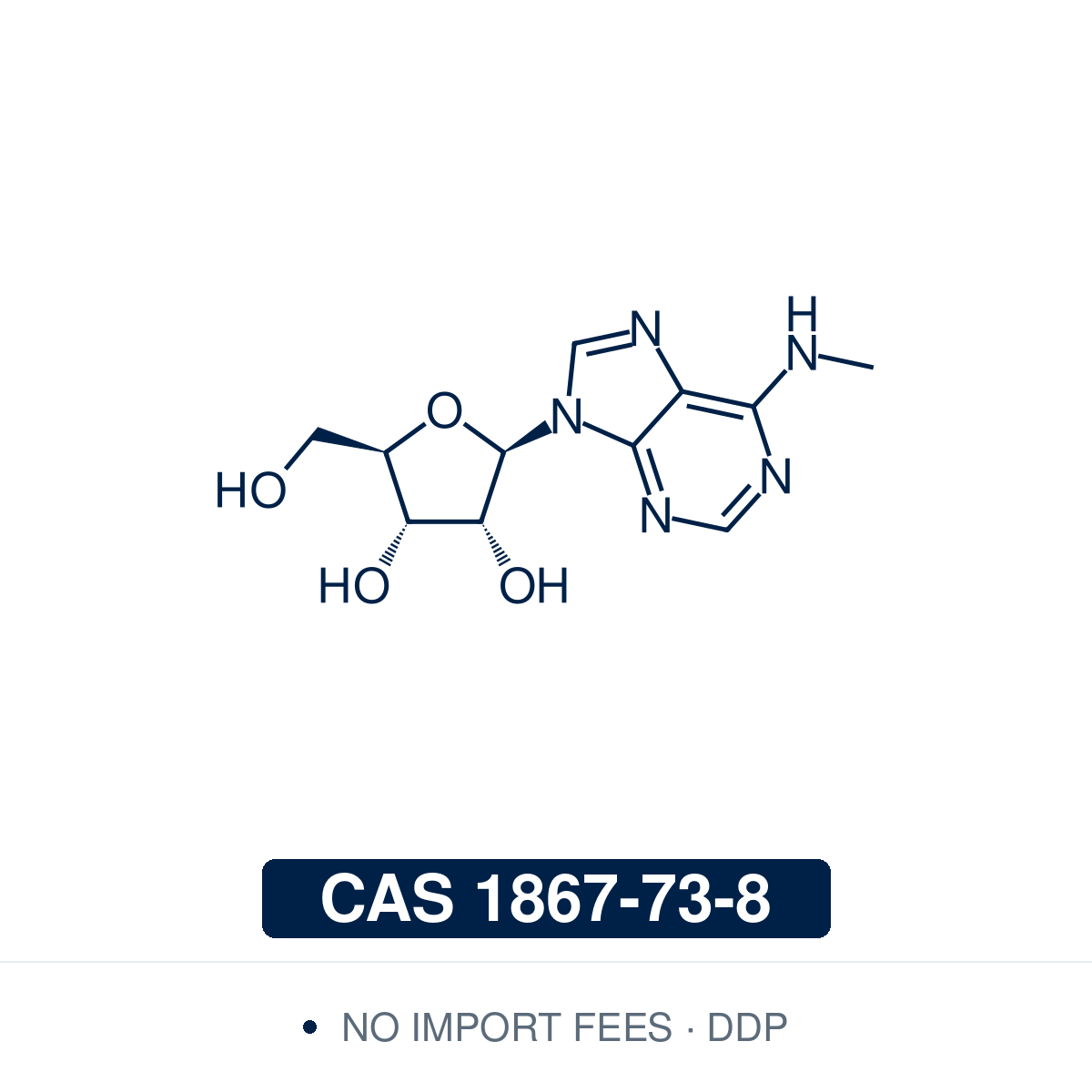
N6-Methyladenosine
N6-Methyladenosine | CAS 1867-73-8 | ≥97%
Pack sizes & prices
| Pack size | Excl. VAT | Incl. VAT | Add to cart |
|---|---|---|---|
| 250 mg | €49,20 | ||
| 1.0 g | €98,20 | ||
| 5.0 g | €329,20 | ||
| 10 g | €598,20 | ||
| 25 g | €1.089,20 |
Taxes and fees, e.g. VAT, included in the price. Shipping calculated at checkout.Free shipping on EU, UK and EFTA orders above €250, and above €400 to the rest of the world.
Technical Specifications
| CAS Number | 1867-73-8 |
| MDL Number | MFCD00005739 |
| SMILES | CNC1=C2C(=NC=N1)N(C=N2)[C@H]3[C@@H]([C@@H]([C@H](O3)CO)O)O |
| InChI | InChI=1S/C11H15N5O4/c1-12-9-6-10(14-3-13-9)16(4-15-6)11-8(19)7(18)5(2-17)20-11/h3-5,7-8,11,17-19H,2H2,1H3,(H,12,13,14)/t5-,7-,8-,11-/m1/s1 |
| InChIKey | VQAYFKKCNSOZKM-IOSLPCCCSA-N |
| PubChem CID | 102175 |
| Molecular Formula | C₁₁H₁₅N₅O₄ |
| Molecular Weight | 281.27 g/mol |
| Purity | ≥97% |
| Physical Form | Solid |
| HS Code | 2934.99 |
| Shelf Life | Retest period: 36 months from date of manufacture |
| Storage Conditions | Store at 2–8 °C in a tightly sealed container. |
Product Description & Scientific Applications
N6-Methyladenosine (m6A) is adenosine with a methyl group on the 6-amino group of the adenine base. It is the most prevalent internal modification of mRNA in higher eukaryotes. An early study looked at mRNA from hepatoma cells and found that the nucleosides methylated on the base were mainly N6-methyladenosine. Two transcriptome-wide methods, m6A-seq and MeRIP-seq, combine antibody capture of methylated RNA with high-throughput sequencing. They found m6A in the mRNAs of thousands of human and mouse genes, with sites concentrated near stop codons.
Formation in RNA. In mammalian cells, m6A is added to nuclear RNAs by a methyltransferase complex whose core is a stable heterodimer of METTL3 and METTL14. The methyl group comes from S-adenosylmethionine (SAM). Crystal structures of the METTL3–METTL14 methyltransferase domains show SAM bound in the catalytic site. In one study, the enzymes were given SAM whose methyl group was labelled with deuterium, and the m6A they formed carried the label. In mammalian mRNA, methylation takes place within the consensus sequence Pu[G>A]m6AC[A/C/U] (Pu = purine), although only some of the sequences that match this pattern carry m6A.
Formation of N6-methyladenosine (m6A, right) from adenosine (left) by the METTL3–METTL14 methyltransferase complex, with S-adenosylmethionine (SAM) as the methyl donor. In RNA the reaction takes place on adenosine residues; the structures are drawn as nucleosides.
Removal by oxidative demethylation. The modification is reversible. In one study, the enzyme FTO removed the methyl group from m6A in RNA by oxidation in vitro. In the same study, lowering FTO levels in human cells raised the amount of m6A in mRNA, and overexpressing FTO lowered it. A later study reported a second mammalian demethylase, ALKBH5, which removes the methyl group from m6A in mRNA by oxidation, both in vitro and in vivo. One study showed that FTO, an Fe(II)- and α-ketoglutarate-dependent enzyme, oxidises m6A first to N6-hydroxymethyladenosine and then to N6-formyladenosine, and that both break down to adenosine in water. The same study found both modifications in mRNA isolated from human cells and mouse tissues.
In one study, FTO, an Fe(II)- and α-ketoglutarate (α-KG)-dependent enzyme, oxidised N6-methyladenosine to N6-hydroxymethyladenosine and then to N6-formyladenosine. Both products break down to adenosine in water; the last arrow shows this for N6-formyladenosine. In RNA the reactions take place on m6A residues; the structures are drawn as nucleosides.
Reader proteins. In one study, the human reader protein YTHDF2 bound m6A-containing mRNA through its C-terminal domain. Its N-terminal domain took the bound mRNA from the pool available for translation to sites of mRNA decay, such as processing bodies. m6A has been reported to affect the localisation, stability, translation and splicing of mRNA.
Dimroth rearrangement. Under alkaline conditions at elevated temperatures, 1-methyladenosine (m1A) rearranges to N6-methyladenosine. Because of this, m1A in RNA may be converted to m6A during purification and measurement, which can add noise to m6A measurements. One study that mapped m1A in mRNA used the rearrangement on purpose. m1A often causes errors during reverse transcription, but m6A rarely does, so converting m1A to m6A with alkali helped the authors confirm where m1A sits.
Dimroth rearrangement of 1-methyladenosine (m1A, left) to N6-methyladenosine (m6A, right) under alkaline conditions at elevated temperatures. m1A is drawn as the imino form given by PubChem.
Modified RNA and immune sensors. In one study, RNA containing m6A, made by in vitro transcription, was less able to stimulate the RNA sensor TLR3 and did not stimulate TLR7 or TLR8. These tests used cultured cells engineered to express each human receptor. In the same study, however, RNA containing m6A still activated primary dendritic cells from blood as strongly as unmodified RNA. Of the modifications tested, only those on uridine stopped this activation.
Analytical standard. Pure m6A has been used, together with pure adenosine, to build standard curves for measuring the m6A/A ratio in mRNA by LC-MS/MS.
Shipping Destinations
- EU & UK: Priority delivery, 2–5 business days.
- United States (DDP): 3–7 business days, duties and taxes prepaid.
- EFTA Countries (DDP): 3–7 business days, duties and taxes prepaid.
- Worldwide: 7–14 business days, selected locations.
Safety Information
| Hazard Class | Not regulated for transport |
| Transport Category | Not classified as dangerous goods for transport (ADR/IATA/IMDG) |
Documentation
| Safety Data Sheet | Download PDF |
Share