NorrChemica™
Neutral Red BS
Neutral Red BS | CAS 553-24-2 | Biological Stain Grade
Couldn't load pickup availability
Technical Specifications
| CAS Number | 553-24-2 |
| EC / EINECS Number | 209-035-8 |
| MDL Number | MFCD00012651 |
| RTECS Number | SG1400000 |
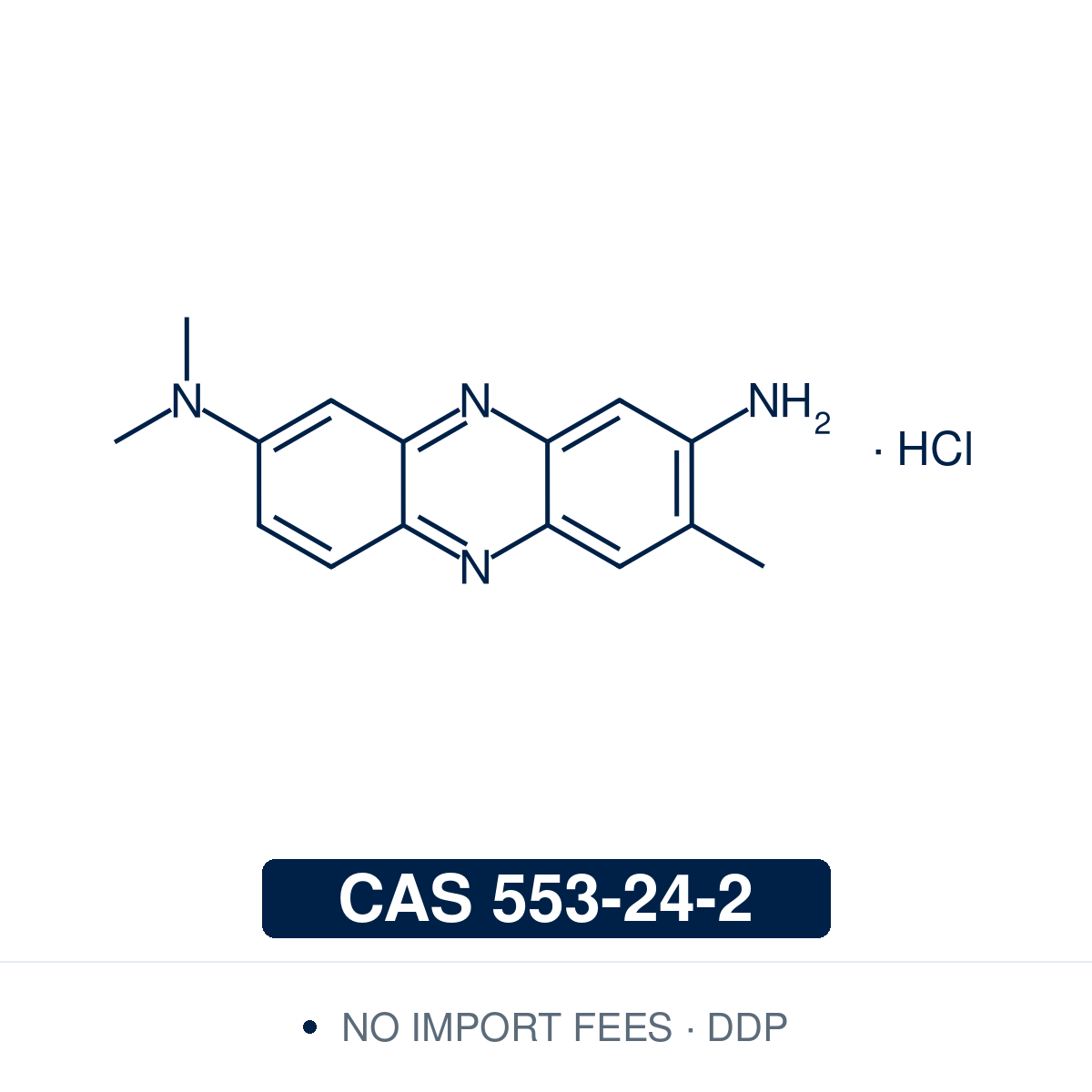
| SMILES | CC1=CC2=NC3=C(C=C(C=C3)N(C)C)N=C2C=C1N.Cl |
| InChI | InChI=1S/C15H16N4.ClH/c1-9-6-13-15(8-11(9)16)18-14-7-10(19(2)3)4-5-12(14)17-13;/h4-8H,16H2,1-3H3;1H |
| InChIKey | PGSADBUBUOPOJS-UHFFFAOYSA-N |
| PubChem CID | 11105 |
| Molecular Formula | C15H17ClN4 |
| Molecular Weight | 288.77 g/mol |
| Melting Point | 290 °C |
| Solubility | Freely soluble in water (50 g/L) and ethanol |
| Purity | Biological Stain Grade |
| Physical Form | Dark green crystalline powder |
| HS Code | 3204.13 |
| Country of Origin | Finland |
| Shelf Life | Retest period: 36 months from date of manufacture |
| Storage Conditions | Store in a cool, dry place in a tightly sealed container, protected from light |
Product Description & Scientific Applications
Neutral Red (C.I. 50040) is a cationic phenazine dye of the eurhodine class. The molecule carries a 3-amino group, a 7-dimethylamino group, and a 2-methyl substituent on the phenazine core. It is supplied as a dark crystalline powder that dissolves to give a deep red solution.
Neutral Red is soluble in water and ethanol. The dye has a pKa near 6.8 in aqueous medium. In mildly acidic conditions, protonation of the phenazine nitrogen system gives the red phenazonium cation with λmax near 535–540 nm. Above neutrality, deprotonation yields the yellow free base with λmax near 450 nm. The colour transition spans pH 6.8–8.0 and is sharp enough for both visual and spectrophotometric readout.
Neutral Red is a weak base with a small lipophilic free-base form that crosses cell membranes. In viable cells the dye enters the cytoplasm and accumulates in acidic intracellular compartments, particularly lysosomes, where protonation and binding trap the dye as the membrane-impermeant phenazonium cation. Loss of lysosomal pH control or membrane integrity lowers Neutral Red retention. This is the molecular basis for the dye's use as a vital stain and as a quantitative reporter of lysosomal integrity in viable cell populations.
Applications:
Neutral Red Uptake (NRU) cytotoxicity assay. Viable mammalian cells take up Neutral Red and concentrate it in lysosomes. Cytotoxic injury disrupts the lysosomal proton gradient and membrane integrity, lowering dye retention. The recovered dye is quantified by absorbance at ~540 nm and is proportional to the surviving cell population. The assay is standard in pharmaceutical, cosmetic, and chemical safety testing, ecotoxicology of environmental samples, and in vitro phototoxicity testing (OECD TG 432, the 3T3 NRU phototoxicity test).
Histological and cytopathological counterstain. Neutral Red provides red contrast for nuclei and cytoplasm in bright-field tissue sections and smears. It pairs with blue counterstains in differential staining workflows. Vital-stain use in tissue smears does not require fluorescence instrumentation, which keeps the workflow compatible with routine bright-field and teaching microscopes.
MacConkey-type differential culture media. Neutral Red is incorporated as the pH indicator in selective and differential media for Enterobacteriaceae. Lactose fermenters acidify the surrounding medium below pH 6.8 and develop red colonies. Non-fermenters remain pale. The colour change is read by eye on the agar plate.
Acid–base pH indicator. Neutral Red is used as a visual or spectrophotometric indicator for titration of weak acids and bases in the pH 6.8–8.0 range. The same chromism serves as a built-in pH reporter in biological culture media to signal microbial growth or CO2 exchange. Neutral Red has also been used in optical pH and dissolved-CO2 sensor work, where protonation-dependent changes in absorption or emission provide the analytical signal.
Shipping Destinations
- EU & UK: Priority delivery, 2–5 business days.
- United States (DDP): 3–7 business days, duties and taxes prepaid.
- EFTA Countries (DDP): 3–7 business days, duties and taxes prepaid.
- Worldwide: 7–14 business days, selected locations.
Safety Information
| Hazard Class | Not regulated for transport |
| Transport Category | Not classified as dangerous goods for transport (ADR/IATA/IMDG) |
Documentation
| Safety Data Sheet | Download PDF |
Share