NorrChemica™
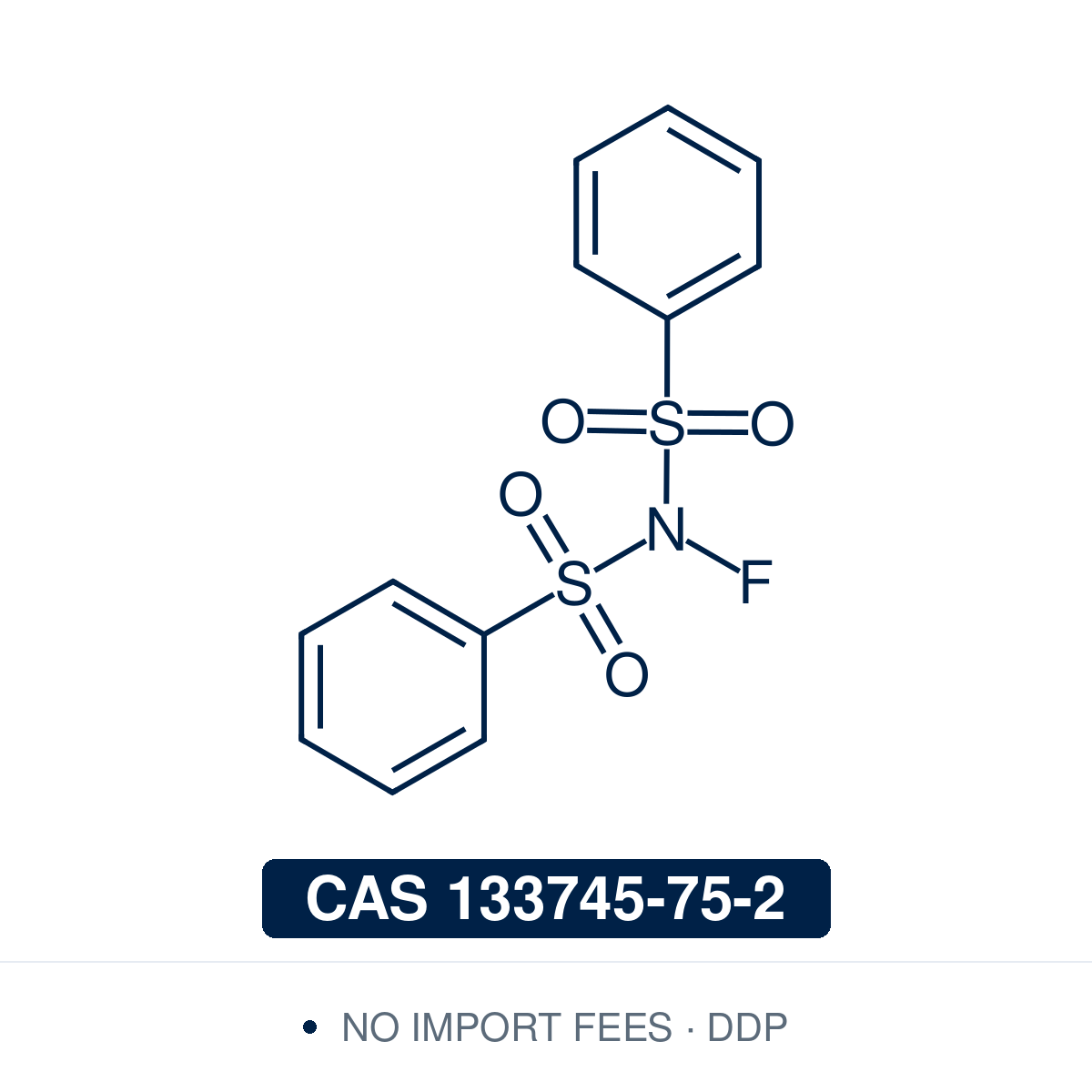
N-Fluorobenzenesulfonimide (NFSI)
CAS 133745-75-2
≥98%
N-Fluorobenzenesulfonimide (NFSI) | CAS 133745-75-2 | ≥98%
Regular price
€34,20 EUR (incl. VAT)
Regular price
Sale price
€34,20 EUR
Taxes included.
Shipping calculated at checkout.
Quantity
Couldn't load pickup availability
Technical Specifications
| CAS Number | 133745-75-2 |
| EC / EINECS Number | 431-940-3 |
| MDL Number | MFCD00144885 |
| SMILES | C1=CC=C(C=C1)S(=O)(=O)N(F)S(=O)(=O)C2=CC=CC=C2 |
| InChI | InChI=1S/C12H10FNO4S2/c13-14(19(15,16)11-7-3-1-4-8-11)20(17,18)12-9-5-2-6-10-12/h1-10H |
| InChIKey | RLKHFSNWQCZBDC-UHFFFAOYSA-N |
| PubChem CID | 588007 |
| Molecular Formula | C₁₂H₁₀FNO₄S₂ |
| Molecular Weight | 315.3 g/mol |
| Melting Point | 110 °C (dec.) |
| Solubility | Very soluble in acetonitrile, dichloromethane, and THF; less soluble in toluene |
| Purity | ≥98% |
| Physical Form | White to light-yellow powder or crystal |
| HS Code | 2935.90 |
| Shelf Life | Retest period: 36 months from date of manufacture |
| Storage Conditions | Store in a cool, dry place in a tightly sealed container, protected from light. |
Product Description & Scientific Applications
N-Fluorobenzenesulfonimide (NFSI), (PhSO2)2NF, is a bench-stable N–F reagent with two modes of reactivity: its electrophilic N–F bond is a fluorine (F+) source, and its benzenesulfonimide fragment is a nitrogen source for oxidative carbon–nitrogen bond formation. It is a strongly electrophilic second-generation fluorinating reagent.
Applications
- NFSI + enolate — Enantioselective α-fluorination of carbonyls: an activated ketene enolate reacts with NFSI to give α-fluorinated carbonyl derivatives of natural products, including chemotherapeutics and antibiotics.
- NFSI + enolate — Organocatalytic asymmetric fluorination: with a tertiary-amine–thiourea catalyst, NFSI is the terminal electrophile in a 1,4-addition/dearomative-fluorination sequence, giving products in 72–95% yield with up to 99:1 d.r. and 98% ee, bearing adjacent tertiary and α-fluoro quaternary stereocentres.
- NFSI + active methine — α-Fluorination of 1,3-dicarbonyls: NFSI converts β-keto phosphonates to enantioenriched α-fluoro-β-keto phosphonates under chiral Lewis-acid catalysis (up to 91% ee), and fluorinates unprotected 3-substituted oxindoles to 3-fluoro-2-oxindoles (up to 98% yield, 99% ee), a route to MaxiPost.
- NFSI + aldehyde (enamine) — Organocatalytic α-fluorination of aldehydes: an imidazolidinone catalyst forms an enamine that reacts with NFSI to give α-fluoro aldehydes with high enantioselectivity (up to 99% ee).
- NFSI + heteroarene — Regioselective late-stage monofluorination of N-protected pyridones, fluorine introduced opposite the carbonyl.
- NFSI + silyl enol ether — Selective mono- and difluorination of silyl enol ethers, with NFSI and its acyl-modified variants.
- NFSI + arene — Directed aromatic C–H fluorination: a Pd(OAc)2–NFSI–TFA system gives ortho-selective monofluorination directed by aryl N-heterocyclic groups (quinoxaline, pyrazole, benzo[d]oxazole, pyrazine).
- NFSI + C–H (benzylic) — Copper-catalysed benzylic C(sp3)–H fluorination; the benzyl fluorides are electrophiles for cross-coupling, and changing the conditions switches the same Cu/NFSI system from C–N to C–F coupling.
- NFSI + boron — Copper(I)-mediated borofluorination: alkynes are converted to cis-(β-fluorovinyl)boronates by an (NHC)copper(I) boryl followed by NFSI, giving anti-Markovnikov products.
- NFSI + alkene (aminofluorination) — Vicinal aminofluorination of styrenes, with NFSI as the source of both nitrogen and fluorine: a palladium-catalysed variant gives vicinal fluoroamines with high regioselectivity; a copper-catalysed radical variant, with NFSI as both radical nitrogen and fluorine source, gives the opposite regioselectivity.
- NFSI + N (amination) — Catalytic imidation and C–H amination, NFSI as the nitrogen source for oxidative C–N bond formation: copper-mediated C–H amination of imidazopyridines, and palladium-catalysed allylic C–H amination of alkenes.
- NFSI + sulfinate — Fluorine source in one-pot syntheses of aryl sulfonyl fluorides — from aryl bromides via DABSO, or from aryl thianthrenium salts — giving SuFEx-relevant products.
Shipping Destinations
- EU & UK: Priority delivery, 2–5 business days.
- United States (DDP): 3–7 business days, duties and taxes prepaid.
- EFTA Countries (DDP): 3–7 business days, duties and taxes prepaid.
- Worldwide: 7–14 business days, selected locations.
Safety Information
| GHS Pictograms |

|
| Signal Word | Warning |
| Hazard Class | Not regulated for transport |
| Transport Category | Not classified as dangerous goods for transport (ADR/IATA/IMDG) |
| H-Statements | H315 - H319 - H335 |
| P-Statements | P261 - P264 - P271 - P280 - P302+P352 - P304+P340 - P305+P351+P338 - P310 - P332+P313 - P362+P364 - P403+P233 - P405 - P501 |
Documentation
| Safety Data Sheet | Download PDF |