NorrChemica™
Biotin NHS ester (NHS-Biotin)
Biotin NHS ester (NHS-Biotin) | CAS 35013-72-0 | ≥97%
Couldn't load pickup availability
Technical Specifications
| CAS Number | 35013-72-0 |
| EC / EINECS Number | 609-055-0 |
| MDL Number | MFCD00078531 |
| SMILES | C1CC(=O)N(C1=O)OC(=O)CCCC[C@H]2[C@@H]3[C@H](CS2)NC(=O)N3 |
| InChI | InChI=1S/C14H19N3O5S/c18-10-5-6-11(19)17(10)22-12(20)4-2-1-3-9-13-8(7-23-9)15-14(21)16-13/h8-9,13H,1-7H2,(H2,15,16,21)/t8-,9-,13-/m0/s1 |
| InChIKey | YMXHPSHLTSZXKH-RVBZMBCESA-N |
| PubChem CID | 6710714 |
| Molecular Formula | C₁₄H₁₉N₃O₅S |
| Molecular Weight | 341.38 g/mol |
| Melting Point | 207–217 °C |
| Solubility | Soluble in DMF and DMSO. Insoluble in water and ethanol. |
| Purity | ≥97% |
| Physical Form | White to off-white powder |
| HS Code | 2932.99 |
| Shelf Life | Retest period: 36 months from date of manufacture. |
| Storage Conditions | Store at −20 °C in a tightly sealed container, protected from moisture. |
Product Description & Scientific Applications
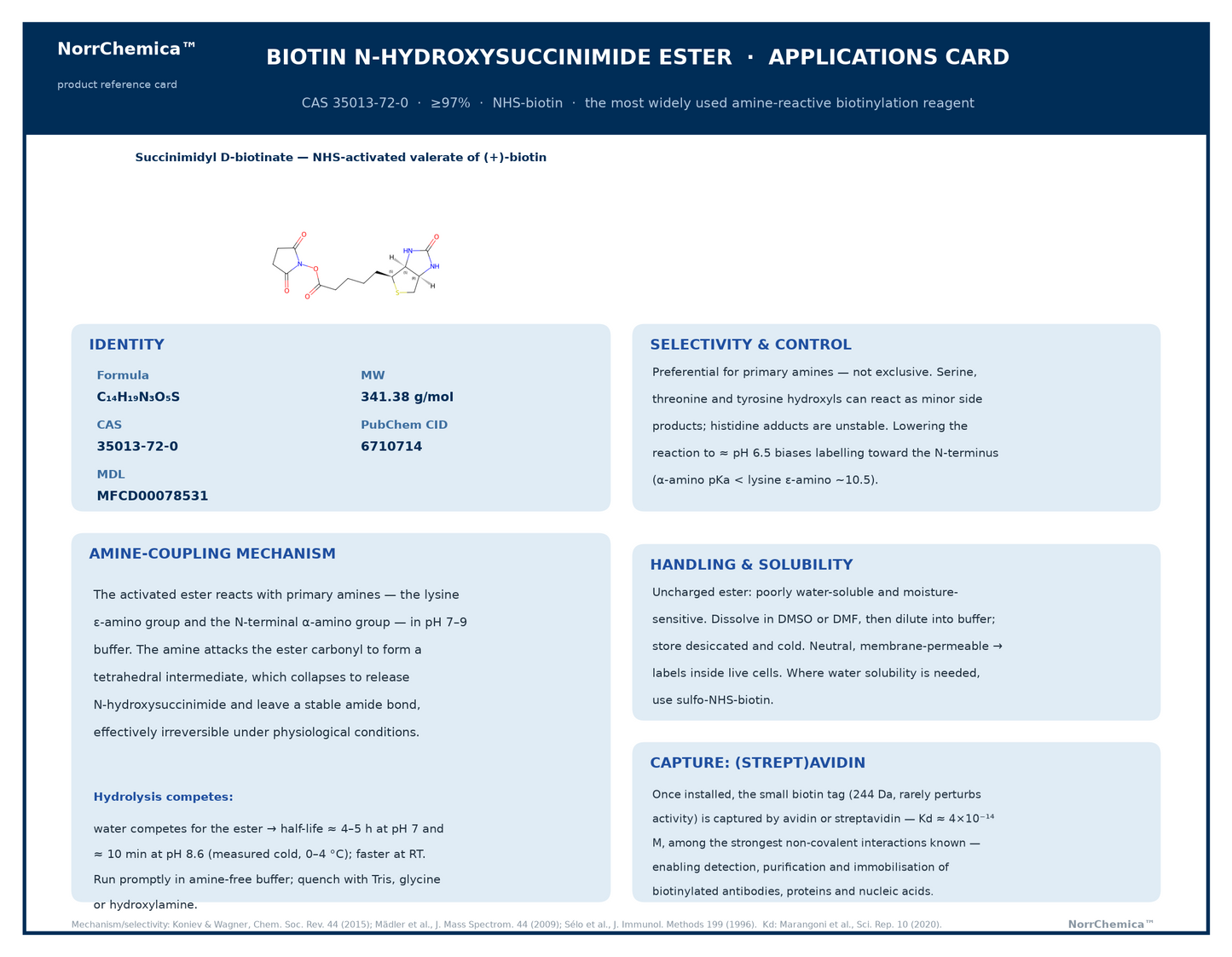
Biotin N-hydroxysuccinimide ester (NHS-biotin; succinimidyl D-biotinate) is the amine-reactive form of biotin. Its valeric-acid carboxyl is activated as an N-hydroxysuccinimide ester. In a single step it couples biotin to proteins, peptides, and other amine-bearing molecules. It is among the most widely used biotinylation reagents.
Amine coupling. The activated ester reacts with primary amines: the ε-amino group of lysine side chains and the α-amino group at each polypeptide N-terminus. Coupling runs in physiological to mildly alkaline buffer, pH 7–9. The amine attacks the ester carbonyl and displaces N-hydroxysuccinimide, leaving a stable amide bond. The amide is effectively irreversible under physiological conditions.
Competing hydrolysis. Water competes with the amine for the ester, so the reagent hydrolyses in parallel to free biotin. Hydrolysis accelerates with pH. Measured cold, at 0–4 °C, the ester half-life is roughly 4–5 hours at pH 7 and about 10 minutes at pH 8.6; it runs faster at room temperature. Reactions are therefore run promptly, at pH 7.2–8.5, in amine-free buffer. Excess reagent is quenched with Tris, glycine, or hydroxylamine.
Selectivity and control. The reagent is preferential for primary amines, not exclusive to them. Serine, threonine, and tyrosine hydroxyls react as minor side products, and histidine imidazole gives adducts that hydrolyse. The lysine ε-amino (pKₐ ≈ 10.5) is far less reactive than the N-terminal α-amino at mildly acidic pH. Lowering the reaction to about pH 6.5 therefore biases labelling toward the N-terminus.
Solubility and handling. The uncharged ester is poorly water-soluble and moisture-sensitive. It is dissolved first in DMSO or DMF, then diluted into aqueous buffer, and stored cold and desiccated. Its neutral, hydrocarbon character makes it membrane-permeable, so it biotinylates inside live cells. For aqueous work, the sulfonated analogue sulfo-NHS-biotin is membrane-impermeant and water-soluble.
Detection and capture. Biotin is a small tag, 244 Da, and rarely perturbs the activity of what it labels. Avidin and streptavidin capture it with a dissociation constant on the order of 10⁻¹⁴ M, among the strongest non-covalent interactions known. This anchors the detection, purification, and surface immobilisation of biotinylated antibodies, proteins, and nucleic acids.
Shipping Destinations
- EU & UK: Priority delivery, 1–2 business days.
- EFTA Countries (DDP): 1–2 business days, duties and taxes prepaid.
Safety Information
| Hazard Class | Not regulated for transport |
| Transport Category | Not classified as dangerous goods for transport (ADR/IATA/IMDG) |
Documentation
| Safety Data Sheet | Download PDF |
Share