NorrChemica™
NHS
NHS | CAS 6066-82-6 | ≥98%
Couldn't load pickup availability
Technical Specifications
| CAS Number | 6066-82-6 |
| EC / EINECS Number | 228-001-3 |
| MDL Number | MFCD00005516 |
| SMILES | C1CC(=O)N(C1=O)O |
| InChI | InChI=1S/C4H5NO3/c6-3-1-2-4(7)5(3)8/h8H,1-2H2 |
| InChIKey | NQTADLQHYWFPDB-UHFFFAOYSA-N |
| PubChem CID | 80170 |
| Molecular Formula | C₄H₅NO₃ |
| Molecular Weight | 115.09 g/mol |
| Melting Point | 95–98 °C |
| Solubility | Soluble in water, ethanol, DMF, DMSO, acetone; sparingly soluble in diethyl ether |
| Purity | ≥98% |
| Physical Form | White crystalline powder |
| HS Code | 2925.19 |
| Shelf Life | Retest period: 36 months from date of manufacture |
| Storage Conditions | Store in a cool, dry place in a tightly sealed container protected from moisture. Midly hygroscopic |
Product Description & Scientific Applications
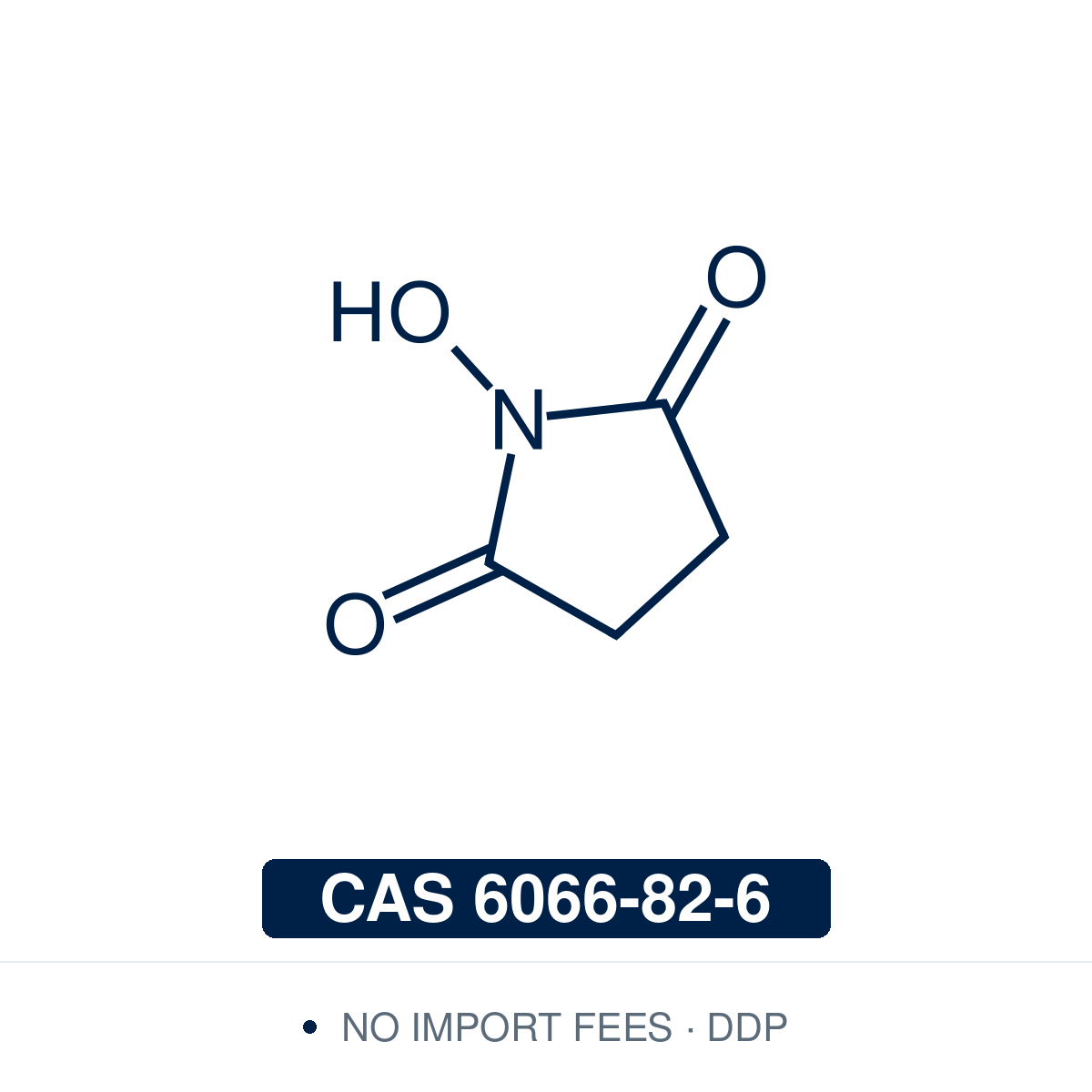
NHS (N-hydroxysuccinimide; 1-hydroxypyrrolidine-2,5-dione; HOSu) is an active-ester additive in amide-bond formation and bioconjugation chemistry. Paired with a carbodiimide such as EDC or DCC, it converts a carboxylic acid into a stable, amine-reactive NHS ester. In peptide synthesis, NHS esters form amide bonds with low racemisation at the α-carbon. EDC/NHS is a standard activation system for aqueous carboxyl-to-amine bioconjugation. NHS is supplied as a white to almost white crystalline solid, soluble in water, DMF and DMSO, and should be kept dry.
Carbodiimide-mediated amide-bond formation
- With EDC or DCC, NHS traps the short-lived O-acylisourea before hydrolysis or rearrangement to the unreactive N-acylurea, diverting the activated acid into an NHS ester — more stable than that intermediate — and improving productive amide formation.
- The NHS ester acylates primary amines under mild, near-neutral to slightly alkaline conditions (pH ≈ 7.2–9.0), giving stable amide bonds; ester hydrolysis competes with aminolysis, so coupling efficiency depends on pH and water exposure.
- EDC/NHS suits aqueous and semi-aqueous media; DCC/NHS handles water-insoluble substrates in organic solvent. Pre-forming the NHS ester separates carboxyl activation from the subsequent amine-coupling step.
Bioconjugation, labelling and protein modification
- Amine-reactive NHS esters of fluorescent dyes, biotin, PEG and ADC linker/payload reagents acylate solvent-accessible lysine ε-amines and N-termini of antibodies and other proteins — core chemistry for antibody labelling, protein modification and lysine-based antibody–drug conjugate assembly.
- Couplings run in aqueous buffer, commonly bicarbonate or phosphate near pH 8 — mild enough to preserve the structure and activity of many folded proteins.
- Because the N-terminal α-amine is less basic than the lysine ε-amine, lower labelling pH can bias acylation toward the N-terminus, giving partial site selectivity rather than true single-site modification.
- Pre-formed NHS esters are crystalline, isolable dry reagents, supplied as ready-to-use amine-reactive derivatives.
Surface functionalisation and biosensors
- EDC/NHS activation of carboxylated surfaces — carboxymethyl-dextran hydrogels used in Biacore CM-series chips or 11-mercaptoundecanoic-acid self-assembled monolayers — is the predominant covalent amine-coupling route for immobilising protein ligands on SPR and related optical biosensors.
- The same activation functionalises carboxylated microarray slides, nanoparticles and microfluidic surfaces through stable amide linkages.
- Sulfo-NHS, the sulfonated water-soluble analogue, improves EDC-mediated coupling on fully aqueous platforms by forming water-soluble amine-reactive esters; remaining activated surface esters are capped with ethanolamine after ligand immobilisation.
Crosslinking and structural biology
- Homobifunctional NHS-ester crosslinkers — DSS and its water-soluble analogue BS3 — bridge proximal lysine ε-amines across an 11.4 Å spacer, capturing protein–protein contacts and stabilising assembled complexes.
- Heterobifunctional reagents such as sulfo-SMCC carry an NHS ester at one end and a maleimide at the other, joining a protein amine to a second molecule's thiol in a controlled, two-step sequence that limits self-conjugation.
- In XL-MS, these crosslinkers — including MS-cleavable analogues such as DSSO and DSBU — provide lysine–lysine distance restraints that support cryo-EM interpretation and computational modelling of complex architecture.
Further Reading
For guidance on selecting between carbodiimides, aminium/uronium salts, phosphonium salts and other reagent classes for amide and peptide bond formation, see NorrChemica's Lab Journal guide: Choosing a Coupling Reagent for Amide and Peptide Bond Formation.
Shipping Destinations
- EU & UK: Priority delivery, 2–5 business days.
- United States (DDP): 3–7 business days, duties and taxes prepaid.
- EFTA Countries (DDP): 3–7 business days, duties and taxes prepaid.
- Worldwide: 7–14 business days, selected locations.
Safety Information
| GHS Pictograms |

|
| Signal Word | Warning |
| Hazard Class | None — not subject to transport regulations |
| Transport Category | Not classified as dangerous goods for transport (ADR/IATA/IMDG) |
| H-Statements | H315 - H319 |
| P-Statements | P264 - P280 - P302+P352 - P305+P351+P338 - P332+P313 - P337+P313 - P362+P364 - P501 |
Documentation
| Safety Data Sheet | Download PDF |