NorrChemica™
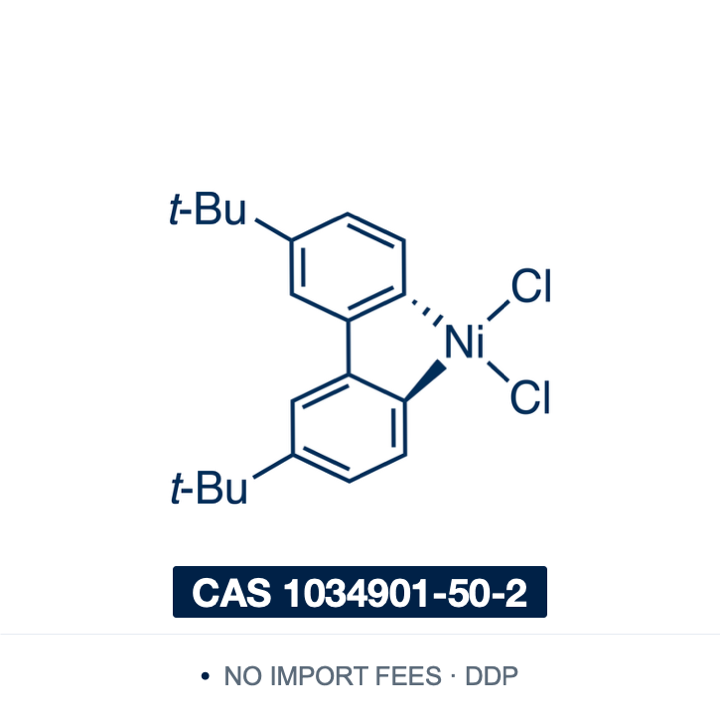
NiCl2(dtbbpy)
NiCl2(dtbbpy) | CAS 1034901-50-2 | ≥97%
| Pack size | Excl. VAT | Incl. VAT | Add to cart |
|---|---|---|---|
| 250 mg | €59,20 | ||
| 1.0 g | €79,20 | ||
| 5.0 g | €273,20 | ||
| 25 g | €1.050,00 |
Taxes and fees, e.g. VAT, included in the price. Shipping calculated at checkout.Free shipping on EU, UK and EFTA orders above €250, and above €400 to the rest of the world.
Technical Specifications
| CAS Number | 1034901-50-2 |
| EC / EINECS Number | 876-244-4 |
| MDL Number | MFCD31807325 |
| SMILES | CC(C)(C)C1=CC(=NC=C1)C2=NC=CC(=C2)C(C)(C)C.Cl[Ni]Cl |
| InChI | InChI=1S/C18H24N2.2ClH.Ni/c1-17(2,3)13-7-9-19-15(11-13)16-12-14(8-10-20-16)18(4,5)6;;;/h7-12H,1-6H3;2*1H;/q;;;+2/p-2 |
| InChIKey | PCWIKFRTCXESOT-UHFFFAOYSA-L |
| PubChem CID | 156589138 |
| Molecular Formula | C₁₈H₂₄Cl₂N₂Ni |
| Molecular Weight | 398.0 g/mol |
| Melting Point | >300 °C |
| Purity | ≥97% |
| Physical Form | Green to dark green powder to crystal |
| HS Code | 2933.39 |
| Shelf Life | Retest period: 36 months from date of manufacture |
| Storage Conditions | Keep container tightly closed in a dry and well-ventilated place. Store in a cool place. Store under nitrogen. |
Product Description & Scientific Applications
NiCl2(dtbbpy) [(4,4'-dtbbpy)NiCl2] is the preformed nickel(II) dichloride complex of 4,4'-di-tert-butyl-2,2'-bipyridine (C18H24Cl2N2Ni, 398.0 g/mol). Preformed is not merely convenient: in α-arylation of N-alkyl N-heterocycles the well-defined complex showed significantly higher activity than NiCl2 alone or NiCl2 combined with the dtbbpy ligand in the flask.
Ni(I)(dtbbpy)+ is the species that performs oxidative addition to an aryl bromide. The solid is air-stable, but stability is not inertness: in Ir/Ni coupling in DMF under CFL irradiation molecular oxygen was essential for activation, where Ni(COD)2 required none.
Applications and Reactions
- α-Arylation of N-heterocycles: 7 mol% with 2 mol% [Ir(dF(CF3)ppy)2(dtbbpy)][PF6], 2,6-lutidine, DMF, 440 nm blue LED — 81% isolated yield.
- Aldehyde synthesis: with an iridium photocatalyst under blue LED, aryl chlorides functionalise 1,3-dioxolane at C2, giving aryl and heteroaryl aldehydes after mild acidic workup.
- C–N amidation: irradiated with an organic amine base, aryl chlorides couple with amides in 80% isolated yield.
- Decarboxylative coupling: oxamates with aryl bromides, 4CzIPN photocatalyst, DMA, 456 nm, 40–45 °C — 71%.
- C(sp3)–H arylation: with TBADT as HAT co-catalyst at 390 nm, gives 1,2-diaryl-syn-diols in 83% yield and greater than 20:1 diastereoselectivity.
- Alkene dicarbofunctionalisation: three-component coupling of electron-deficient alkenes, alcohols and aryl bromides under acridinium/PCET catalysis at 450 nm — 82%.
- Electrochemical cross-electrophile coupling: 2 mol% with a cobalt phthalocyanine mediator sustains 12 mA/cm2 at 95% yield; unmediated, C(sp2)–C(sp3) coupling runs at 73%.
- Aryl esterification: with an energy-transfer photocatalyst in 1:1 DMSO/toluene, benzoic acid couples to 5-bromophthalide in 81% yield.
- Limitations: performance is ligand-sensitive, not universal. In an electrochemical Ni-catalysed C–N coupling of an aryl halide with pyrrolidine, dtbbpy gave 22% where other sp2-N ligands did better — worth screening alternatives when electrochemical amination is the target.
Shipping Destinations
- EU & UK: Priority delivery, 2–5 business days.
- United States (DDP): 3–7 business days, duties and taxes prepaid.
- EFTA Countries (DDP): 3–7 business days, duties and taxes prepaid.
- Worldwide: 7–14 business days, selected locations.
Safety Information
| GHS Pictograms |

|
| Signal Word | Danger |
| Hazard Class | Not regulated for transport |
| Transport Category | Not classified as dangerous goods for transport (ADR/IATA/IMDG) |
| H-Statements | H317 - H334 - H350 - H372 |
| P-Statements | P201 - P202 - P260 - P264 - P270 - P272 - P280 - P284 - P302+P352 - P304+P340 - P308+P313 - P333+P313 - P342+P311 - P362+P364 - P405 - P501 |
Documentation
| Safety Data Sheet | Download PDF |