NorrChemica™
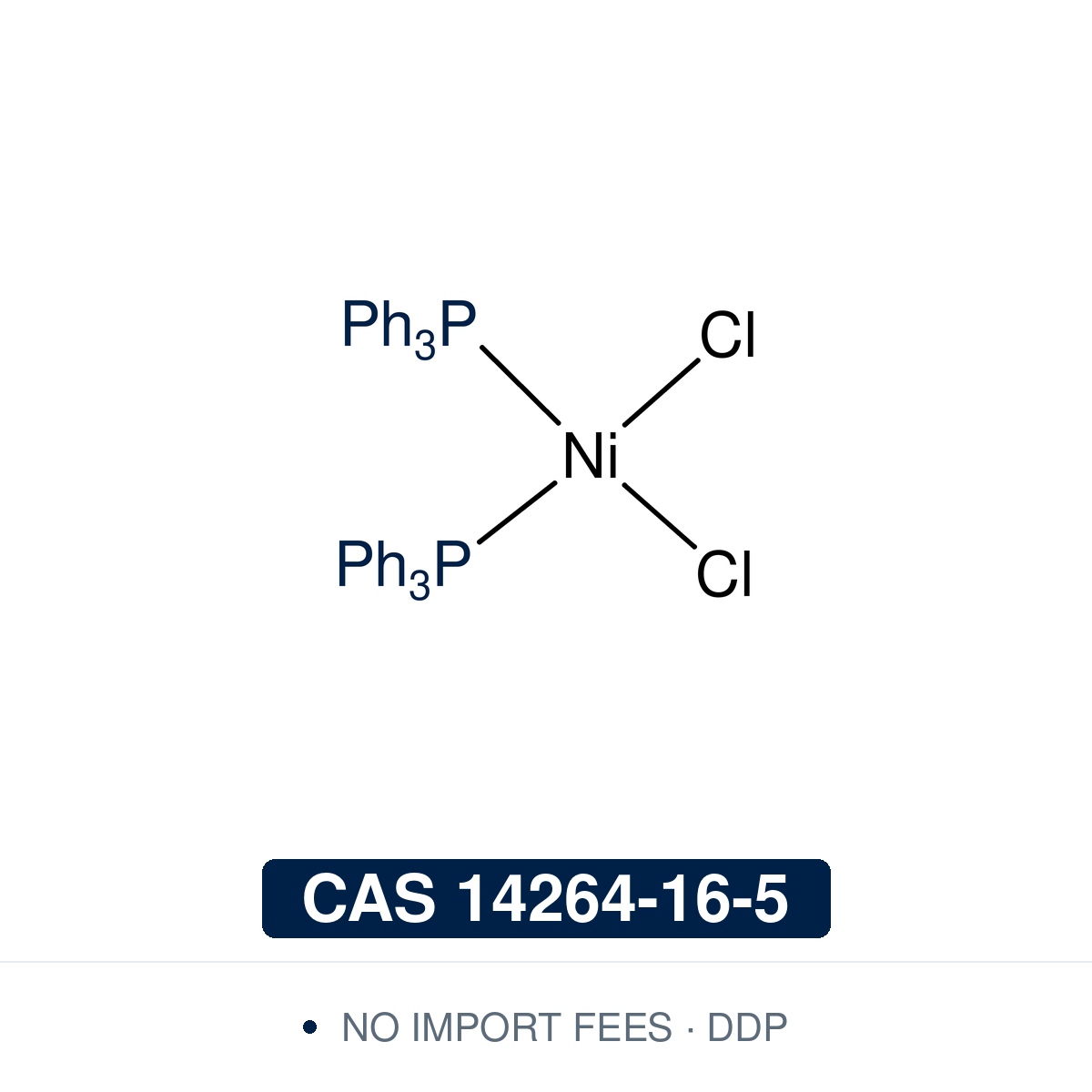
NiCl₂(PPh₃)₂
NiCl₂(PPh₃)₂ | CAS 14264-16-5 | ≥98%
| Pack size | Excl. VAT | Incl. VAT | Add to cart |
|---|---|---|---|
| 5 g | €79,20 | ||
| 25 g | €98,20 | ||
| 100 g | €124,20 | ||
| 500 g | €249,20 |
Taxes and fees, e.g. VAT, included in the price. Shipping calculated at checkout.Free shipping on EU, UK and EFTA orders above €250, and above €400 to the rest of the world.
Technical Specifications
| CAS Number | 14264-16-5 |
| EC / EINECS Number | 238-154-8 |
| MDL Number | MFCD00009592 |
| RTECS Number | QR6170000 |
| SMILES | C1=CC=C(C=C1)P(C2=CC=CC=C2)C3=CC=CC=C3.C1=CC=C(C=C1)P(C2=CC=CC=C2)C3=CC=CC=C3.Cl[Ni]Cl |
| InChI | InChI=1S/2C18H15P.2ClH.Ni/c2*1-4-10-16(11-5-1)19(17-12-6-2-7-13-17)18-14-8-3-9-15-18;;;/h2*1-15H;2*1H;/q;;;;+2/p-2 |
| InChIKey | ZBRJXVVKPBZPAN-UHFFFAOYSA-L |
| PubChem CID | 498315 |
| Molecular Formula | C₃₆H₃₀Cl₂NiP₂ |
| Molecular Weight | 654.2 g/mol |
| Melting Point | 250 °C (decomposes) |
| Purity | ≥98% |
| Physical Form | Dark green solid |
| HS Code | 2931.90 |
| Shelf Life | Retest period: 36 months from date of manufacture |
| Storage Conditions | Keep in a dry, cool and well-ventilated place. Keep container tightly closed. Keep under nitrogen. |
Product Description & Scientific Applications
NiCl₂(PPh₃)₂ (dichlorobis(triphenylphosphine)nickel(II)) is a four-coordinate nickel(II) complex. A review of nickel and palladium precatalysts notes that it can exist as square-planar or tetrahedral isomers. Spectroscopic studies treat it as pseudotetrahedral and paramagnetic, with an S = 1 nickel(II) ion.
High-frequency and high-field EPR spectroscopy, applied to this complex and its bromide and iodide analogues, gave zero-field splitting parameters for NiCl₂(PPh₃)₂ in good agreement with magnetic susceptibility and magnetisation measurements. A ligand-field analysis in the same study showed the chloride ligands acting as strong π-donors and the triphenylphosphine ligands as π-acceptors. Its fine-structure transitions have also been observed directly by far-infrared magnetic spectroscopy. In a ligand K-edge X-ray absorption study of how coordination geometry affects metal–phosphorus and metal–chlorine covalency, the tetrahedral complex showed much weaker Ni–P and Ni–Cl pre-edge features than square-planar NiCl₂(dppe) (dppe = Ph₂P(CH₂)₂PPh₂).
As a precatalyst. NiCl₂(PPh₃)₂ is described as an air-stable precatalyst. It belongs to the nickel(II) dihalide precatalysts [LₙNiX₂] discussed in the review. For this class, one possible activation pathway is transmetallation of both halide ligands by the nucleophile of the coupling, followed by reductive elimination of an organic by-product, although this process has not been studied. More commonly, these precatalysts are used with an elemental reductant such as manganese or zinc, which reduces nickel(II) to nickel(0); the review adds that these reductants lower functional-group tolerance. A further weakness of the class is low solubility, which can prevent reactions at ambient temperature in non-polar solvents.
Cross-coupling catalysis. An early report, from 1979, showed that NiCl₂(PPh₃)₂ combined with methyl- or phenylmagnesium bromide catalyses the arylation or alkylation of enol ethers and the arylation of aryl ethers. More than twenty years later, it was shown to catalyse Suzuki–Miyaura reactions of aryl halides in the presence of excess PPh₃. In one study of the coupling of aryl chlorides with arylboronic acids, with PPh₃ as supporting ligand, highly active catalysts were obtained by reducing NiCl₂(PPh₃)₂ with n-BuLi in the presence of the aryl chloride.
Suzuki–Miyaura coupling of aryl chlorides with arylboronic acids, as reported in one study with NiCl₂(PPh₃)₂ activated by n-BuLi. The positions of R¹ and R² are drawn for illustration only; other reagents and conditions are not shown.
Aryl mesylates, aryl tosylates and allyl carbonates have been coupled with lithium arylborates using NiCl₂(PPh₃)₂. NiCl₂(PPh₃)₂ can also catalyse Suzuki–Miyaura couplings of phenol derivatives such as sulfamates and carbamates, which can serve as directing groups in C–H functionalisation. The review also lists 1,3-disubstituted secondary allylic carbonates as electrophiles in Suzuki–Miyaura reactions with this precatalyst. In one study, NiCl₂(PPh₃)₂ and 1-butyl-3-methylimidazolium bromide, with a base, formed a nickel species in situ that bears one N-heterocyclic carbene and two phosphines. This species catalysed cross-couplings of diarylborinic acids with aryl chlorides, tosylates and sulfamates.
One study used NiCl₂(PPh₃)₂ for a Negishi cross-coupling of amides to diaryl ketones by selective C–N bond activation; the reaction showed high functional-group tolerance and favoured ketone over biaryl products. Another described a one-pot, regio- and stereoselective sequence of allylzincation of acetylenic sulfones followed by Negishi coupling with organic halides, catalysed by NiCl₂(PPh₃)₂, which gives tetrasubstituted olefins containing a 1,4-diene unit. Isoflavones have been prepared by NiCl₂(PPh₃)₂-catalysed Negishi coupling of 3-iodo- or 3-bromochromones with arylzinc bromides.
Isoflavones from 3-iodo- or 3-bromochromones and arylzinc bromides with NiCl₂(PPh₃)₂, as reported in one study. Conditions are not shown.
With added PPh₃, NiCl₂(PPh₃)₂ has been used to couple bromomagnesium diarylamides, generated in situ from diarylamines, with aryl bromides or iodides to give triarylamines. The authors present this as an alternative to Pd-catalysed or Cu-mediated syntheses of triarylamines. In a study of couplings of propargyl halides with organotitanium reagents, NiCl₂(PPh₃)₂ was the best catalyst for substituted propargyl halides, giving allenes or alkynes preferentially. Two further studies used it to couple organoaluminium reagents: aluminium acetylides with benzylic, aryl and heterocyclic bromides, and alkenylaluminium reagents with benzylic bromides or chlorides.
Hydroalumination of alkynes. In one study of the nickel-catalysed hydroalumination of terminal alkynes with diisobutylaluminium hydride (DIBAL-H), Ni(dppp)Cl₂ (dppp = Ph₂P(CH₂)₃PPh₂) gave α-selective addition. Under the same conditions, NiCl₂(PPh₃)₂ made the reaction highly β-selective and, unlike uncatalysed reactions with DIBAL-H, gave little or no alkynylaluminium by-product.
Carboxylation with carbon dioxide. In a 2012 study, NiCl₂(PPh₃)₂ was the precatalyst for the carboxylation of aryl chlorides with carbon dioxide to carboxylic acids, with metallic manganese as the reductant. The study's mechanistic work suggested that a nickel(I) species is involved in the catalytic cycle. A later mechanistic investigation, which used the carboxylation of aryl halides with NiCl₂(PPh₃)₂ as a model reaction, found that both a Lewis acid and a halide source benefit catalysis. It established that metallic manganese and zinc reductants are multifaceted reagents: their oxidation generates non-innocent Mn(II) or Zn(II) Lewis acids. MnCl₂ is presumably formed as a by-product when the precatalyst is activated to the nickel(0) active species. Control experiments in the same investigation suggest that, with NiCl₂(PPh₃)₂ as precatalyst, Ni(PPh₃)₄ is the catalyst resting state, so that PPh₃ dissociation is likely to limit turnover. The later investigation also isolated a rare, well-defined nickel(I) aryl complex and showed that its reaction with carbon dioxide gives a carboxylic acid after work-up.
Carboxylation of aryl chlorides with carbon dioxide, as reported in one 2012 study with NiCl₂(PPh₃)₂ as precatalyst and manganese as reductant. The position of R is drawn for illustration only; solvent, quantities and conditions are not shown.
Light-driven coupling. In one study, NiCl₂(PPh₃)₂ catalysed the visible-light-induced coupling of secondary phosphine oxides with aryl halides to give tertiary phosphine oxides, without a separate photocatalyst. The authors propose that ligand-to-metal charge transfer in the complex generates Ni(I) species and chlorine atoms (Cl•), and that this allows a nickel(IV)–phosphorus species to form.
Reactions with added zinc powder. In one study, NiCl₂(PPh₃)₂ with zinc powder catalysed the ring-opening of 7-oxabenzonorbornadiene and of its N-methoxycarbonyl aza analogue by aryl iodides, giving cis-1,2-dihydro-2-aryl-1-naphthols and the corresponding cis-configured methyl carbamates with complete stereoselectivity. The same nickel system also opened highly substituted oxabicyclo[2.2.1] compounds with organic halides, giving products with four fixed stereocentres. A related study used terminal alkenylzirconium reagents as the nucleophiles: with NiCl₂(PPh₃)₂ and zinc powder, they opened 7-oxa- and 7-azabenzonorbornadienes regio- and stereoselectively to cis-2-alkenyl-1,2-dihydronaphthalene derivatives. With added PPh₃ and zinc powder, NiCl₂(PPh₃)₂ has also catalysed the [2+2] cycloaddition of oxabenzonorbornadienes and an azabenzonorbornadiene with alkynes, giving exo-cyclobutene derivatives. In another study, NiCl₂(PPh₃)₂ with zinc powder catalysed the regio- and stereoselective three-component assembly of monosubstituted allenes, aryl iodides and alkenylzirconium reagents to give 1,4-dienes.
Ring-opening of 7-oxabenzonorbornadiene by aryl iodides with NiCl₂(PPh₃)₂ and zinc, as reported in one study. The cis relative configuration is shown; conditions are not shown.
Ring construction from zirconacycles. In one method, an alkyne and a nitrile are first coupled on zirconium to give an azazirconacyclopentadiene. This reacts with a second alkyne in the presence of a stoichiometric amount of NiCl₂(PPh₃)₂ to give a pyridine. With two different symmetrical alkynes, the method gives a single pyridine product. Azazirconacycles formed from an alkyne, Cp₂ZrEt₂ and an isocyanate or a carbodiimide, treated with a second alkyne and NiCl₂(PPh₃)₂, gave pyridones or iminopyridines. In a related approach, zirconacyclopentadienes reacted with vinyl bromide in the presence of NiCl₂(PPh₃)₂ to give 1,2,3,4-tetrasubstituted benzenes.
Precursor to other nickel complexes. In one study, NiCl₂(PPh₃)₂ reacted directly with two 1,3-disubstituted imidazolium chlorides, [R₂im]Cl, to give ionic nickel(II) complexes [R₂im][Ni(PPh₃)Cl₃]. In another, transmetallation from a silver complex of a redox-active N-heterocyclic carbene (NHC) to NiCl₂(PPh₃)₂ gave trans-[NiCl₂(NHC)₂], in work on controlling Kumada coupling activity with that carbene. A germanium–nickel–sulfur (Ge₂NiS₄) cluster in which nickel is tetrahedral has also been obtained from a reaction with NiCl₂(PPh₃)₂.
Shipping Destinations
- EU & UK: Priority delivery, 2–5 business days.
- United States (DDP): 3–7 business days, duties and taxes prepaid.
- EFTA Countries (DDP): 3–7 business days, duties and taxes prepaid.
- Worldwide: 7–14 business days, selected locations.
Safety Information
| GHS Pictograms |


|
| Signal Word | Danger |
| Hazard Class | Not regulated for transport |
| Transport Category | Not classified as dangerous goods for transport (ADR/IATA/IMDG) |
| H-Statements | H317 - H350 - H412 |
| P-Statements | P202 - P261 - P273 - P280 - P302+P352 - P308+P313 - P501 |
Documentation
| Safety Data Sheet | Download PDF |