NorrChemica™
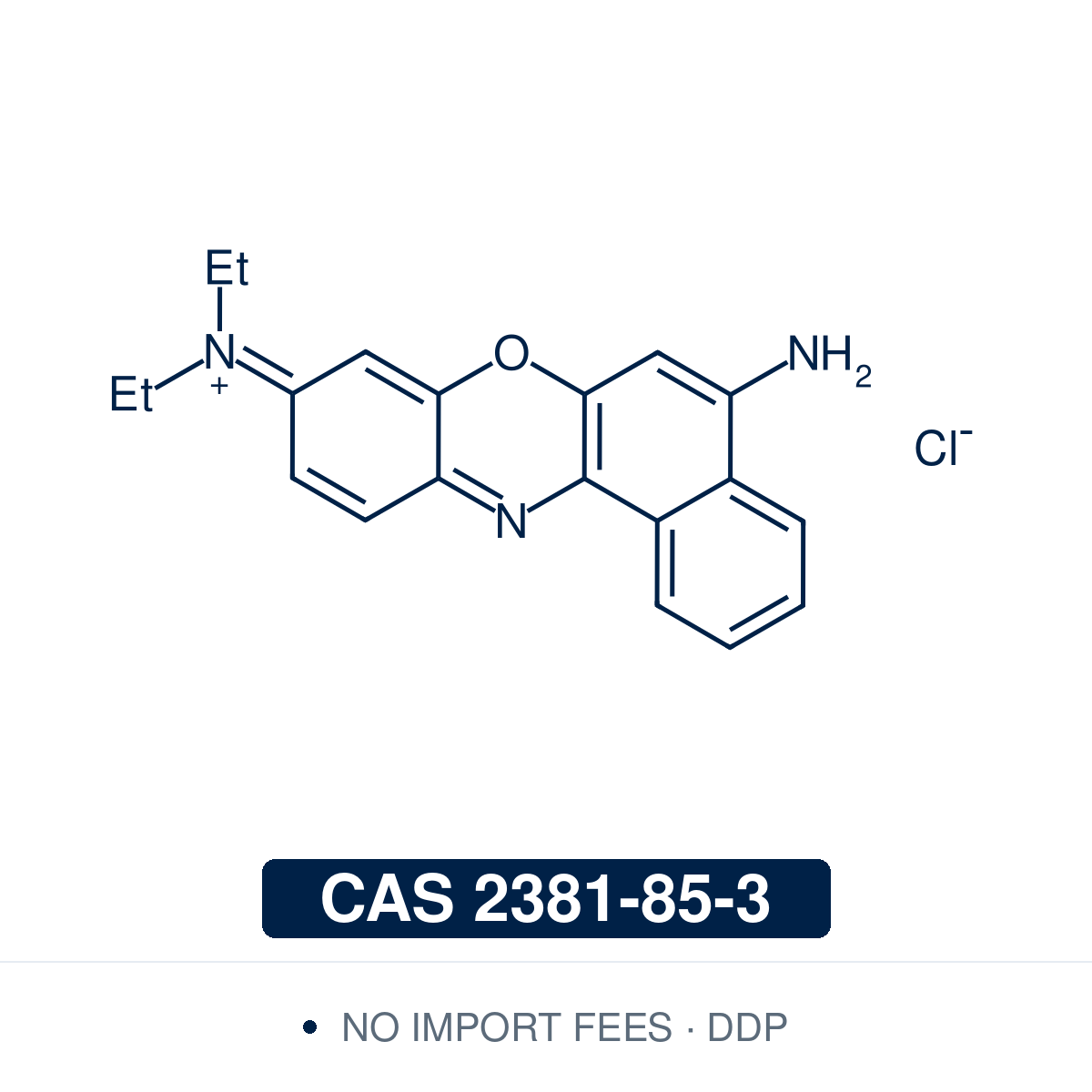
Nile Blue Chloride
Nile Blue Chloride | CAS 2381-85-3 | Reagent Grade
Couldn't load pickup availability
Technical Specifications
| CAS Number | 2381-85-3 |
| EC / EINECS Number | 219-181-4 |
| MDL Number | MFCD00011936 |
| RTECS Number | DJ1930000 |
| SMILES | CC[N+](=C1C=CC2=NC3=C(C=C(C4=CC=CC=C43)N)OC2=C1)CC.[Cl-] |
| InChI | InChI=1S/C20H19N3O.ClH/c1-3-23(4-2)13-9-10-17-18(11-13)24-19-12-16(21)14-7-5-6-8-15(14)20(19)22-17;/h5-12,21H,3-4H2,1-2H3;1H |
| InChIKey | SHXOKQKTZJXHHR-UHFFFAOYSA-N |
| PubChem CID | 16938 |
| Molecular Formula | C₂₀H₂₀ClN₃O |
| Molecular Weight | 353.8 g/mol |
| Melting Point | >250 °C (reported) |
| Solubility | Water: ~1 mg/mL, opaque blue to very deep blue solution; soluble in ethanol |
| Purity | Reagent Grade |
| Physical Form | Green to dark blue crystalline powder |
| HS Code | 3204.13 |
| Shelf Life | Retest period: 36 months from date of manufacture. |
| Storage Conditions | Store in a cool, dry place in a tightly sealed container, protected from light. |
Product Description & Scientific Applications
Nile Blue is a water-soluble, cationic oxazine dye of the benzophenoxazine family and a fluorescent stain long used in cell biology. An intense absorption band in the red gives the dye its blue colour. The dye is solvatochromic, its absorption and fluorescence shifting bathochromically as solvent polarity rises, a π→π* transition whose excited state is more polar than the ground state.
Lipid histochemistry. Introduced by Lorrain Smith, Nile Blue distinguishes neutral lipoids, namely esters and hydrocarbons, from acidic lipoids such as phospholipids and fatty acids, while cholesterol is not detected. The classical method combines the dye's oxazine form with its oxazone, which sharpens sensitivity to the acidic lipoids.
Nile Red, the oxazone. That oxazone is Nile Red, 9-diethylamino-5H-benzo[a]phenoxazin-5-one, a near-ideal lysochrome that fluoresces strongly only within a hydrophobic environment and is quenched in water. It stains intracellular lipid droplets as a vital stain read by fluorescence microscopy and flow cytometry, and in phosphatidylcholine vesicles it fluoresces with an excitation maximum at 549 nm and an emission maximum at 628 nm.
Bacterial storage granules. In heat-fixed bacteria Nile Blue stains poly-β-hydroxybutyrate granules, which fluoresce strong orange under 460 nm excitation, whereas glycogen and polyphosphate stay dark. It marks these inclusions more specifically than Sudan black B, which makes it a fluorescent stain for detecting the storage polymer.
DNA binding and photosensitisation. Nile Blue binds double-stranded DNA in two competing modes, minor-groove binding and intercalation, its cationic charge favouring the minor groove through electrostatic attraction to the phosphate backbone. Under visible light the bound dye photosensitises DNA by drawing an electron from a neighbouring guanine, a Type I electron-transfer mechanism rather than singlet-oxygen generation, signalled by near-complete quenching of the dye's fluorescence on guanine-rich strands. This electron-transfer route remains effective under the hypoxia that limits singlet-oxygen photosensitisers, and the dye's absorption maximum falls within the phototherapeutic window (620–850 nm), so it is studied as a photosensitiser for photodynamic therapy.
Shipping Destinations
- EU & UK: Priority delivery, 2–5 business days.
- United States (DDP): 3–7 business days, duties and taxes prepaid.
- EFTA Countries (DDP): 3–7 business days, duties and taxes prepaid.
- Worldwide: 7–14 business days, selected locations.
Safety Information
| Hazard Class | None — not subject to transport regulations |
| Transport Category | Not classified as dangerous goods for transport (ADR/IATA/IMDG) |
Documentation
| Safety Data Sheet | Download PDF |
Share