NorrChemica™
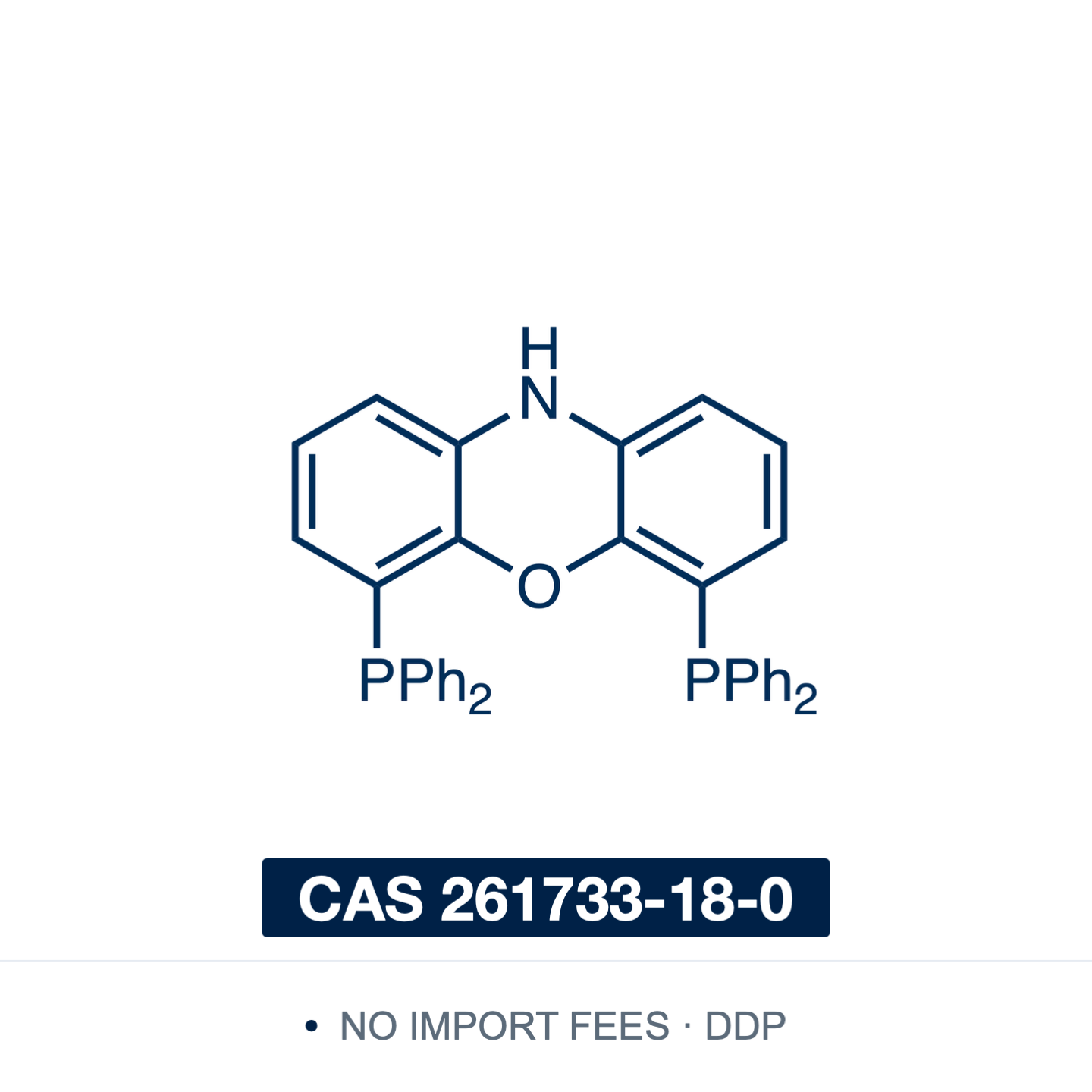
NixantPhos
NixantPhos | CAS 261733-18-0 | ≥97%
Couldn't load pickup availability
Technical Specifications
| CAS Number | 261733-18-0 |
| EC / EINECS Number | 812-116-6 |
| MDL Number | MFCD03788937 |
| SMILES | C1=CC=C(C=C1)P(C2=CC=CC=C2)C3=CC=CC4=C3OC5=C(N4)C=CC=C5P(C6=CC=CC=C6)C7=CC=CC=C7 |
| InChI | InChI=1S/C36H27NOP2/c1-5-15-27(16-6-1)39(28-17-7-2-8-18-28)33-25-13-23-31-35(33)38-36-32(37-31)24-14-26-34(36)40(29-19-9-3-10-20-29)30-21-11-4-12-22-30/h1-26,37H |
| InChIKey | HSWZLYXRAOXOLL-UHFFFAOYSA-N |
| PubChem CID | 3255346 |
| Molecular Formula | C₃₆H₂₇NOP₂ |
| Molecular Weight | 551.6 g/mol |
| Melting Point | 256–262 °C |
| Solubility | Insoluble in water, soluble in common organic solvents |
| Purity | ≥97% |
| Physical Form | White to light gray to green powder to crystal |
| HS Code | 2934.99 |
| Shelf Life | Retest period: 36 months from date of manufacture |
| Storage Conditions | Store refrigerated (2–8 °C) in a tightly sealed container under inert gas (N₂ or Ar), protected from light |
Product Description & Scientific Applications
Nixantphos (4,6-bis(diphenylphosphino)phenoxazine) is a wide-bite-angle diphosphine carrying an N–H bridge where Xantphos has a gem-dimethyl group, and a natural bite angle of 114°. The phenoxazine core has a pKa near 22, so that N–H can be removed by base — and the deprotonated ligand behaves like a different compound.
It is more air- and oxidation-stable than the trialkylphosphines used for the same substrates, several of which are pyrophoric. It is not bench-stable in absolute terms: the phenoxazine core oxidises, and the material is supplied air- and heat-sensitive, stored refrigerated under inert gas.
Applications and Reactions
- Room-temperature coupling of unactivated aryl chlorides: with an alkali-metal silylamide base the ligand is deprotonated to a heterobimetallic alkali-metal–ligand–palladium system that oxidatively adds unactivated aryl chlorides at 24 °C — something chelating diphosphines were not expected to do, since they react through the less favourable bis-ligated pathway and normally require heating. In deprotonative cross-coupling of diarylmethanes to triarylmethanes, palladium acetate with this ligand gave 56–99% yields across eleven aryl chlorides at 2.5–10 mol% loading in tetrahydrofuran at room temperature, with cyano, keto, acetyl, phenol, acetamide, phenothiazine and indole groups all tolerated. In the same screen the ligand gave 91% assay yield, its N-benzylated analogue — which cannot be deprotonated — under 2%, and Xantphos and DPEphos none at all.
- Linear-selective hydroformylation: at 114° it sits among the high-bite-angle diphosphines that give the best linear-to-branched ratios, up to 96:4. Substituted for a binaphthyl diphosphine in one system, it raised product yield to 95% with no detectable loss of linear selectivity.
- Carbonylation: across a diphosphine series yields improved as the bite angle increased, and at 114° it gave 89% of the carbamate product.
- Decarboxylative coupling: the reaction requires this diphosphine to support the palladium. Ligand-free conditions and two other phosphines gave only traces.
- Iridium emitters: with its xanthene relative it forms luminescent iridium(III) complexes, solution emission efficiency falling slightly as the ligand bulk widens the bite angle.
- Where the nitrogen costs: in one bis-alkoxycarbonylation it gave 55% of the diester against 82% for Xantphos, competitive coordination of its nitrogen to palladium the proposed cause. In one linear-aldehyde synthesis both yield and regioselectivity were only moderate, and in the deprotonative coupling 3-chloropyridine and the 2- and 3-chlorothiophenes fail.
Further Reading
Practical guidance on choosing a phosphine ligand for palladium- and nickel-catalysed cross-coupling in NorrChemica's Lab Journal: Phosphine Ligands for Cross-Coupling.
Shipping Destinations
- EU & UK: Priority delivery, 2–5 business days.
- United States (DDP): 3–7 business days, duties and taxes prepaid.
- EFTA Countries (DDP): 3–7 business days, duties and taxes prepaid.
- Worldwide: 7–14 business days, selected locations.
Safety Information
| Hazard Class | Not regulated for transport |
| Transport Category | Not classified as dangerous goods for transport (ADR/IATA/IMDG) |
Documentation
| Safety Data Sheet | Download PDF |
Share