NorrChemica™
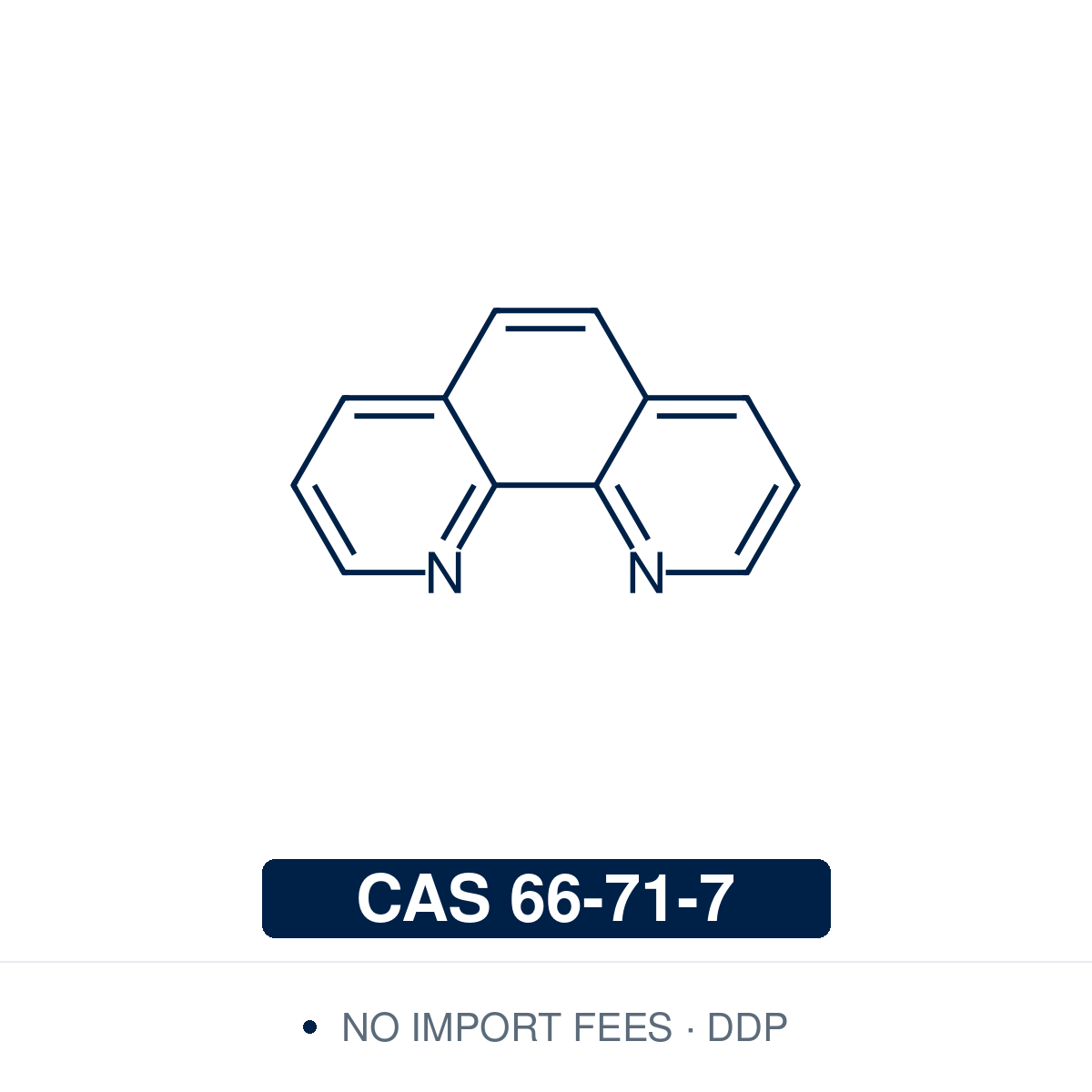
o-Phenanthroline
CAS 66-71-7
≥98%
o-Phenanthroline | CAS 66-71-7 | ≥98%
| Pack size | Excl. VAT | Incl. VAT | Add to cart |
|---|---|---|---|
| 5.0 g | €39,20 | ||
| 10 g | €57,20 | ||
| 25 g | €79,20 |
Taxes and fees, e.g. VAT, included in the price. Shipping calculated at checkout.Free shipping on EU, UK and EFTA orders above €250, and above €400 to the rest of the world.
Technical Specifications
| CAS Number | 66-71-7 |
| EC / EINECS Number | 200-629-2 |
| MDL Number | MFCD00011678 |
| SMILES | C1=CC2=C(C3=C(C=CC=N3)C=C2)N=C1 |
| InChI | InChI=1S/C12H8N2/c1-3-9-5-6-10-4-2-8-14-12(10)11(9)13-7-1/h1-8H |
| InChIKey | DGEZNRSVGBDHLK-UHFFFAOYSA-N |
| PubChem CID | 1318 |
| Molecular Formula | C₁₂H₈N₂ |
| Molecular Weight | 180.2 g/mol |
| Melting Point | 97–102 °C |
| Solubility | Slightly soluble in water, soluble in common organic solvents |
| Purity | ≥98% |
| Physical Form | White to off-white crystalline solid |
| HS Code | 2933.99 |
| Shelf Life | Retest period: 36 months from date of manufacture |
| Storage Conditions | Store in a dry, well-ventilated place in a tightly sealed container |
Product Description & Scientific Applications
1,10-Phenanthroline, also sold as o-phenanthroline, is a rigid, planar bidentate N-donor ligand whose optimally oriented nitrogen atoms coordinate strongly to most metals, especially transition metals, lanthanides and actinides.
Its extended conjugation over three fused rings makes it an electron-deficient, strong-acceptor ligand that stabilises soft metal cations. Unlike bipyridine, its extra fused ring blocks ligand rotation, giving more rigid catalyst complexes.
Applications and Reactions
- Copper-catalysed Ullmann amination: it enables amination of aryl halides with amines at 110 °C and 10 mol% copper, below the classical stoichiometric-copper method.
- Copper C–S coupling: with Cu₂O it supports coupling of aryl halides with thiols in 75–99% yield.
- CuAAC click chemistry: added to copper(I) catalysts it accelerates azide–alkyne cycloaddition, enabling efficient catalysis in hydroalcoholic solvents.
- Nickel coupling in water: Ni(phen)₂Br₂ at 2 mol%, with zinc nanopowder and K₃PO₄, couples decanethiol to 4-methoxyiodobenzene in aqueous surfactant solution. Manganese, ascorbic acid and PMHS all fail as the reductant.
- Palladium aerobic oxidation: with palladium(II) it gives water-tolerant, recyclable catalysts for aerobic oxidation of alcohols to aldehydes, ketones and carboxylic acids.
- Redox indicator: with Fe²⁺ it forms ferroin, the most widely used redox indicator in chemistry, absorbing at 510 nm with a molar absorptivity of 11,100 mol⁻¹ dm³ cm⁻¹.
- Ligand specificity: 2,9-dimethyl substitution (neocuproine) impairs the same nickel coupling, and DPPF, DPPE and DPPB give significantly lower yields.
Shipping Destinations
- EU & UK: Priority delivery, 3–5 business days.
- Switzerland (DDP): 3–7 business days, duties and taxes prepaid.
Safety Information
| GHS Pictograms |


|
| Signal Word | Danger |
| Hazard Class | UN 2811 — Toxic solid, organic, n.o.s. (1,10-phenanthroline) (Class 6.1, PG III) |
| Transport Category | Class 6.1, PG III (ADR/IATA/IMDG) |
| H-Statements | H301 - H400 |
| P-Statements | P264 - P270 - P273 - P301+P310 - P391 - P501 |
Documentation
| Safety Data Sheet | Download PDF |