NorrChemica™
Oxyma
Oxyma | CAS 3849-21-6 | ≥95%
Couldn't load pickup availability
Technical Specifications
| CAS Number | 3849-21-6 |
| EC / EINECS Number | 223-351-3 |
| MDL Number | MFCD00002112 |
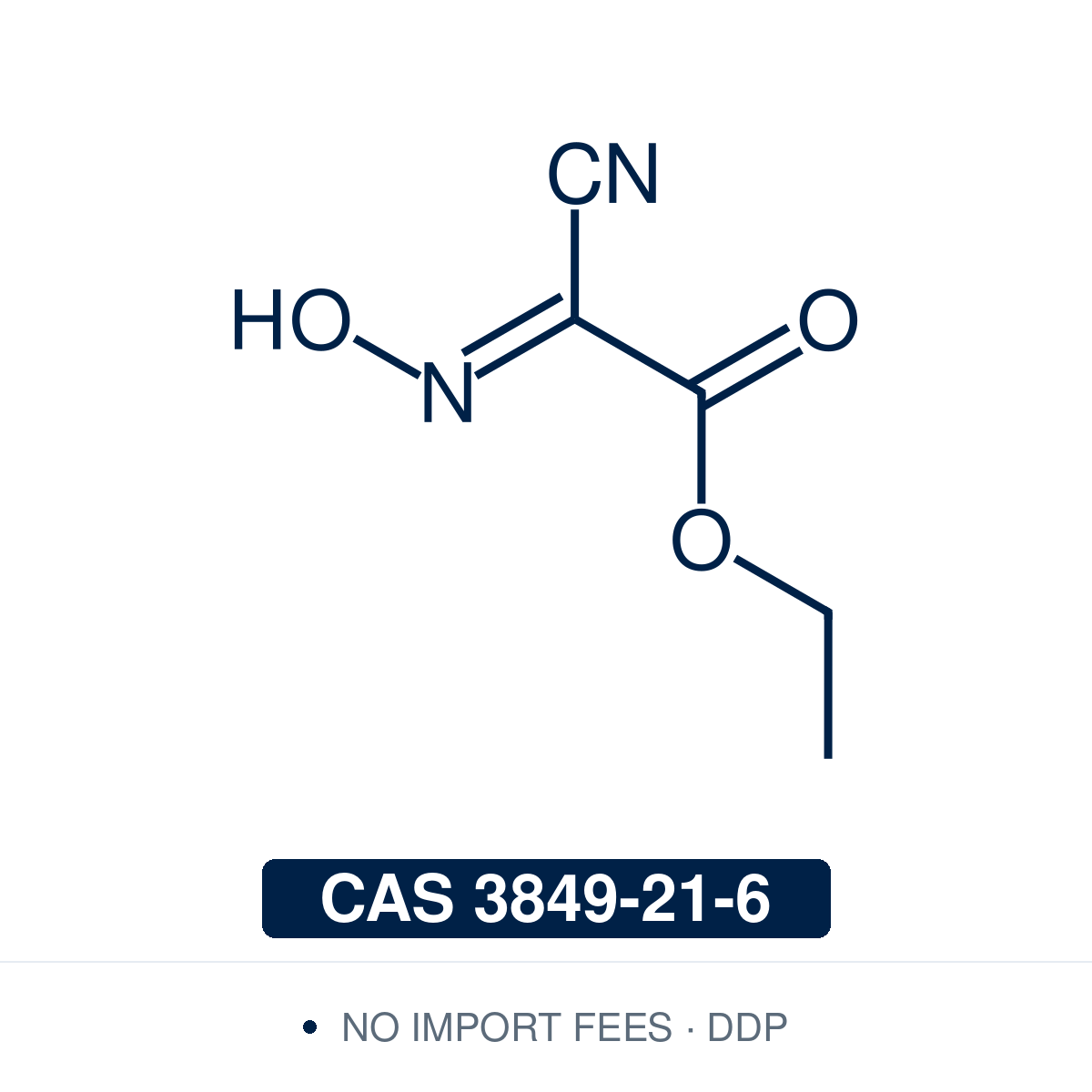
| SMILES | CCOC(=O)C(=NO)C#N |
| InChI | InChI=1S/C5H6N2O3/c1-2-10-5(8)4(3-6)7-9/h9H,2H2,1H3 |
| InChIKey | LCFXLZAXGXOXAP-UHFFFAOYSA-N |
| PubChem CID | 6399078 |
| Molecular Formula | C₅H₆N₂O₃ |
| Molecular Weight | 142.11 g/mol |
| Melting Point | 130–132 °C (lit.) |
| Solubility | Soluble in DMF, NMP, acetonitrile, DCM, and water; partially soluble in toluene |
| Purity | ≥95% |
| Physical Form | White to off-white crystalline powder |
| HS Code | 2928.00 |
| Shelf Life | Retest period: 36 months from date of manufacture |
| Storage Conditions | Store refrigerated (2–8 °C) in a tightly sealed container |
Product Description & Scientific Applications
Oxyma (Oxyma Pure; ethyl (2Z)-2-cyano-2-(hydroxyimino)acetate; ethyl cyanoglyoxylate-2-oxime; ethyl isonitrosocyanoacetate) is the oxime of ethyl cyanoacetate and a non-benzotriazole coupling additive introduced as an alternative to the benzotriazole additives HOBt and HOAt. As a markedly acidic oxime (pKa ≈ 4.6), it traps the O-acylisourea formed from a carboxylic acid and a carbodiimide as a less racemisation-prone Oxyma active ester, while its acidity tempers the basic conditions that drive racemisation, giving high coupling efficiency with strong epimerisation suppression. Oxyma is used across solution-phase, solid-phase, and microwave-assisted peptide synthesis, and unlike uronium reagents used in excess, it does not cap the resin or growing peptide under standard coupling conditions.
Common Scientific Applications
Coupling additive for carbodiimide-mediated synthesis: Used with diisopropylcarbodiimide (DIC), EDC·HCl, or DCC to suppress racemisation and improve yields in amide-bond formation, by diverting the carbodiimide-generated O-acylisourea into a less racemisation-prone Oxyma active ester. Beyond peptides, the same activation strategy is used in broader amide and ester bond formation.
Automated and microwave-assisted Fmoc-SPPS: The Oxyma/DIC combination is widely used in place of HOBt/DIC on modern automated and microwave-assisted Fmoc solid-phase peptide synthesisers, delivering fast couplings and high crude-peptide purity under matched microwave conditions.
Difficult and sterically hindered couplings: In demanding sequences requiring double coupling, Oxyma/DIC is competitive with — and in reported cases superior to — uronium systems such as HATU/sym-collidine, improving the proportion of the target peptide in the crude product.
pH-modulatory suppression of base-driven side reactions: Oxyma is a low-pKa additive whose buffering capacity tempers the basic conditions that drive several SPPS side reactions. Included in the Fmoc-deprotection step, it suppresses base-catalysed aspartimide formation and the derived piperidide, and it reduces proline-based overcoupling during chain elongation. Because Oxyma is acidic, its use with highly acid-labile supports such as 2-chlorotrityl chloride (2-CTC) resin warrants attention to the risk of premature cleavage; the less acidic potassium salt (K-Oxyma) is an alternative where acidity must be minimised.
Beyond carbodiimide chemistry: Oxyma's oxime is the active-ester component of standalone third-generation coupling reagents — the uronium-type COMU and the PyOx family of phosphonium salts — and free Oxyma is also used as an additive with fluoroformamidinium reagents such as TFFH.
Greener-solvent SPPS workflows: Oxyma's high solubility in a broad range of peptide-synthesis solvents supports its use in studies evaluating greener alternatives to DMF for solid-phase peptide synthesis, where solvent polarity, resin swelling, and reagent compatibility are matched to the sequence and resin.
Further Reading
For guidance on selecting between carbodiimides, aminium/uronium salts, phosphonium salts, and other reagent classes for amide and peptide bond formation, see NorrChemica's Lab Journal guide: Choosing a Coupling Reagent for Amide and Peptide Bond Formation.
Shipping Destinations
- EU & UK: Priority delivery, 2–5 business days.
- United States (DDP): 3–7 business days, duties and taxes prepaid.
- EFTA Countries (DDP): 3–7 business days, duties and taxes prepaid.
- Worldwide: 7–14 business days, selected locations.
Safety Information
| Hazard Class | None — not subject to transport regulations |
| Transport Category | Not classified as dangerous goods for transport (ADR/IATA/IMDG) |
Documentation
| Safety Data Sheet | Download PDF |
Share