NorrChemica™
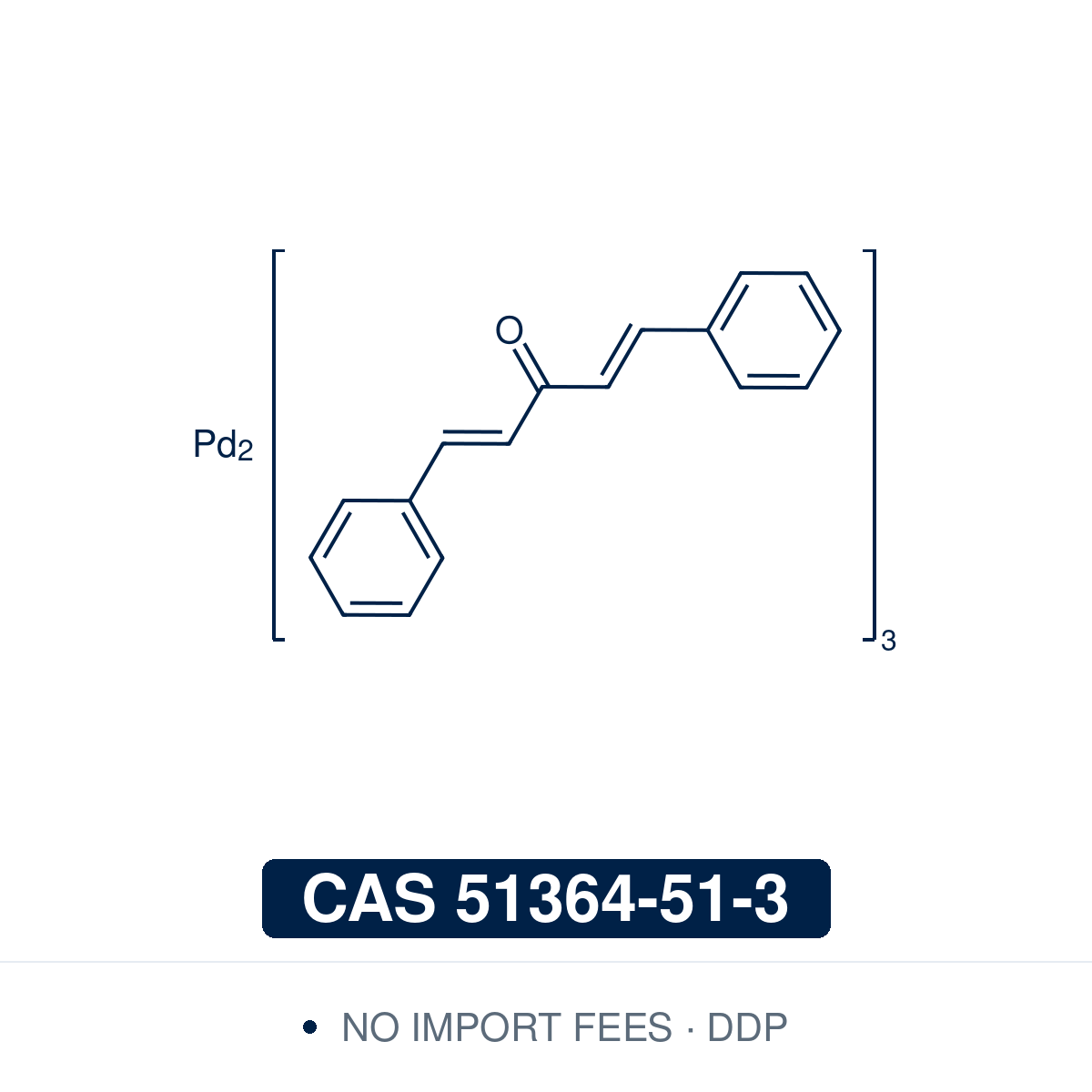
Pd₂(dba)₃
Pd₂(dba)₃ | CAS 51364-51-3 | ≥98%
| Pack size | Excl. VAT | Incl. VAT | Add to cart |
|---|---|---|---|
| 250 mg | €29,20 | ||
| 1.0 g | €89,20 | ||
| 2.0 g | €149,20 | ||
| 5.0 g | €349,20 | ||
| 10 g | €698,20 | ||
| 25 g | €1.498,00 |
Taxes and fees, e.g. VAT, included in the price. Shipping calculated at checkout.Free shipping on EU, UK and EFTA orders above €250, and above €400 to the rest of the world.
Technical Specifications
| CAS Number | 51364-51-3 |
| EC / EINECS Number | 479-280-5 |
| MDL Number | MFCD00013310 |
| SMILES | C1=CC=C(C=C1)/C=C/C(=O)/C=C/C2=CC=CC=C2.C1=CC=C(C=C1)/C=C/C(=O)/C=C/C2=CC=CC=C2.C1=CC=C(C=C1)/C=C/C(=O)/C=C/C2=CC=CC=C2.[Pd].[Pd] |
| InChI | InChI=1S/3C17H14O.2Pd/c3*18-17(13-11-15-7-3-1-4-8-15)14-12-16-9-5-2-6-10-16;;/h3*1-14H;;/b3*13-11+,14-12+;; |
| InChIKey | CYPYTURSJDMMMP-WVCUSYJESA-N |
| PubChem CID | 9811564 |
| Molecular Formula | C₅₁H₄₂O₃Pd₂ |
| Molecular Weight | 915.72 g/mol |
| Melting Point | 152–155 °C |
| Solubility | Insoluble in water, soluble in chlorinated solvents, benzene and THF |
| Purity | ≥98% |
| Physical Form | Dark purple to brown solid |
| HS Code | 2843.90 |
| Shelf Life | Retest period: 36 months from date of manufacture |
| Storage Conditions | Relatively stable in air. Store at room temperature in a tightly closed container in a dry, cool place, protected from light. For long-term storage keep under nitrogen to maintain product quality. |
| SDS / CoA | Download PDF |
Product Description & Scientific Applications
Tris(dibenzylideneacetone)dipalladium(0) (Pd₂(dba)₃) is a bench-stable source of soluble palladium(0) for cross-coupling. Three dibenzylideneacetone ligands bridge two palladium centres, bound through the alkene units and not the carbonyl. The ligands are weakly held and readily displaced, so the active LnPd(0) catalyst forms in situ when a phosphine or N-heterocyclic carbene is added. Palladium-to-ligand ratios between 1:1.5 and 1:6 are the usual working range.
Effect of the dba ligand. Coordinated dba lowers reactivity, a documented limitation with biarylphosphine ligands. After oxidative addition part of the dba is displaced, and displaced dba lowers the coupling barrier. Both effects operate; which one dominates depends on the ligand and the reaction step.
Applications and Reactions
- Suzuki–Miyaura coupling: with an electron-rich biarylphosphine, a catalytic quantity gives biaryls with four ortho substituents.
- Buchwald–Hartwig amination: palladium(0) entry point for aromatic C–N bond formation from aryl halides and triflates, with a dialkylbiaryl phosphine.
- Negishi coupling and allylic alkylation: Trost asymmetric allylic alkylation and the Carroll rearrangement, where π-allyl palladium chemistry starts from palladium(0).
- Palladium nanoparticle synthesis: molecular precursor to palladium nanoparticles and to supported palladium.
Batch age and palladium content. Commercial Pd₂(dba)₃ is not a single well-defined substance. Zalesskiy and Ananikov (Organometallics 2012, 31, 2302) determined the palladium species actually present in commercial material and found palladium nanoparticles alongside the molecular complex, in proportions that vary between samples. Crystallography on as-grown platelets separately gives a structure consistent with Pd₂(dba)₃ but a measured composition near Pd₁.₀₇(dba)₃, one palladium short of the formula. Two consequences follow at the bench: a loading calculated from 915.7 g/mol can overstate the palladium actually delivered, and an aged bottle is not interchangeable with a fresh one when a reaction is being optimised. Date of manufacture and the certificate of analysis matter more on this reagent than on a simple organic building block.
Other limits. The chloroform solvate decomposes to palladium black over long reaction times at elevated temperature. Where a two-coordinate PdL₂ species is required, this precursor, like Pd(PPh₃)₄ and Pd(OAc)₂, does not generate it efficiently.
Further reading: For phosphine-ligand selection, palladium sources and precatalysts, and Suzuki–Miyaura and Buchwald–Hartwig reagent choice, see NorrChemica's Lab Journal guide: Choosing a Phosphine Ligand for Cross-Coupling: A Practical Guide.
Shipping Destinations
- EU & UK: Priority delivery, 2–5 business days.
- United States (DDP): 3–7 business days, duties and taxes prepaid.
- EFTA Countries (DDP): 3–7 business days, duties and taxes prepaid.
- Worldwide: 7–14 business days, selected locations.
Safety Information
| GHS Pictograms |

|
| Signal Word | Warning |
| Hazard Class | Not regulated for transport |
| Transport Category | Not classified as dangerous goods for transport (ADR/IATA/IMDG) |
| H-Statements | H317 |
| P-Statements | P280 - P302+P352 - P333+P313 |
Documentation
| Safety Data Sheet | Download PDF |