NorrChemica™
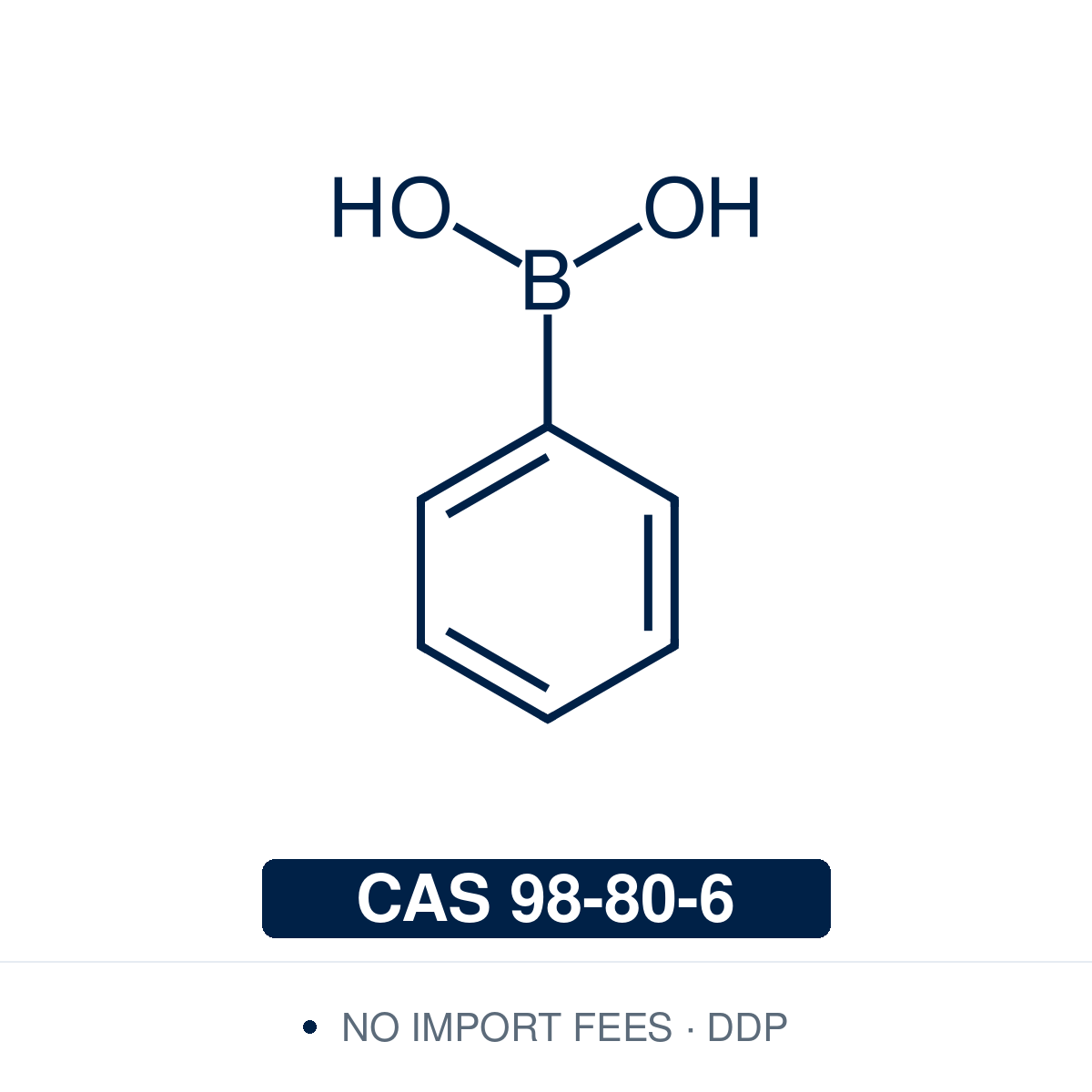
Phenylboronic Acid
Phenylboronic Acid | CAS 98-80-6 | ≥98%
Couldn't load pickup availability
Technical Specifications
| CAS Number | 98-80-6 |
| EC / EINECS Number | 202-701-9 |
| MDL Number | MFCD00002103 |
| RTECS Number | CY8575000 |
| SMILES | B(C1=CC=CC=C1)(O)O |
| InChI | InChI=1S/C6H7BO2/c8-7(9)6-4-2-1-3-5-6/h1-5,8-9H |
| InChIKey | HXITXNWTGFUOAU-UHFFFAOYSA-N |
| PubChem CID | 66827 |
| Molecular Formula | C₆H₇BO₂ |
| Molecular Weight | 121.93 g/mol |
| Melting Point | 216–219 °C |
| Solubility | Slightly soluble in water; soluble in common polar organic reaction solvents. Solubility increases under basic aqueous conditions through boronate formation |
| Log Pow | 1.58 (XLogP3) |
| Purity | ≥98%. May contain small variable amounts of boron anhydrides |
| Physical Form | White to off-white crystalline powder |
| HS Code | 2931.90 |
| Shelf Life | Retest period: 36 months from date of manufacture |
| Storage Conditions | Store at room temperature in a tightly sealed container in a dry place |
Product Description & Scientific Applications
Phenylboronic acid (benzeneboronic acid, PhB(OH)₂) is the unsubstituted parent of the arylboronic acid family. It serves two main roles: introducing the phenyl group through transition-metal-catalysed C–C and C–heteroatom bond formation, and reversibly binding diols for saccharide recognition, sensing, and boronate protection in carbohydrate and polyol synthesis.
In the solid state it may contain variable amounts of its cyclic anhydride, phenylboroxine. The acid and boroxine forms re-equilibrate under aqueous/basic coupling conditions, but batch composition can affect assay, effective stoichiometry, and reproducibility.
Applications and Reactions
- Suzuki–Miyaura coupling: Parent arylboronic partner for installing the phenyl group into aryl, heteroaryl, and alkenyl scaffolds; a baseline reagent for evaluating catalyst, ligand, base, solvent, electrophile, boronic-acid speciation, and protodeboronation effects.
- Chan–Lam coupling: Transfers the phenyl group to heteroatom nucleophiles under copper-mediated aerobic conditions, giving N-phenyl amines, amides, sulfonamides, carbamates, and N-phenyl heterocycles, plus selected O- and S-phenylated products where the nucleophile and copper system are compatible.
- Rhodium-catalysed conjugate addition: 1,4-addition transferring the phenyl group to the β-position of enones, enoates, enamides, and related Michael acceptors; chiral ligands give enantioenriched β-aryl carbonyl products.
- Petasis borono-Mannich reaction: Multicomponent reaction with an amine and a carbonyl giving amines bearing phenyl α to nitrogen; glyoxylic acid/glyoxylates and α-hydroxy aldehydes access α-aryl-α-amino acid derivatives and β-amino-alcohol scaffolds.
- Diol recognition and saccharide sensing: Reversibly binds cis-1,2- and 1,3-diols in aqueous or mixed solvent to form cyclic boronate esters, used to recognise glucose, fructose, sialic acid, and other cis-diol analytes.
- Boronate ester formation: Forms cyclic esters with 1,2- and 1,3-diols to temporarily mask paired hydroxyls in carbohydrate, polyol, and natural-product synthesis; cleaved by hydrolysis, transesterification, or oxidation where compatible.
- Ipso-halodeboronation: Replaces the boronic acid group with chlorine, bromine, or iodine using electrophilic halogen sources to access phenyl halides or halogenated intermediates.
- Protected boronate ester preparation: Precursor to pinacol, neopentyl glycol, and MIDA phenylboronates when a more stable or chromatographically tractable boron building block is needed.
- Materials and functional-molecule synthesis: Phenyl-transfer building block for biaryl and arylated intermediates in materials and functional-molecule R&D.
- Oxidative hydroxylation: Benchmark substrate for boronic acid → phenol conversion under aerobic photoredox, peroxide-mediated, or copper-catalysed conditions.
For further reading: Boron reagent selection for Suzuki–Miyaura coupling
Shipping Destinations
- EU & UK: Priority delivery, 2–5 business days.
- United States (DDP): 3–7 business days, duties and taxes prepaid.
- EFTA Countries (DDP): 3–7 business days, duties and taxes prepaid.
- Worldwide: 7–14 business days, selected locations.
Safety Information
| GHS Pictograms |

|
| Signal Word | Warning |
| Hazard Class | None — not subject to transport regulations |
| Transport Category | Not classified as dangerous goods for transport (ADR/IATA/IMDG) |
| H-Statements | H302 |
| P-Statements | P264 - P270 - P301+P317 - P330 - P501 |
Documentation
| Safety Data Sheet | Download PDF |