NorrChemica™
Phloxine B (Powder)
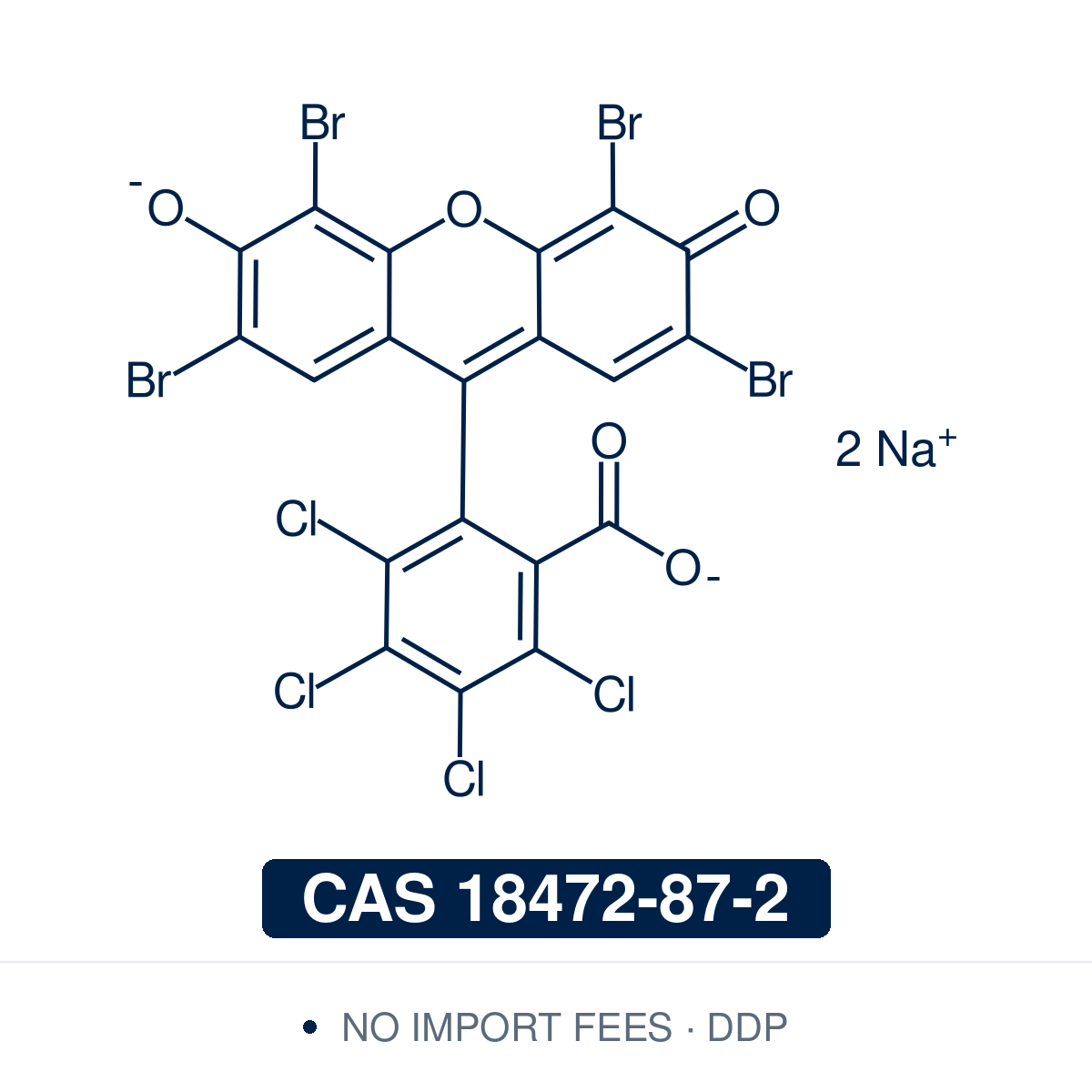
Phloxine B (Powder) | CAS 18472-87-2 | Dye content ≥90%
Couldn't load pickup availability
Technical Specifications
| CAS Number | 18472-87-2 |
| EC / EINECS Number | 242-355-6 |
| MDL Number | MFCD00070627 |
| RTECS Number | LM5900000 |
| SMILES | C1=C2C(=C3C=C(C(=O)C(=C3OC2=C(C(=C1Br)[O-])Br)Br)Br)C4=C(C(=C(C(=C4Cl)Cl)Cl)Cl)C(=O)[O-].[Na+].[Na+] |
| InChI | InChI=1S/C20H4Br4Cl4O5.2Na/c21-5-1-3-7(8-9(20(31)32)13(26)15(28)14(27)12(8)25)4-2-6(22)17(30)11(24)19(4)33-18(3)10(23)16(5)29;;/h1-2,29H,(H,31,32);;/q;2*+1/p-2 |
| InChIKey | GVKCHTBDSMQENH-UHFFFAOYSA-L |
| PubChem CID | 6097185 |
| Molecular Formula | C₂₀H₂Br₄Cl₄Na₂O₅ |
| Molecular Weight | 829.6 g/mol |
| Melting Point | >203 °C (dec.) |
| Solubility | Soluble in water, ethanol, DMSO, and DMF. |
| Purity | Dye content ≥90% |
| Physical Form | Red to red-brown powder |
| HS Code | 3204.19 |
| Shelf Life | Retest period: 36 months from date of manufacture |
| Storage Conditions | Store in a cool, dry place in a tightly sealed container, protected from light |
Product Description & Scientific Applications
Phloxine B is the tetrabromo, tetrachloro derivative of fluorescein, a red xanthene dye also designated D&C Red No. 28 and used as a colorant in drugs, cosmetics, and, in some countries, foods. Visible light turns it into a photosensitiser: it generates singlet oxygen with a quantum yield of 0.59 in D₂O, and its bromine and chlorine substituents make it a far more efficient singlet-oxygen generator than the less-halogenated dichlorofluorescein, whose yield is 0.06. Photoexcitation proceeds mainly by a Type-II, singlet-oxygen route, with a minor radical pathway yielding superoxide, a semiquinone radical, and hydrogen peroxide; these species oxidise membrane lipids and damage DNA.
Common Scientific Applications
Phototoxic insecticide. Phloxine B is a light-activated bait toxicant for tephritid fruit flies, and its action requires the insect to ingest the dye. In medfly larvae, light lowers the lethal concentration more than twenty-fold (dark LC₅₀ 11.03 mM versus 0.45 mM after light exposure), the effect is dose-dependent, and the dye damages larval muscle. As an environmentally safer alternative to malathion, field bait sprays against Mexican, West Indian, and Mediterranean fruit flies match malathion-bait efficacy, with the protein carrier strongly affecting performance. Against melon and oriental fruit flies it requires higher concentrations than spinosad; adjuvants such as Tween 60 lower the effective dose and shorten the time to kill.
Antimicrobial photoinactivation. Under illumination, phloxine B permeabilises bacterial membranes. It drives potassium leakage from Staphylococcus aureus within minutes and collapses the membrane potential, acting through singlet oxygen and binding to the cells; among common xanthene dyes its membrane activity is second only to rose bengal. Loaded into poly(2-hydroxyethyl methacrylate) films, it works as a solid-supported photosensitiser, its singlet-oxygen output peaking near 2 wt% as fluorescence self-quenching sets in above 0.1 wt%.
Cell-viability reporter in yeast genetics. Phloxine B stains non-viable yeast cells without affecting living ones, so the redness of a colony marks its dead-cell fraction; this gives a viability score used across large Schizosaccharomyces pombe gene-deletion fitness screens, and it also separates diploid colonies from haploid ones. In fission yeast the dye acts as a light-dependent pro-oxidant: under illumination it raises protein carbonyl content and transiently depletes reduced glutathione, and a superoxide-dismutase-deficient (sod1) mutant is hypersensitive.
Differential bacterial stain. Phloxine B separates Gram-positive from Gram-negative bacteria in under two minutes, read by eye or under bright-field, fluorescence, or confocal microscopy, giving a rapid alternative to the Gram stain; its staining tracks its bactericidal action. In histology it is the red component of Lendrum's phloxine–tartrazine method for acidophilic inclusion bodies.
Ion-channel probe. In electrophysiology, phloxine B modulates the CFTR chloride channel at several sites: low-micromolar concentrations raise the channel's open probability, while higher concentrations block the pore in a voltage-dependent manner.
Shipping Destinations
- EU & UK: Priority delivery, 2–5 business days.
- United States (DDP): 3–7 business days, duties and taxes prepaid.
- EFTA Countries (DDP): 3–7 business days, duties and taxes prepaid.
- Worldwide: 7–14 business days, selected locations.
Safety Information
| Hazard Class | None — not subject to transport regulations |
| Transport Category | Not classified as dangerous goods for transport (ADR/IATA/IMDG) |
Documentation
| Safety Data Sheet | Download PDF |
Share