NorrChemica™
Ponceau S (Acid Red 112)
Ponceau S (Acid Red 112) | CAS 6226-79-5 | BS Grade
Couldn't load pickup availability
Technical Specifications
| CAS Number | 6226-79-5 |
| EC / EINECS Number | 228-319-2 |
| MDL Number | MFCD00003892 |
| RTECS Number | QJ6600000 |
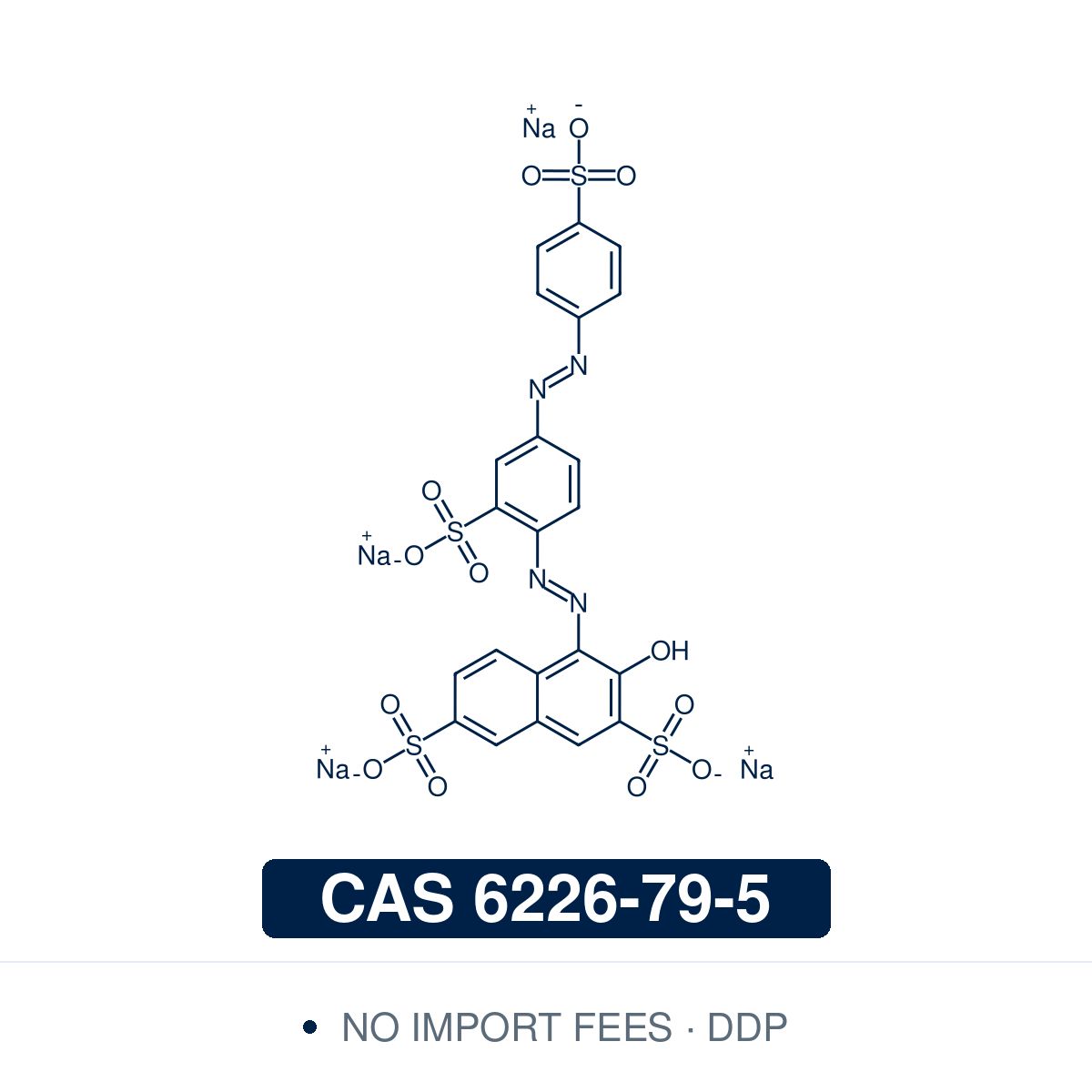
| SMILES | C1=CC(=CC=C1N=NC2=CC(=C(C=C2)N=NC3=C4C=CC(=CC4=CC(=C3O)S(=O)(=O)[O-])S(=O)(=O)[O-])S(=O)(=O)[O-])S(=O)(=O)[O-].[Na+].[Na+].[Na+].[Na+] |
| InChI | InChI=1S/C22H16N4O13S4.4Na/c27-22-20(43(37,38)39)10-12-9-16(41(31,32)33)6-7-17(12)21(22)26-25-18-8-3-14(11-19(18)42(34,35)36)24-23-13-1-4-15(5-2-13)40(28,29)30;;;;/h1-11,27H,(H,28,29,30)(H,31,32,33)(H,34,35,36)(H,37,38,39);;;;/q;4*+1/p-4 |
| InChIKey | KQHKSGRIBYJYFX-UHFFFAOYSA-J |
| PubChem CID | 2723873 |
| Molecular Formula | C₂₂H₁₂N₄Na₄O₁₃S₄ |
| Molecular Weight | 760.57 g/mol |
| Melting Point | >300 °C (dec.) |
| Solubility | Soluble in water (~1 mg/mL); practically insoluble in organic solvents |
| Purity | Dye content: ≥ 85% |
| Physical Form | Red to reddish-brown powder |
| HS Code | 3204.12 |
| Country of Origin | Finland |
| Shelf Life | Retest period: 36 months from date of manufacture |
| Storage Conditions | Store at room temperature in a tightly sealed container under inert atmosphere |
Product Description & Scientific Applications
Ponceau S (Acid Red 112; C.I. 27195) is a tetrasodium tetra-sulfonated disazo dye, the most commonly used reversible total-protein stain on nitrocellulose and PVDF membranes after Western transfer. It binds non-covalently and rinses free for downstream blocking and antibody detection.
Reversible Total-Protein Detection on Membranes and Gels. Immediately after SDS-PAGE Western transfer, Ponceau S gives a rapid read of transfer efficiency, lane loading, molecular-weight ladder position, and transfer uniformity before blocking. A typical working stain is 0.1% (w/v) in 1–5% acetic acid; pink-red bands develop in 1–5 minutes and are removed by water or TBS rinses. Positively charged nylon membranes retain the anionic dye too strongly for clean destaining and are not used with Ponceau S. It is also catalogued for staining proteins on cellulose-acetate membranes and electrophoresis gels, read visually or by densitometry.
Total-Protein Normalisation in Quantitative Immunoblotting. Ponceau S is used for whole-lane total-protein normalisation in quantitative Western blotting, correcting per lane for unequal loading, sample-preparation variation, and transfer differences. Unlike single-housekeeping-protein normalisation, it tolerates conditions where housekeeping proteins themselves vary with treatment, model, or tissue type — a documented limitation of β-actin, GAPDH, and α-tubulin. Detection sensitivity is largely insensitive to dye concentration across roughly 0.001–2% (w/v) and to acid type (acetic, sulfosalicylic, or trichloroacetic), so a simple 0.01% formulation in 1% acetic acid can match more concentrated ones. Fluorescence imaging under 488 nm excitation improves linearity, sensitivity, and repeatability for conventional and challenging samples.
Disazo Chromophore, Visible-Region Spectroscopy, and Protein Binding. Structurally, Ponceau S is a naphthol-based disazo dye carrying two −N=N− bridges that conjugate a 4-sulfonatophenyl ring through a sulfonated phenyl linker into a 3-hydroxy-naphthalene-2,7-disulfonate core, isolated as the tetrasodium salt. The extended π-conjugation across the two azo bridges and three aromatic rings gives the visible absorption maximum near 519–520 nm in dilute aqueous acid, and the four sulfonate groups confer high water solubility and strong anionic character. Electrophoresis-grade material is commonly specified by a 1% (w/v) absorbance A1cm1% ≥ 460 at 519.4 nm, convenient for Beer–Lambert quantification and visible-region dye assays. Protein binding is generally attributed to electrostatic ion pairing between sulfonate anions and protonated basic residues, especially the guanidinium and ammonium groups of arginine and lysine, supplemented by non-covalent contacts with less polar regions; binding is pH-dependent, favoured under acidic staining conditions and disrupted by water, buffer, or alkaline rinses, the basis of the reversible destaining.
Histology, Plant Tissue, and Catalogue Distinctions. In histology and microscopy, Ponceau S is catalogued as an acidic protein stain. In plant biology it is a permanent visible-light stain for callose (β-1,3-glucan) deposits in fixed plant tissue, preferred when bright-field imaging or archival permanence is wanted over fluorescence-based aniline blue methods. It is not interchangeable with Ponceau 2R (also Xylidine ponceau; Acid Red 26; C.I. 16150; CAS 3761-53-3), a smaller mono-azo disodium dye used as the red counterstain in classical Masson's trichrome; order Ponceau S (CAS 6226-79-5) and Ponceau 2R separately by CAS.
Other Applications
- Model anionic disazo dye in studies of dye–protein interactions and reversible non-covalent staining
- Model substrate in photocatalytic and advanced oxidation degradation studies, including ZnO photocatalysis, Fe₂O₃/WO₃ solar photocatalysis, photo-Fenton/electro-Fenton, Co²⁺/H₂O₂/UV, and UV/chlorine or persulfate-based AOP workflows
- Fiducial marker in mass spectrometric imaging (MALDI-TOF) workflows
- Membrane documentation and blot-cutting support before downstream immunodetection
Shipping Destinations
- EU & UK: Priority delivery, 2–5 business days.
- United States (DDP): 3–7 business days, duties and taxes prepaid.
- EFTA Countries (DDP): 3–7 business days, duties and taxes prepaid.
- Worldwide: 7–14 business days, selected locations.
Safety Information
| Hazard Class | None — not subject to transport regulations |
| Transport Category | Not classified as dangerous goods for transport (ADR/IATA/IMDG) |
Documentation
| Safety Data Sheet | Download PDF |
Share