NorrChemica™
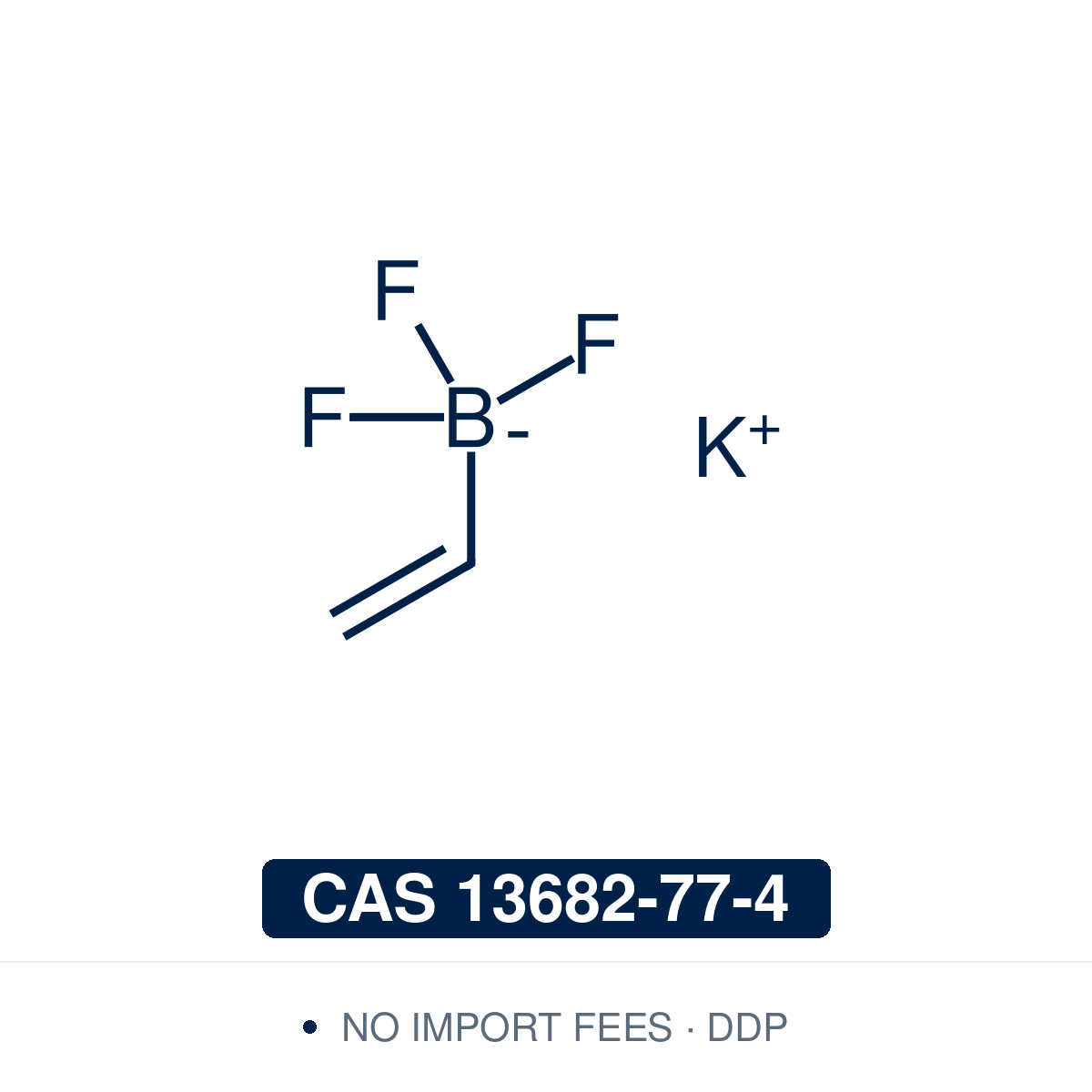
Potassium Vinyltrifluoroborate
Potassium Vinyltrifluoroborate | CAS 13682-77-4 | ≥95%
Couldn't load pickup availability
Technical Specifications
| CAS Number | 13682-77-4 |
| EC / EINECS Number | 629-487-3 |
| MDL Number | MFCD02093335 |
| SMILES | [B-](C=C)(F)(F)F.[K+] |
| InChI | InChI=1S/C2H3BF3.K/c1-2-3(4,5)6;/h2H,1H2;/q-1;+1 |
| InChIKey | ZCUMGICZWDOJEM-UHFFFAOYSA-N |
| PubChem CID | 23679353 |
| Molecular Formula | C₂H₃BF₃K |
| Molecular Weight | 133.95 g/mol |
| Melting Point | 226–230 °C (dec.) |
| Solubility | Soluble in water, methanol, acetone, acetonitrile, DMSO and DMF; poorly soluble in diethyl ether, hexane, toluene and dichloromethane. |
| Purity | ≥95% |
| Physical Form | White to off-white crystalline powder |
| HS Code | 2931.90 |
| Country of Origin | Finland |
| Shelf Life | Retest period: 36 months from date of manufacture |
| Storage Conditions | Store in a cool, dry place in a tightly sealed container |
Product Description & Scientific Applications
Potassium Vinyltrifluoroborate (potassium trifluoro(vinyl)borate, vinyl-BF3K) is a monomeric, air- and moisture-stable crystalline salt for vinyl transfer in palladium- and other metal-catalysed C–C bond formation. Free vinylboronic acid is prone to protodeboronation and equilibrates with its boroxine, leaving it neither stable nor of fixed stoichiometry, while vinyllithium and vinyl-Grignard reagents are pyrophoric and poorly tolerant of functional groups. The trifluoroborate carries none of these liabilities: it is weighed to an exact stoichiometry and handled in air.
Applications and Reactions
- Suzuki–Miyaura vinylation: under palladium catalysis it transfers a vinyl group to aryl and heteroaryl halides and triflates, giving styrenes and vinyl heterocycles — building blocks for pharmaceutical and materials synthesis.
- Controlled boron release: as a masked boronic acid, it hydrolyses only slowly under the aqueous, basic coupling conditions, supplying the active vinylboron species at the low concentration that clean transmetalation needs.
- Vinylation of arenediazonium salts: palladium-catalysed coupling with arenediazonium salts, often base- and ligand-free, gives styrenes rapidly, and sequential Suzuki–Heck reactions extend this to stilbenes.
- Beyond cross-coupling: potassium organotrifluoroborates, including alkenyl members, undergo rhodium-catalysed 1,4-addition to enones (for example, isopropenyltrifluoroborate to cyclic enones), illustrating reactivity of the BF3K family beyond classical coupling.
- Polymer and π-conjugated materials: the vinyl unit is built into poly(arylenevinylene)-type conjugated polymers and into materials for dye-sensitised solar cells and photonic crystals.
Further Reading
For practical guidance on choosing boronic acids, boronate esters, and organotrifluoroborates as cross-coupling partners, see the NorrChemica Lab Journal article: Choosing Your Boron Source for Suzuki–Miyaura Coupling.
Shipping Destinations
- EU & UK: Priority delivery, 2–5 business days.
- United States (DDP): 3–7 business days, duties and taxes prepaid.
- EFTA Countries (DDP): 3–7 business days, duties and taxes prepaid.
- Worldwide: 7–14 business days, selected locations.
Safety Information
| GHS Pictograms |

|
| Signal Word | Warning |
| Hazard Class | Not regulated for transport |
| Transport Category | Not classified as dangerous goods for transport (ADR/IATA/IMDG) |
| H-Statements | H315 - H319 |
| P-Statements | P264 - P280 - P302+P352 - P305+P351+P338 - P332+P313 - P337+P313 - P362+P364 - P501 |
Documentation
| Safety Data Sheet | Download PDF |