NorrChemica™
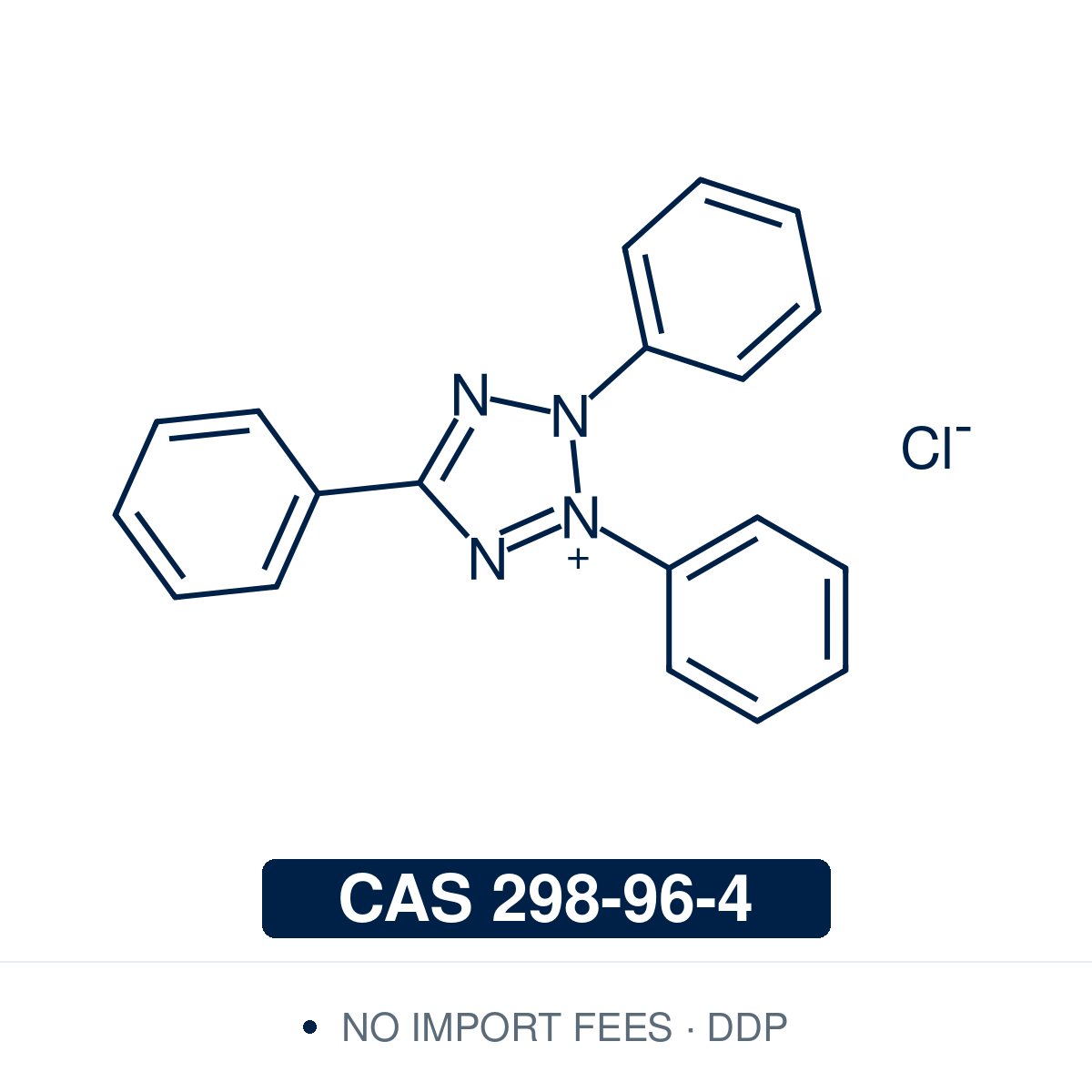
2,3,5-Triphenyltetrazolium Chloride
2,3,5-Triphenyltetrazolium Chloride | CAS 298-96-4 | ≥98%
| Pack size | Excl. VAT | Incl. VAT | Add to cart |
|---|---|---|---|
| 5 g−42% | |||
| 10 g | €69,20 | ||
| 25 g−24% | |||
| 50 g | €219,20 |
Taxes and fees, e.g. VAT, included in the price. Shipping calculated at checkout.Free shipping on EU, UK and EFTA orders above €250, and above €400 to the rest of the world.
Technical Specifications
| CAS Number | 298-96-4 |
| EC / EINECS Number | 206-071-6 |
| MDL Number | MFCD00011963 |
| RTECS Number | XF8100000 |
| SMILES | C1=CC=C(C=C1)C2=NN([N+](=N2)C3=CC=CC=C3)C4=CC=CC=C4.[Cl-] |
| InChI | InChI=1S/C19H15N4.ClH/c1-4-10-16(11-5-1)19-20-22(17-12-6-2-7-13-17)23(21-19)18-14-8-3-9-15-18;/h1-15H;1H/q+1;/p-1 |
| InChIKey | PKDBCJSWQUOKDO-UHFFFAOYSA-M |
| PubChem CID | 9283 |
| Molecular Formula | C₁₉H₁₅ClN₄ |
| Molecular Weight | 334.8 g/mol |
| Melting Point | 235-245 °C |
| Solubility | Soluble in water |
| Purity | ≥98% |
| Physical Form | White to off-white crystalline powder |
| HS Code | 2933.99 |
| Country of Origin | Finland |
| Shelf Life | Retest period: 36 months from date of manufacture |
| Storage Conditions | Store in a cool, dry place in a tightly sealed container, protected from light |
| SDS / CoA | Download PDF |
Product Description & Scientific Applications
2,3,5-Triphenyltetrazolium chloride (TTC; Red Tetrazolium; Tetrazolium Red) is a tetrazolium salt that acts as an artificial electron acceptor. The salt itself is colourless; reduction by respiratory dehydrogenases opens the tetrazolium ring to give the intensely red triphenylformazan, which precipitates where it forms. Metabolically active tissue therefore stains red while dead tissue stays pale, and the boundary between them can be measured directly.
The reaction is oxygen-sensitive, and this is not a detail. In the bacterial work establishing the dehydrogenase route, stable formazan accumulated only under strictly anaerobic conditions, and oxidase-defective mutants failed to develop colour at all. TTC competes with the respiratory chain for electrons rather than reporting on it passively, so incubation conditions determine whether a negative result means dead cells or simply aerobic ones.
Infarct delineation. In cardiac ischaemia-reperfusion models the stain turns all living tissue brick red and leaves the infarcted region unstained, giving a boundary that can be planimetrically measured. The same approach applied to brain sections after cerebral ischaemia stains viable neuronal and glial tissue deep red and delineates infarct volume.
Seed and plant viability. Reduction to insoluble red triphenylformazan detects viability in seeds, buds, leaves and cultured cells, giving plant laboratories a staining result in hours where a germination trial takes weeks.
Microbiology and preservative testing. Used as a chromogenic marker to gauge antibacterial potency, and in preservative-efficacy testing of cosmetic and over-the-counter drug products, where surviving bacteria turn the enrichment broth red or pink.
Pharmaceutical analysis. Formazan formation underlies simple spectrophotometric determinations of micro-amounts of drugs, cefepime and cefuroxime among them.
Where it disagrees with the reference method. In a seed study the technique underestimated viability relative to ex situ germination, and gave systematically higher estimates for dark-coated seeds than for pale ones — a testa-colour artefact worth controlling for.
Shipping Destinations
- EU & UK & Switzerland only: 3–7 business days.
Safety Information
| GHS Pictograms |


|
| Signal Word | Danger |
| Hazard Class | Not regulated for transport |
| Transport Category | Not classified as dangerous goods for transport (ADR/IATA/IMDG) |
| H-Statements | H228 - H315 - H319 |
| P-Statements | P261 - P264 - P271 - P280 - P302 + P352 - P304 + P340 - P305 + P351 + P338 - P332 + P317 - P337 + P317 - P403 + P233 - P405 - P501 |
Documentation
| Safety Data Sheet | Download PDF |