NorrChemica™
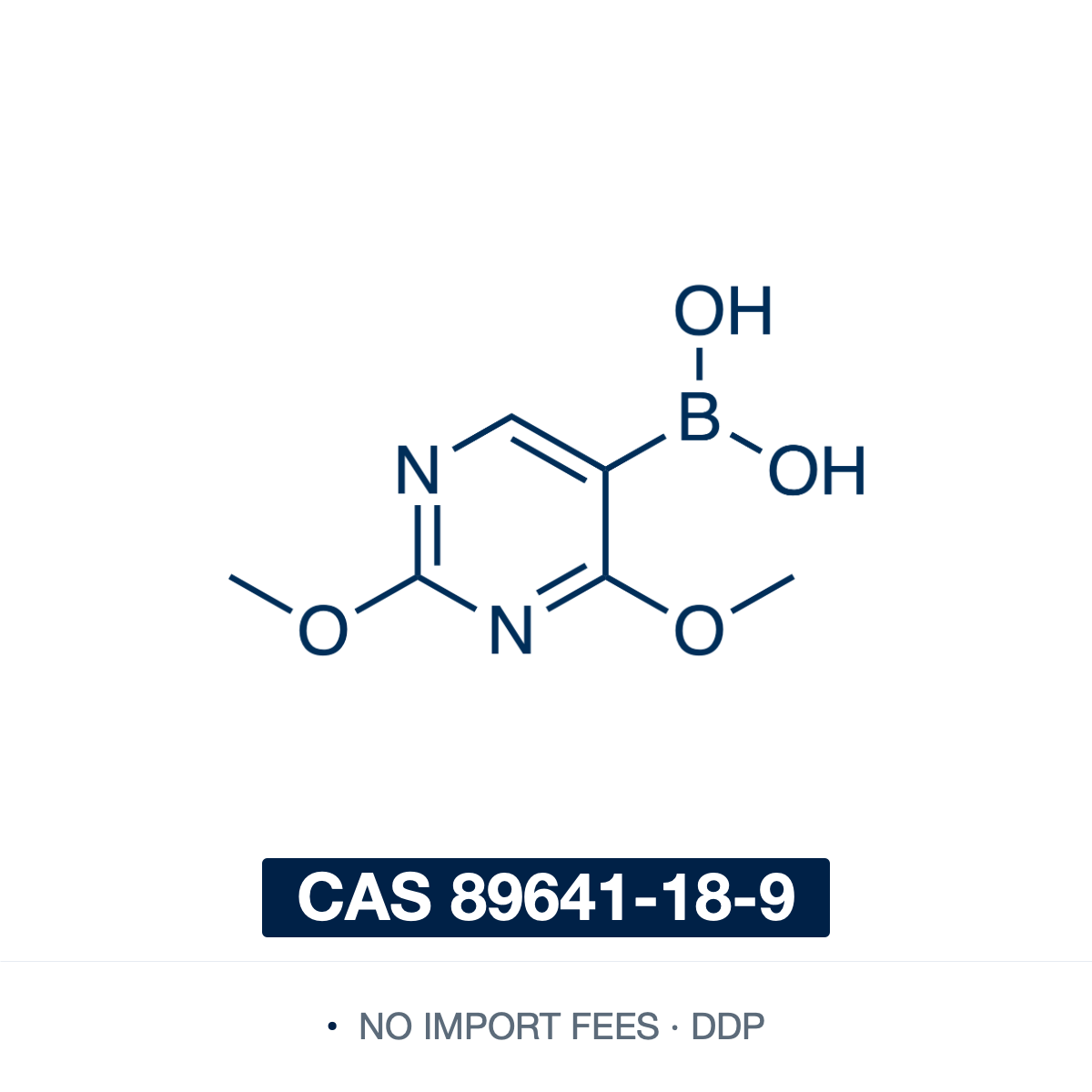
2,4-Dimethoxypyrimidine-5-boronic Acid
2,4-Dimethoxypyrimidine-5-boronic Acid | CAS 89641-18-9 | ≥98%
Couldn't load pickup availability
Technical Specifications
| CAS Number | 89641-18-9 |
| EC / EINECS Number | 672-292-3 |
| MDL Number | MFCD01318985 |
| SMILES | B(C1=CN=C(N=C1OC)OC)(O)O |
| InChI | InChI=1S/C6H9BN2O4/c1-12-5-4(7(10)11)3-8-6(9-5)13-2/h3,10-11H,1-2H3 |
| InChIKey | LKGKUACPLXCVOF-UHFFFAOYSA-N |
| PubChem CID | 2736209 |
| Molecular Formula | C₆H₉BN₂O₄ |
| Molecular Weight | 183.96 g/mol |
| Melting Point | 113–117 °C |
| Solubility | Soluble in methanol, ethanol, DMSO, DMF, chloroform, dichloromethane, and THF. |
| Purity | ≥98%. May contain varying amounts of the corresponding boronic acid anhydrides |
| Physical Form | White to off-white crystalline powder |
| HS Code | 2933.59 |
| Country of Origin | Finland |
| Shelf Life | Retest period: 36 months from date of manufacture |
| Storage Conditions | Store at 2–8 °C in a tightly sealed container. Keep dry. |
Product Description & Scientific Applications
2,4-Dimethoxypyrimidine-5-boronic acid ((2,4-dimethoxypyrimidin-5-yl)boronic acid) is uracil O-methylated at both carbonyls, bearing boron at C5. The electron-donating methoxy groups temper the π-deficient ring.
May contain small amounts of the cyclic anhydride (2,4-dimethoxypyrimidin-5-yl)boroxine. Under the aqueous, basic coupling conditions the two forms re-equilibrate, and the effect on yield is minor.
Suzuki–Miyaura coupling. It couples aryl and heteroaryl halides, and triflates, to give 5-substituted 2,4-dimethoxypyrimidines, the biaryl and heterobiaryl intermediates; alkenyl (alkylidene) halides couple likewise. Typical conditions are Pd(dppf)Cl₂ with a carbonate or phosphate base in aqueous dioxane or THF, under thermal or microwave heating. Common electrophile functional groups are tolerated. A boronic acid next to a ring nitrogen protodeboronates too fast to couple; this is why the 2- and 6-pyrimidinyl isomers are poor partners. This reagent's boron is clear of both nitrogens, so it is stable and transmetalates cleanly. The coupling takes place exclusively at the C–B bond without affecting the two methoxy groups.
Masked uracil. The 2,4-dimethoxy is the O-protected form of uracil, a clean electron-poor arene for coupling. Free uracil is a poor substrate for direct C5 arylation: its acidic N–H groups and several tautomers complicate metalation, and a free C5-boron uracil protodeboronates. After coupling, dilute acid under mild reflux removes both methyl ethers to reveal the 2,4-dione, so the product is a 5-substituted uracil, 5-aryl or 5-alkenyl. Such uracils are nucleobases; a later glycosylation delivers nucleoside analogues, an established antiviral class.
Boron surrogates. For demanding or iterative couplings the C5 boron is also used as its pinacol ester, MIDA boronate, or potassium trifluoroborate. The pinacol ester is isolable and chromatographable; the MIDA and trifluoroborate forms are bench-stable and release the boronic acid slowly, suited to iterative Suzuki assembly and storage.
Medicinal-chemistry building block. Pyrimidine is a common pharmacophore, offering hydrogen-bond acceptors and aqueous solubility, and recurs across kinase, phosphodiesterase, and antibacterial agents. This reagent installs a 2,4-dimethoxypyrimidin-5-yl group into such scaffolds, and it serves as a pyrimidine fragment in screening libraries. Documented products include antibacterial oxazolidinone hybrids and imidazopyridazine and aminopyrimidine kinase- and enzyme-inhibitor cores.
Further Reading. For boronic acids, boronic esters, organotrifluoroborates, protodeboronation, boroxine content, and Suzuki–Miyaura reagent selection, see NorrChemica's Lab Journal guide: Choosing Your Boron Source for Suzuki–Miyaura Coupling.
Shipping Destinations
- EU & UK: Priority delivery, 2–5 business days.
- United States (DDP): 3–7 business days, duties and taxes prepaid.
- EFTA Countries (DDP): 3–7 business days, duties and taxes prepaid.
- Worldwide: 7–14 business days, selected locations.
Safety Information
| GHS Pictograms |

|
| Signal Word | Warning |
| Hazard Class | Not regulated for transport |
| Transport Category | Not classified as dangerous goods for transport (ADR/IATA/IMDG) |
| H-Statements | H315 - H319 - H335 |
| P-Statements | P261 - P264 - P271 - P280 - P302+P352 - P304+P340 - P305+P351+P338 - P332+P313 - P337+P313 - P362+P364 - P501 |
Documentation
| Safety Data Sheet | Download PDF |