NorrChemica™
2-Chloropyridine-3-boronic Acid
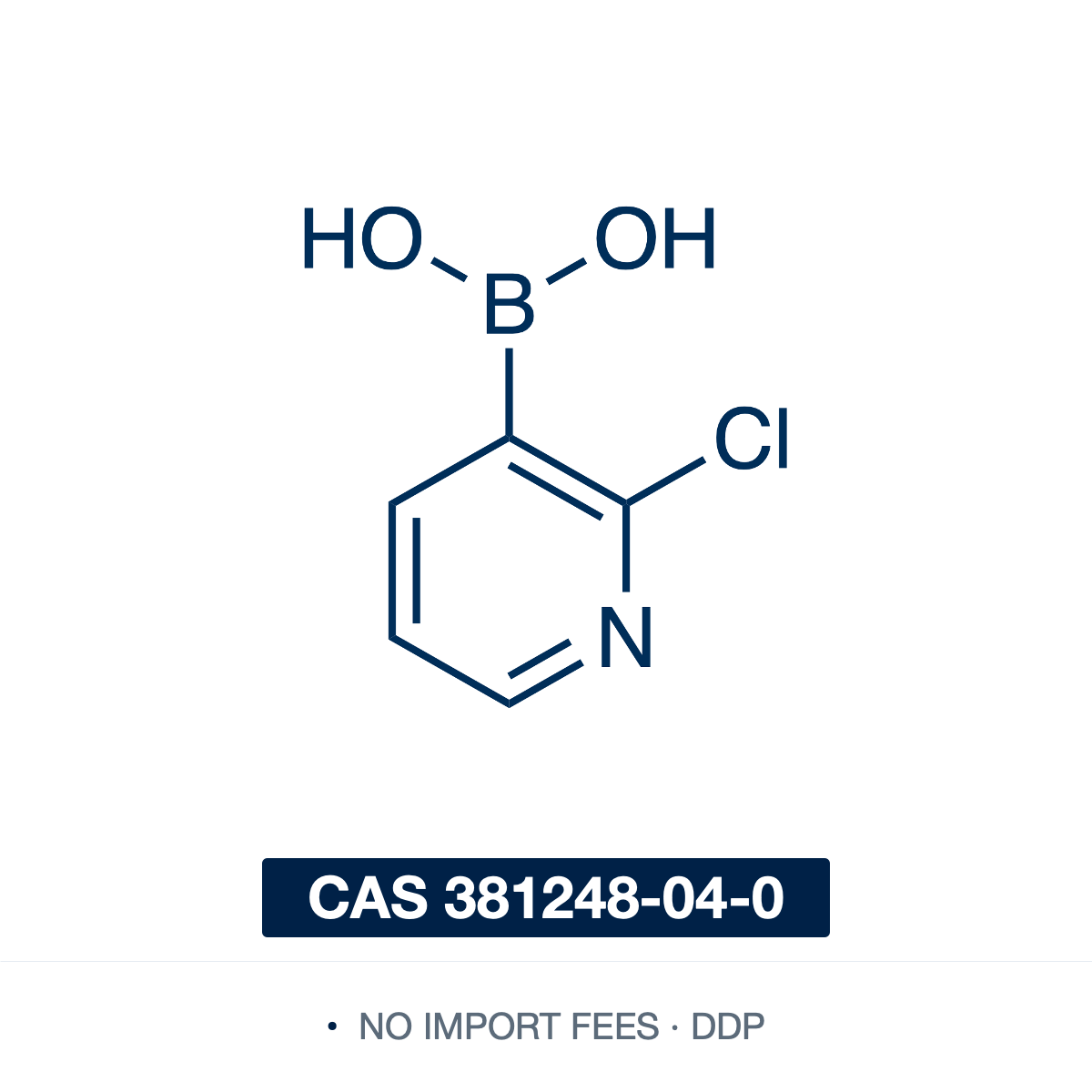
2-Chloropyridine-3-boronic Acid | CAS 381248-04-0 | ≥98%
| Pack size | Excl. VAT | Incl. VAT | Add to cart |
|---|---|---|---|
| 1 g | €29,20 | ||
| 2 g | €43,20 | ||
| 5 g | €57,20 | ||
| 10 g | €94,20 | ||
| 25 g | €179,20 | ||
| 50 g | €309,90 | ||
| 100 g | €589,90 | ||
| 250 g | €1.429,00 |
Taxes and fees, e.g. VAT, included in the price. Shipping calculated at checkout.Free shipping on EU, UK and EFTA orders above €250, and above €400 to the rest of the world.
Technical Specifications
| CAS Number | 381248-04-0 |
| EC / EINECS Number | 624-435-6 |
| MDL Number | MFCD03094997 |
| SMILES | B(C1=C(N=CC=C1)Cl)(O)O |
| InChI | InChI=1S/C5H5BClNO2/c7-5-4(6(9)10)2-1-3-8-5/h1-3,9-10H |
| InChIKey | VRDAOVQZVXYRNH-UHFFFAOYSA-N |
| PubChem CID | 2762704 |
| Molecular Formula | C₅H₅BClNO₂ |
| Molecular Weight | 157.36 g/mol |
| Melting Point | 160 °C |
| Solubility | Soluble in methanol, ethanol, DMSO, DMF, and dilute aqueous alkali; sparingly soluble in water at neutral pH |
| Purity | ≥98%. May contain varying amounts of the corresponding boronic acid anhydrides |
| Physical Form | White to off-white crystalline powder |
| HS Code | 2931.90 |
| Country of Origin | Finland |
| Shelf Life | Retest period: 36 months from date of manufacture |
| Storage Conditions | Store in a cool, dry place in a tightly sealed container |
Product Description & Scientific Applications
2-Chloropyridine-3-boronic acid ((2-chloropyridin-3-yl)boronic acid) is an electron-deficient heteroaryl boronic acid bearing boron at the pyridine 3-position and chlorine at the adjacent 2-position. The two handles are orthogonal in reactivity, which is what the reagent is for.
May contain small amounts of the cyclic anhydride tris(2-chloropyridin-3-yl)boroxine. Under aqueous or basic coupling conditions the two forms re-equilibrate and the impact on yield is minor.
Position and stability: boron at C-3 sits two bonds from the ring nitrogen, outside the arrangement that destabilises the 2-pyridyl isomer. 3- and 4-pyridylboronic acids survive heating under strongly basic conditions with a half-life over a week at pH 12 and 70 °C, whereas the 2-pyridyl isomer degrades in tens of seconds at neutral pH. The compound therefore couples directly without MIDA or trifluoroborate masking. As with other N-heteroaryl boronic acids, the Lewis-basic nitrogen can coordinate palladium and slow turnover, and bulky electron-rich biarylphosphines are the standard remedy on demanding substrates. The basic ring nitrogen is also protonated under acidic work-up, which complicates isolation.
Applications and Reactions
- Suzuki–Miyaura cross-coupling: installs the 2-chloropyridin-3-yl group onto aryl, heteroaryl and vinyl halides under Pd(PPh₃)₄ or Pd(dppf)Cl₂ with K₂CO₃ in aqueous dioxane. C–Cl bonds are less reactive than C–Br under palladium catalysis, so the boron couples in preference to the ring chloride.
- Sequential functionalisation: the surviving 2-chloro substituent is a competent electrophile for palladium-catalysed amination, and 2-chloropyridines couple with primary and secondary amines under Buchwald–Hartwig conditions. Coupling at boron followed by amination at C-2 gives 2,3-disubstituted pyridines from a single reagent. Uncatalysed nucleophilic aromatic substitution is not a substitute here: 2-halopyridines without an additional electron-withdrawing group are poor SNAr substrates with amines.
- Medicinal-chemistry building block: the 3-pyridyl group is among the most common nitrogen heterocycles in approved drugs and a frequent phenyl bioisostere, raising aqueous solubility and adding a hydrogen-bond acceptor. The retained chloride allows late-stage diversification at C-2.
- Boron surrogates: for demanding or iterative couplings the C-3 boron is also used as its pinacol ester, MIDA boronate or potassium trifluoroborate.
Further Reading
For boronic acids, boronic esters, organotrifluoroborates, protodeboronation, boroxine content, and Suzuki–Miyaura reagent selection, see NorrChemica's Lab Journal guide: Choosing Your Boron Source for Suzuki–Miyaura Coupling.
Shipping Destinations
- EU & UK: Priority delivery, 2–5 business days.
- United States (DDP): 3–7 business days, duties and taxes prepaid.
- EFTA Countries (DDP): 3–7 business days, duties and taxes prepaid.
- Worldwide: 7–14 business days, selected locations.
Safety Information
| GHS Pictograms |

|
| Signal Word | Warning |
| Hazard Class | Not regulated for transport |
| Transport Category | Not classified as dangerous goods for transport (ADR/IATA/IMDG) |
| H-Statements | H315 - H319 - H335 |
| P-Statements | P261 - P264 - P271 - P280 - P302+P352 - P304+P340 - P305+P351+P338 - P332+P313 - P337+P313 - P362+P364 - P501 |
Documentation
| Safety Data Sheet | Download PDF |