NorrChemica™
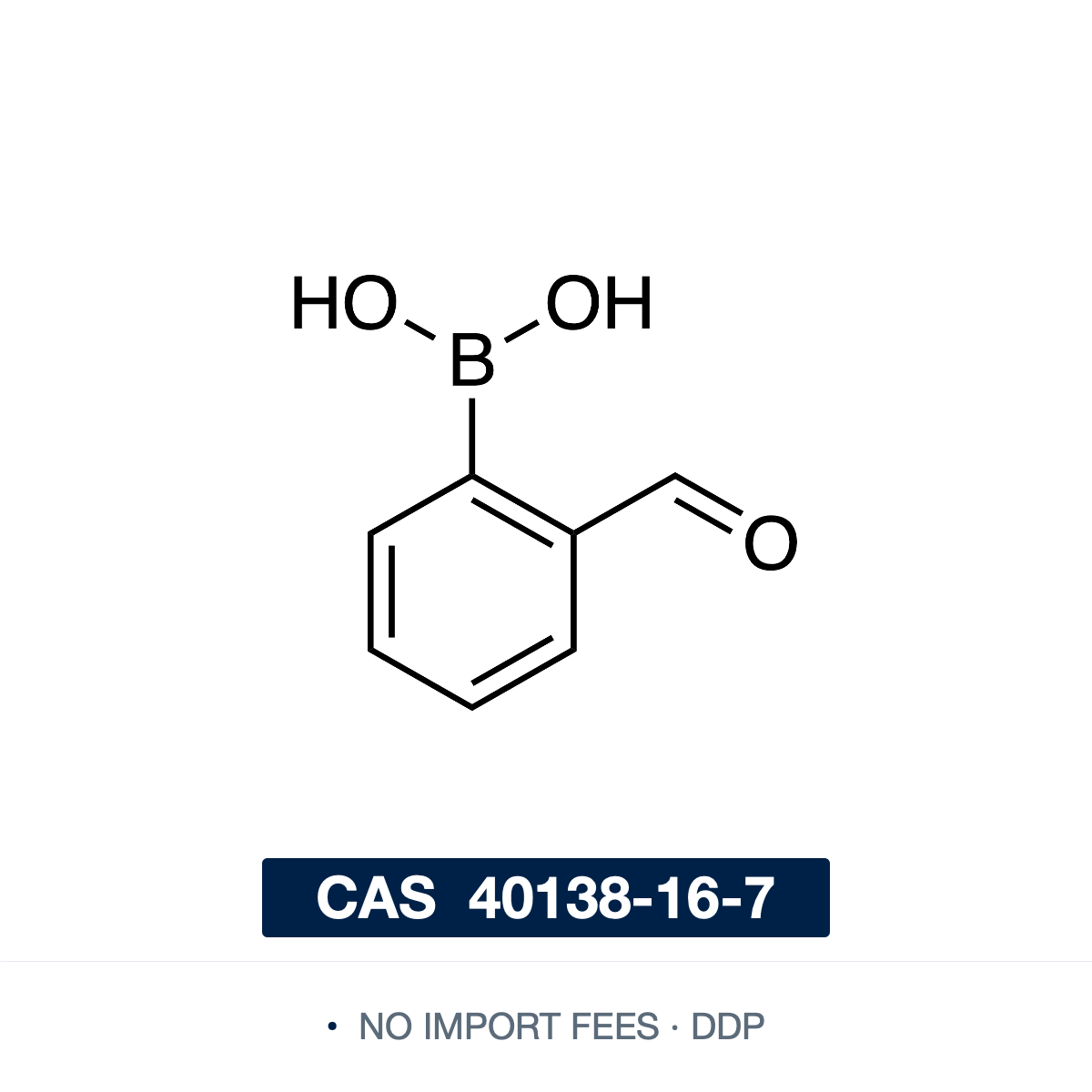
2-Formylphenylboronic Acid (2-FPBA)
2-Formylphenylboronic Acid (2-FPBA) | CAS 40138-16-7 | ≥98%
Couldn't load pickup availability
Technical Specifications
| CAS Number | 40138-16-7 |
| EC / EINECS Number | 628-526-1 |
| MDL Number | MFCD00151822 |
| SMILES | B(C1=CC=CC=C1C=O)(O)O |
| InChI | InChI=1S/C7H7BO3/c9-5-6-3-1-2-4-7(6)8(10)11/h1-5,10-11H |
| InChIKey | DGUWACLYDSWXRZ-UHFFFAOYSA-N |
| PubChem CID | 292189 |
| Molecular Formula | C₇H₇BO₃ |
| Molecular Weight | 149.94 g/mol |
| Melting Point | 115–120 °C |
| Solubility | Soluble in methanol, ethanol, DMSO, THF, dichloromethane and toluene; water-soluble (increasingly so at higher pH). Practically insoluble in hexane. |
| Purity | ≥98%. May contain varying amounts of the corresponding boronic acid anhydrides |
| Physical Form | White to pale yellow crystalline solid |
| HS Code | 2931.90 |
| Country of Origin | Finland |
| Shelf Life | Retest period: 36 months from date of manufacture |
| Storage Conditions | Store in a cool, dry place in a tightly sealed container |
Product Description & Scientific Applications
2-Formylphenylboronic acid (2-FPBA; 2-boronobenzaldehyde) is a bifunctional reagent carrying an aldehyde ortho to a boronic acid on the same ring. That proximity is the source of its chemistry: the two groups act together, and the compound exists in equilibrium with its cyclic tautomer, a 3-hydroxybenzoxaborole. It is the ortho (2-) isomer specifically that behaves this way — the 3- and 4-formyl isomers cannot. Like other boronic acids, it is supplied with variable amounts of the boroxine anhydride.
Mechanistic basis. The neighbouring boronic acid activates the aldehyde toward condensation with nitrogen and sulfur nucleophiles and then stabilises the product through an intramolecular boron–heteroatom (B–N or B–O) interaction. The resulting bonds are dynamic covalent: an iminoboronate is far more stable thermodynamically than an ordinary imine yet remains kinetically labile to hydrolysis, so conjugation is fast and — depending on the nucleophile — either reversible or effectively permanent. Reactions with α-nucleophiles proceed with rate constants exceeding 1000 M⁻¹s⁻¹ under physiological conditions.
Applications and Uses
- Amine conjugation (iminoboronates). Condenses with primary amines — lysine side chains, aminophospholipids, 1,2-diamines — to give iminoboronates that form and hydrolyse reversibly under physiological conditions, a basis for dynamic, reversible covalent labelling and reversible covalent probes.
- Cysteine and N-terminal-cysteine conjugation (thiazolidino boronates). Reacts rapidly with 1,2-aminothiols, including N-terminal cysteine, at low micromolar concentrations to give thiazolidino boronate (TzB) complexes of high stability — a handle for site-specific protein and peptide labelling.
- α-Nucleophile conjugation (diazaborines). Condenses with hydrazines and related α-nucleophiles to form stable diazaborine heterocycles; the thiazolidine and diazaborine forms interconvert, letting the outcome be steered by the choice and order of reactants.
- Bifunctional building block. Pairing a boron nucleophile with an ortho-aldehyde supports tandem coupling–cyclisation: it is used in asymmetric Suzuki–Miyaura coupling followed by transformation of the formyl group, and in metal-catalysed cycloadditions such as the cobalt-catalysed [2+3] with alkynes to give indenols.
- Reversible enzyme inhibition. Beyond its conjugation chemistry, 2-FPBA serves as a reversible, active-site-directed enzyme inhibitor: it is a potent, slow-onset inhibitor of mandelate racemase (Kᵢ 5.1 μM), engaging a catalytic active-site lysine through a boron–nitrogen dative bond.
Shipping Destinations
- EU & UK: Priority delivery, 2–5 business days.
- United States (DDP): 3–7 business days, duties and taxes prepaid.
- EFTA Countries (DDP): 3–7 business days, duties and taxes prepaid.
- Worldwide: 7–14 business days, selected locations.
Safety Information
| GHS Pictograms |

|
| Signal Word | Warning |
| Hazard Class | Not regulated for transport |
| Transport Category | Not classified as dangerous goods for transport (ADR/IATA/IMDG) |
| H-Statements | H315 - H319 - H335 |
| P-Statements | P261 - P264 - P271 - P280 - P302+P352 - P304+P340 - P305+P351+P338 - P332+P313 - P337+P313 - P362+P364 - P501 |
Documentation
| Safety Data Sheet | Download PDF |