NorrChemica™
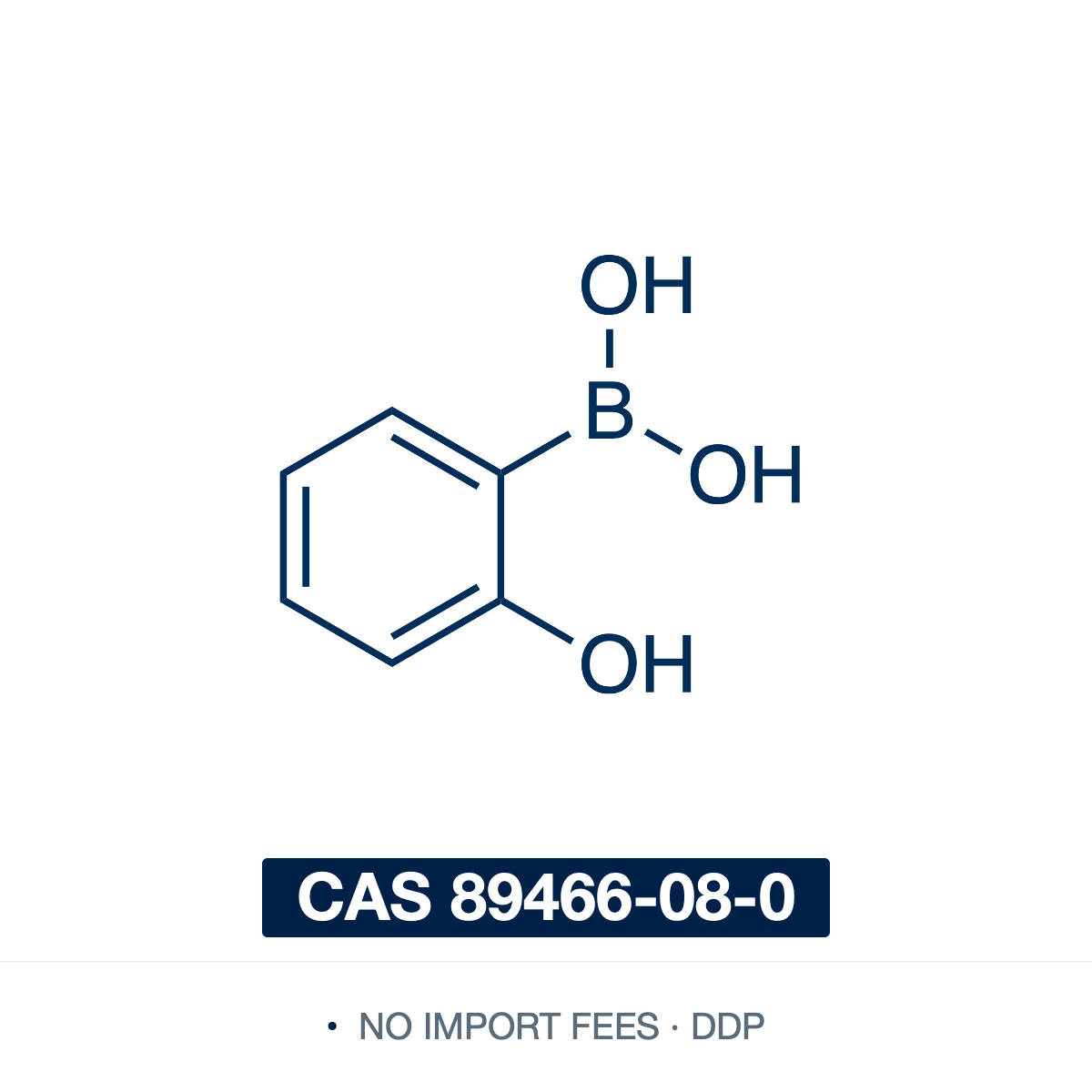
(2-Hydroxyphenyl)boronic Acid
(2-Hydroxyphenyl)boronic Acid | CAS 89466-08-0 | ≥98%
Couldn't load pickup availability
Technical Specifications
| CAS Number | 89466-08-0 |
| EC / EINECS Number | 677-277-5 |
| MDL Number | MFCD01074581 |
| SMILES | B(C1=CC=CC=C1O)(O)O |
| InChI | InChI=1S/C6H7BO3/c8-6-4-2-1-3-5(6)7(9)10/h1-4,8-10H |
| InChIKey | YDMRDHQUQIVWBE-UHFFFAOYSA-N |
| PubChem CID | 2773454 |
| Molecular Formula | C₆H₇BO₃ |
| Molecular Weight | 137.93 g/mol |
| Melting Point | 178–182 °C |
| Solubility | Soluble in methanol, ethanol, DMSO, DMF, chloroform, dichloromethane, and THF. |
| Purity | ≥98%. May contain varying amounts of the corresponding boronic acid anhydrides |
| Physical Form | White to pale yellow crystalline powder |
| HS Code | 2931.90 |
| Country of Origin | Finland |
| Shelf Life | Retest period: 36 months from date of manufacture |
| Storage Conditions | Store in a cool, dry place in a tightly sealed container. Refrigeration recommended. |
Product Description & Scientific Applications
(2-Hydroxyphenyl)boronic acid (2-boronophenol) is a phenylboronic acid bearing a phenolic hydroxyl ortho to boron. The boron is a handle for carbon–carbon coupling, the phenol for carbon–oxygen bond formation. It forms cyclic esters reversibly with 1,2- and 1,3-diols and binds anions, the position of both equilibria set by its acidity.
May contain small amounts of the cyclic anhydride (2-hydroxyphenyl)boroxine. Under the aqueous, basic coupling conditions the two forms re-equilibrate, and the effect on yield is minor.
Suzuki–Miyaura coupling. Under a suitable palladium/ligand system it couples with aryl and heteroaryl halides to 2-hydroxybiaryls, the ortho phenol carried through unprotected.
Oxygen heterocycles. Suzuki coupling with a 1,2-dihaloarene, followed by copper(I) thiophene-2-carboxylate cyclisation, converts the reagent into dibenzofurans and benzofuro-fused heterocycles such as benzofuropyridines. The boron forms the biaryl bond, and the phenol closes onto the retained halide as an intramolecular carbon–oxygen bond. These ring systems serve as OLED emitters and host materials and as bioactive cores.
Axially chiral biaryls. As its boronate ester it couples atroposelectively with ortho-substituted aryl bromides. A resolved sulfonated SPhos ligand (sSPhos) builds axially chiral 2,2′-biphenols in high enantioselectivity, 92% ee in a representative case. The related sRuPhos ligand extends the method to 2-amino-2′-hydroxybiphenyls in up to 99% ee. A hydrogen bond from the phenol to the ligand sulfonate organises the transition state and sets the axis. These biaryl diols are standard chiral ligands and recurring motifs in medicinal chemistry.
Labile carbon–boron bond. The ortho hydroxyl labilises the carbon–boron bond, so the free acid protodeboronates readily and is commonly stored and used as its MIDA boronate. The same lability is a tool: installed on a phenol, the boronic acid blocks the ortho position or directs meta functionalisation, then leaves by thermal protodeboronation in DMSO.
Further Reading. For boronic acids, boronic esters, protodeboronation, boroxine content, and Suzuki–Miyaura reagent selection, see NorrChemica's Lab Journal guide: Choosing Your Boron Source for Suzuki–Miyaura Coupling.
Shipping Destinations
- EU & UK: Priority delivery, 2–5 business days.
- United States (DDP): 3–7 business days, duties and taxes prepaid.
- EFTA Countries (DDP): 3–7 business days, duties and taxes prepaid.
- Worldwide: 7–14 business days, selected locations.
Safety Information
| GHS Pictograms |

|
| Signal Word | Warning |
| Hazard Class | Not regulated for transport |
| Transport Category | Not classified as dangerous goods for transport (ADR/IATA/IMDG) |
| H-Statements | H315 - H319 - H335 |
| P-Statements | P261 - P264 - P271 - P280 - P302+P352 - P304+P340 - P305+P351+P338 - P332+P313 - P337+P313 - P362+P364 - P501 |
Documentation
| Safety Data Sheet | Download PDF |