NorrChemica™
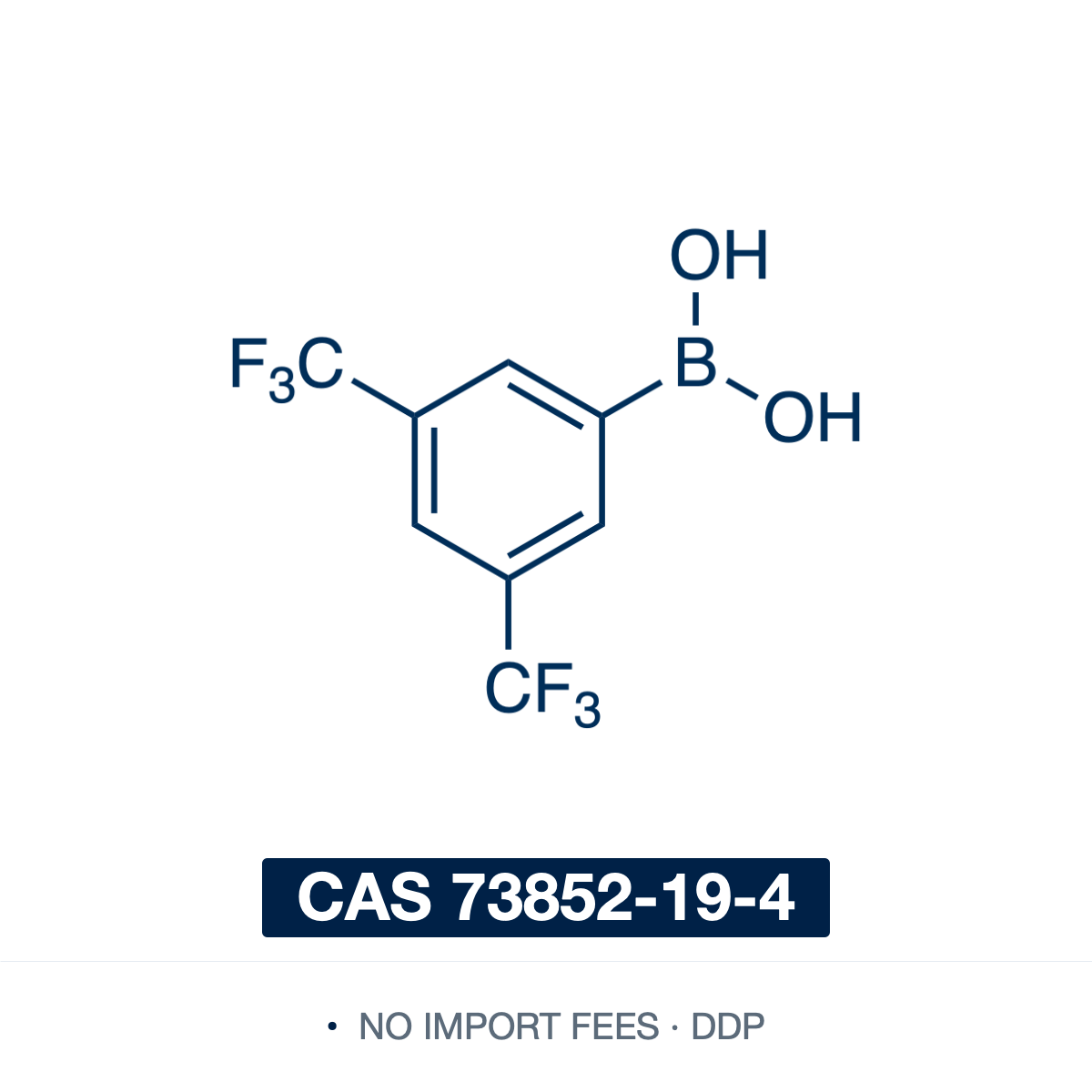
3,5-Bis(trifluoromethyl)phenylboronic Acid
3,5-Bis(trifluoromethyl)phenylboronic Acid | CAS 73852-19-4 | ≥98%
Couldn't load pickup availability
Technical Specifications
| CAS Number | 73852-19-4 |
| EC / EINECS Number | 642-864-7 |
| MDL Number | MFCD00051850 |
| SMILES | B(C1=CC(=CC(=C1)C(F)(F)F)C(F)(F)F)(O)O |
| InChI | InChI=1S/C8H5BF6O2/c10-7(11,12)4-1-5(8(13,14)15)3-6(2-4)9(16)17/h1-3,16-17H |
| InChIKey | BPTABBGLHGBJQR-UHFFFAOYSA-N |
| PubChem CID | 156265 |
| Molecular Formula | C₈H₅BF₆O₂ |
| Molecular Weight | 257.93 g/mol |
| Melting Point | 217-220 °C |
| Solubility | Soluble in alcoholic solvents, acetonitrile, DMF, DMSO. |
| Purity | ≥98%. May contain varying amounts of the corresponding boronic acid anhydrides |
| Physical Form | White to off-white powder |
| HS Code | 2931.90 |
| Country of Origin | Finland |
| Shelf Life | Retest period: 36 months from date of manufacture |
| Storage Conditions | Store in a cool, dry place in a tightly sealed container |
Product Description & Scientific Applications
3,5-Bis(trifluoromethyl)phenylboronic acid (3,5-bis(trifluoromethyl)benzeneboronic acid) is a strongly electron-poor arylboronic acid. Two trifluoromethyl groups occupy the 3- and 5-positions, meta to boron; both withdraw electron density by induction and raise the acidity of the boronic acid relative to the unsubstituted parent. The symmetric substitution makes the six fluorines equivalent, giving a single 19F resonance as a clean spectroscopic handle. Like the meta- and para-trifluoromethyl isomers, it resists protodeboronation, and couples reliably under aqueous conditions. It is used as a 3,5-bis(trifluoromethyl)phenyl building block in medicinal chemistry, agrochemicals, and electron-poor π-conjugated materials.
May contain small amounts of the cyclic anhydride 3,5-bis(trifluoromethyl)phenylboroxine. Under aqueous or basic coupling conditions the two forms re-equilibrate and the impact on yield is minor.
Applications and Reactions
- Suzuki–Miyaura coupling: with aryl, heteroaryl, or alkenyl electrophiles to give 3,5-bis(trifluoromethyl)-substituted biaryls, heterobiaryls, and styrenes under matched Pd/base conditions.
- Rhodium-catalysed conjugate addition: aryl donor in asymmetric 1,4-addition to enones, nitroalkenes, and related acceptors, installing the electron-poor aryl group with enantiocontrol under a chiral ligand.
- Chan–Lam coupling: copper-mediated C–N and C–O arylation onto amines, amides, sulfonamides, and phenols. As a strongly electron-poor arene, it couples in lower yield and over longer reaction times than electron-neutral or electron-rich boronic acids.
- Nickel-catalysed aryl transfer to aldehydes: 1,2-addition to aryl aldehydes to give electron-poor diarylmethanols.
- 19F NMR handle: the six equivalent fluorines give a single sharp 19F signal, a sensitive reporter for tracking the aryl group in reactions, binding studies, and complex mixtures.
- Electron-poor materials building block: Suzuki installation of the 3,5-bis(trifluoromethyl)phenyl unit into biaryls, chromophores, ligands, and organic-electronic architectures as an electron-accepting group.
- Non-classical arylation: with arenediazonium salts, diaryliodonium salts, and related hypervalent-iodine reagents.
- Protected boronate esters: precursor to pinacol (Bpin), neopentyl glycol, and MIDA boronates for iterative cross-coupling.
- Ipso-halodeboronation: conversion of the C–B bond to C–Br, C–Cl, or C–I under electrophilic halogenation.
- Oxidative hydroxylation: to 3,5-bis(trifluoromethyl)phenol under peroxide, photoredox, or copper-catalysed conditions.
Further Reading
For boronic acids, boronic esters, organotrifluoroborates, protodeboronation, boroxine content, and Suzuki–Miyaura reagent selection, see NorrChemica's Lab Journal guide: Choosing Your Boron Source for Suzuki–Miyaura Coupling.
Shipping Destinations
- EU & UK: Priority delivery, 2–5 business days.
- United States (DDP): 3–7 business days, duties and taxes prepaid.
- EFTA Countries (DDP): 3–7 business days, duties and taxes prepaid.
- Worldwide: 7–14 business days, selected locations.
Safety Information
| GHS Pictograms |

|
| Signal Word | Warning |
| Hazard Class | Not regulated for transport |
| Transport Category | Not classified as dangerous goods for transport (ADR/IATA/IMDG) |
| H-Statements | H315 - H319 - H335 |
| P-Statements | P261 - P264 - P271 - P280 - P302+P352 - P305+P351+P338 - P332+P313 - P337+P313 - P362+P364 - P501 |
Documentation
| Safety Data Sheet | Download PDF |