NorrChemica™
Chrome Azurol S
Chrome Azurol S | CAS 1667-99-8 | Analytical Reagent Grade
Couldn't load pickup availability
Technical Specifications
| CAS Number | 1667-99-8 |
| EC / EINECS Number | 216-787-0 |
| MDL Number | MFCD00001615 |
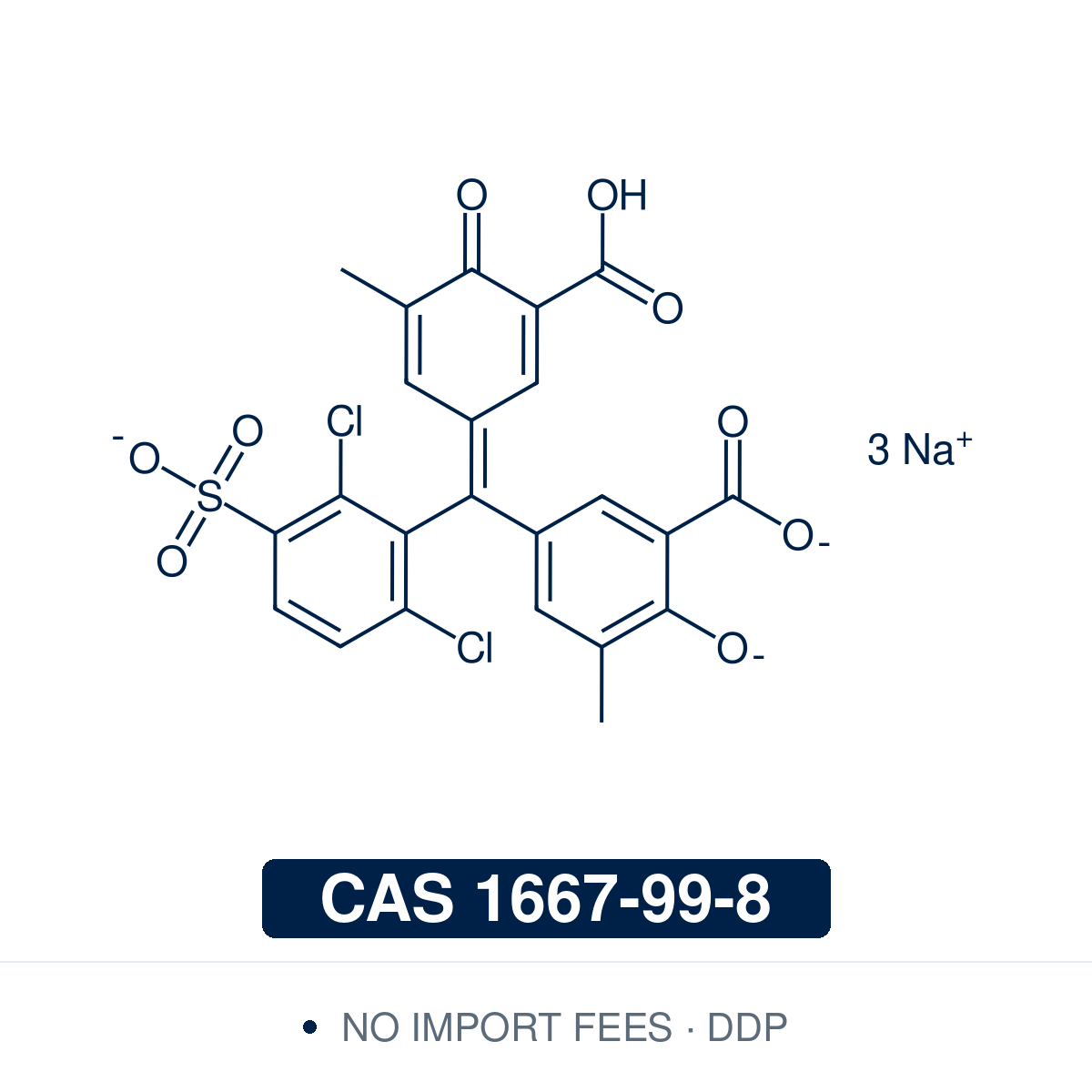
| SMILES | CC1=CC(=CC(=C1[O-])C(=O)[O-])C(=C2C=C(C(=O)C(=C2)C(=O)O)C)C3=C(C=CC(=C3Cl)S(=O)(=O)[O-])Cl.[Na+].[Na+].[Na+] |
| InChI | InChI=1S/C23H16Cl2O9S.3Na/c1-9-5-11(7-13(20(9)26)22(28)29)17(12-6-10(2)21(27)14(8-12)23(30)31)18-15(24)3-4-16(19(18)25)35(32,33)34;;;/h3-8,26H,1-2H3,(H,28,29)(H,30,31)(H,32,33,34);;;/q;3*+1/p-3 |
| InChIKey | FUIZKNBTOOKONL-UHFFFAOYSA-K |
| PubChem CID | 54736314 |
| Molecular Formula | C₂₃H₁₃Cl₂Na₃O₉S |
| Molecular Weight | 605.28 g/mol |
| Melting Point | >250 °C |
| Solubility | Soluble in water, giving a reddish-brown to yellow-brown solution at neutral pH and a blue–violet solution in dilute alkali. Soluble in aqueous lower alcohols (ethanol, 2-propanol mixtures). Sparingly soluble in non-polar organic solvents. |
| Purity | Analytical Reagent Grade |
| Physical Form | Dark red-brown powder |
| HS Code | 3204.12 |
| Country of Origin | Finland |
| Shelf Life | Retest period: 36 months from date of manufacture. |
| Storage Conditions | Store in a cool, dry place in a tightly sealed container, protected from light. |
Product Description & Scientific Applications
Chrome Azurol S (Mordant Blue 29) is the trisodium salt of a sulfonated triphenylmethane dye carrying two carboxylate groups, one phenolic hydroxyl, one sulfonate, and two ortho-chloro substituents across the three aryl rings of a central methine carbon. The phenolic hydroxyl and ortho-carboxylate on adjacent ring positions form the chelating pocket characteristic of metallochromic triphenylmethane indicators. The compound is a hydrophilic anion supplied as a dark brown to black crystalline powder.
Aqueous solutions are reddish-brown to yellow at neutral pH and turn deep violet-blue on addition of dilute alkali, reflecting deprotonation of the phenolic hydroxyl and formation of the extended-conjugation quinoid chromophore. On chelation with hard and borderline metal cations at mildly acidic pH, the visible absorption shifts to longer wavelengths in the 570–630 nm region, producing the intense blue colour central to the compound’s use as a metallochromic reagent.
Applications:
Spectrophotometric determination of metal ions. Forms intensely coloured metal–dye complexes with Al(III), Be(II), Fe(III), Ga(III), Cu(II), and Cr(III) at acidic to mildly acidic pH, allowing trace-level quantification in water, geological samples, soils, plant material, and biological matrices by visible spectroscopy. The Al(III)–CAS method at pH 4.6 (λmax 567.5 nm) is one of the canonical aluminium reagents in drinking-water, environmental, and clinical analysis; the Be(II) method is established in environmental and occupational-exposure monitoring.
Chrome Azurol S (CAS) assay for siderophore detection. The blue Fe(III)–CAS–HDTMA ternary complex (λmax 630 nm) acts as a colorimetric reporter for iron-binding ligands secreted by bacteria and fungi: siderophores abstract iron from the more weakly binding ternary complex, releasing free dye and producing a yellow-to-orange shift on agar plates or in liquid culture. Standard screen for siderophore-producing isolates in rhizosphere microbiology, fungal iron-acquisition studies, and environmental microbiology.
Metallochromic indicator for complexometric titrations. Used at low concentrations for endpoint detection in EDTA chelometric and displacement titrations of metal ions including Al(III), Cu(II), Fe(III), Ni(II), and Th(IV); the endpoint corresponds to a sharp transition from the blue metal–dye complex to the free dye colour as EDTA sequesters the metal. Often paired with surfactant additives and masking agents to sharpen the colour transition and suppress interferences.
Determination of cationic surfactants. Forms ion-association complexes with cetyltrimethylammonium and analogous quaternary ammonium surfactants in aqueous medium, extractable into 1-butanol as a pink-violet phase for spectrophotometric quantification of cationic surfactants in water samples.
Shipping Destinations
- EU & UK: Priority delivery, 2–5 business days.
- United States (DDP): 3–7 business days, duties and taxes prepaid.
- EFTA Countries (DDP): 3–7 business days, duties and taxes prepaid.
- Worldwide: 7–14 business days, selected locations.
Safety Information
| GHS Pictograms |

|
| Signal Word | Warning |
| Hazard Class | Not regulated for transport |
| Transport Category | Not classified as dangerous goods for transport (ADR/IATA/IMDG) |
| H-Statements | H315 - H319 - H335 |
| P-Statements | P261 - P264 - P271 - P280 - P302+P352 - P304+P340 - P305+P351+P338 - P332+P313 - P337+P313 - P362+P364 - P501 |
Documentation
| Safety Data Sheet | Download PDF |