NorrChemica™
Crystal Violet
Crystal Violet | CAS 548-62-9 | Dye Content ≥88%
| Pack size | Excl. VAT | Incl. VAT | Add to cart |
|---|---|---|---|
| 50 g | €49,20 | ||
| 100 g | €64,20 |
Taxes and fees, e.g. VAT, included in the price. Shipping calculated at checkout.Free shipping on EU, UK and EFTA orders above €250, and above €400 to the rest of the world.
Technical Specifications
| CAS Number | 548-62-9 |
| EC / EINECS Number | 208-953-6 |
| MDL Number | MFCD00011750 |
| RTECS Number | BO7000000 |
| SMILES | [Cl-].CN(C)c1ccc(cc1)C(=C1C=CC(=[N+](C)C)C=C1)c1ccc(N(C)C)cc1 |
| InChI | InChI=1S/C25H30N3.ClH/c1-26(2)22-13-7-19(8-14-22)25(20-9-15-23(16-10-20)27(3)4)21-11-17-24(18-12-21)28(5)6;/h7-18H,1-6H3;1H/q+1;/p-1 |
| InChIKey | ZXJXZNDDNMQXFV-UHFFFAOYSA-M |
| PubChem CID | 11057 |
| Molecular Formula | C₂₅H₃₀ClN₃ |
| Molecular Weight | 407.98 g/mol |
| Melting Point | 173 °C |
| Solubility | Soluble in water (≈1.7%) and ethanol (≈14%); soluble in chloroform; insoluble in diethyl ether. Aqueous solutions are intensely violet. |
| Log Pow | 1.172 |
| Purity | Dye Content ≥88% |
| Physical Form | Dark green crystalline powder with metallic lustre |
| HS Code | 3204.13 |
| Country of Origin | Finland |
| Shelf Life | Retest period: 36 months from date of manufacture. |
| Storage Conditions | Store in a cool, dry place in a tightly sealed container, protected from light. |
Product Description & Scientific Applications
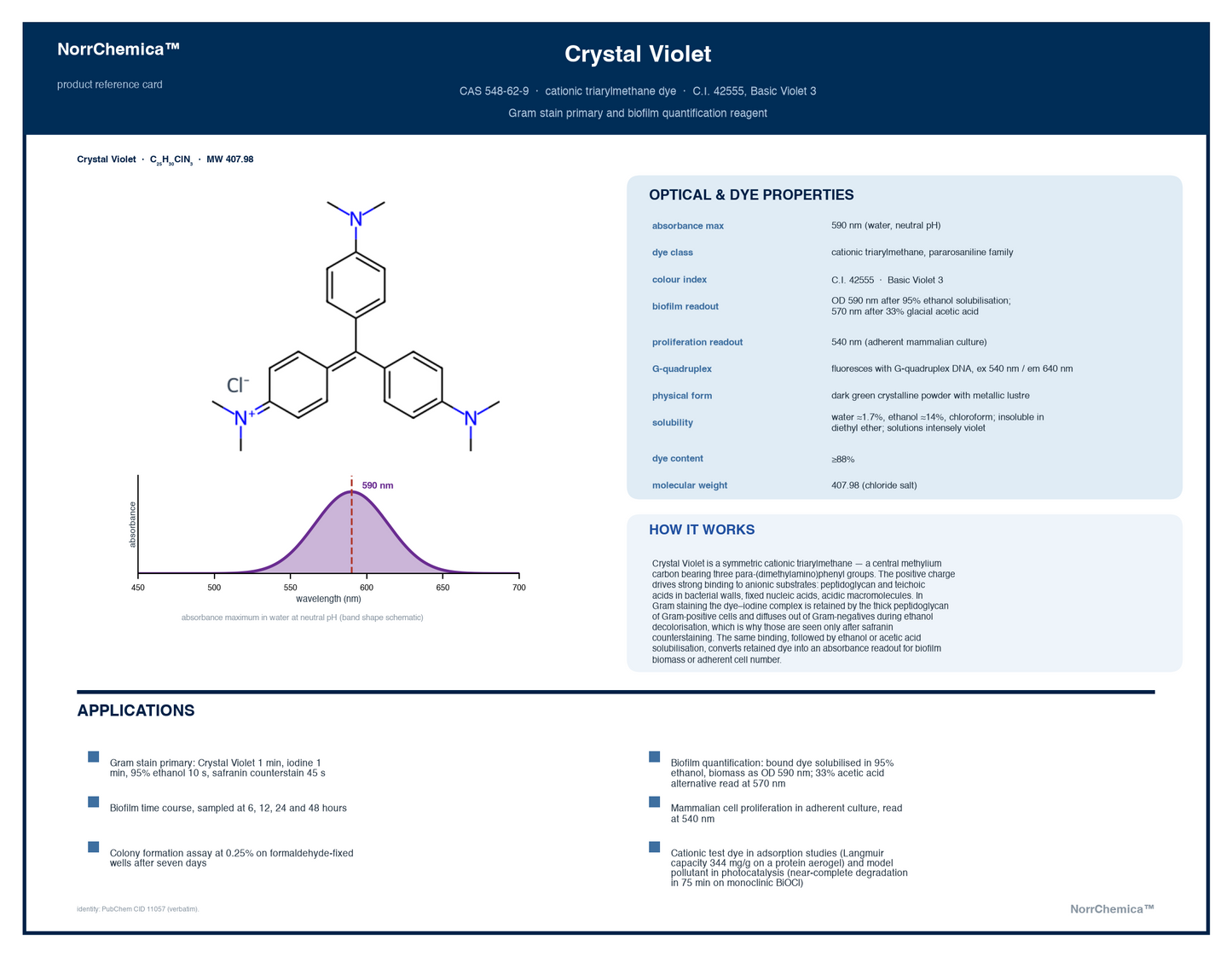
Identity and dye class. Crystal Violet, also sold as gentian violet or Methyl Violet 10B, is a cationic triphenylmethane dye. It is used in textile dyeing, paper printing, leather treatment, biological staining and medicinal compositions.
Absorption maximum. The dye absorbs with a λmax of 590 nm in water at neutral pH.
Cell-wall binding. Crystal Violet binds bacterial cell walls, which is the basis of its role in Gram staining. The same affinity lets it stain bacteria held within a biofilm.
Basic-dye affinity. As a basic dye it binds strongly to negatively charged wall components, including teichoic acids and peptidoglycans.
Gram-negative decolorisation. Gram-negative cells have a thinner peptidoglycan layer, so the Crystal Violet–iodine complex diffuses out during decolorisation. Those cells become visible only after safranin counterstaining.
Gram staining protocol. A working Gram protocol applies Crystal Violet for one minute, then iodine for one minute. Decolorisation with 95% ethanol for ten seconds precedes a 45-second safranin counterstain.
Biofilm quantification. In the biofilm assay, bound dye is solubilised with 95% ethanol. Biofilm biomass is then quantified as optical density at 590 nm.
Acetic acid solubilisation. Glacial acetic acid at 33% is an alternative solubilising agent. Absorbance is then read at 570 nm on a microplate reader.
Biofilm time course. The assay tracks biofilm biomass over time, sampled at 6, 12, 24 and 48 hours of incubation.
Mammalian cell proliferation. The same dye measures cell proliferation in adherent mammalian culture, read at 540 nm.
Colony formation assay. At 0.25% it stains formaldehyde-fixed wells for colony number and morphology after seven days of treatment.
Adsorption test dye. Crystal Violet serves as the cationic test dye in adsorption studies. Langmuir capacities reached 344 mg per gram on a protein aerogel.
Photocatalysis model pollutant. It also acts as the model pollutant in photocatalytic tests. Monoclinic bismuth oxychloride degraded nearly 100% of the dye within 75 minutes.
G-quadruplex fluorescence. With G-quadruplex DNA the dye fluoresces, excited at 540 nm and emitting at 640 nm.
Shipping Destinations
- EU & UK only: Priority delivery, 2–5 business days. Classified as dangerous goods — shipping restrictions apply outside the EU/UK.
Safety Information
| GHS Pictograms |


|
| Signal Word | Danger |
| Hazard Class | UN 3077 — Environmentally hazardous substance, solid, n.o.s. (Crystal Violet) (Class 9, PG III) |
| Transport Category | Class 9, PG III (ADR/IATA/IMDG) |
| H-Statements | H302 - H318 - H351 - H410 |
| P-Statements | P201 - P264 - P273 - P280 - P301+P312 - P305+P351+P338 - P308+P313 - P391 - P501 |
Documentation
| Safety Data Sheet | Download PDF |