NorrChemica™
D-Tartaric Acid
D-Tartaric Acid | CAS 147-71-7 | ≥99.0%
Couldn't load pickup availability
Technical Specifications
| CAS Number | 147-71-7 |
| EC / EINECS Number | 205-695-6 |
| MDL Number | MFCD00004238 |
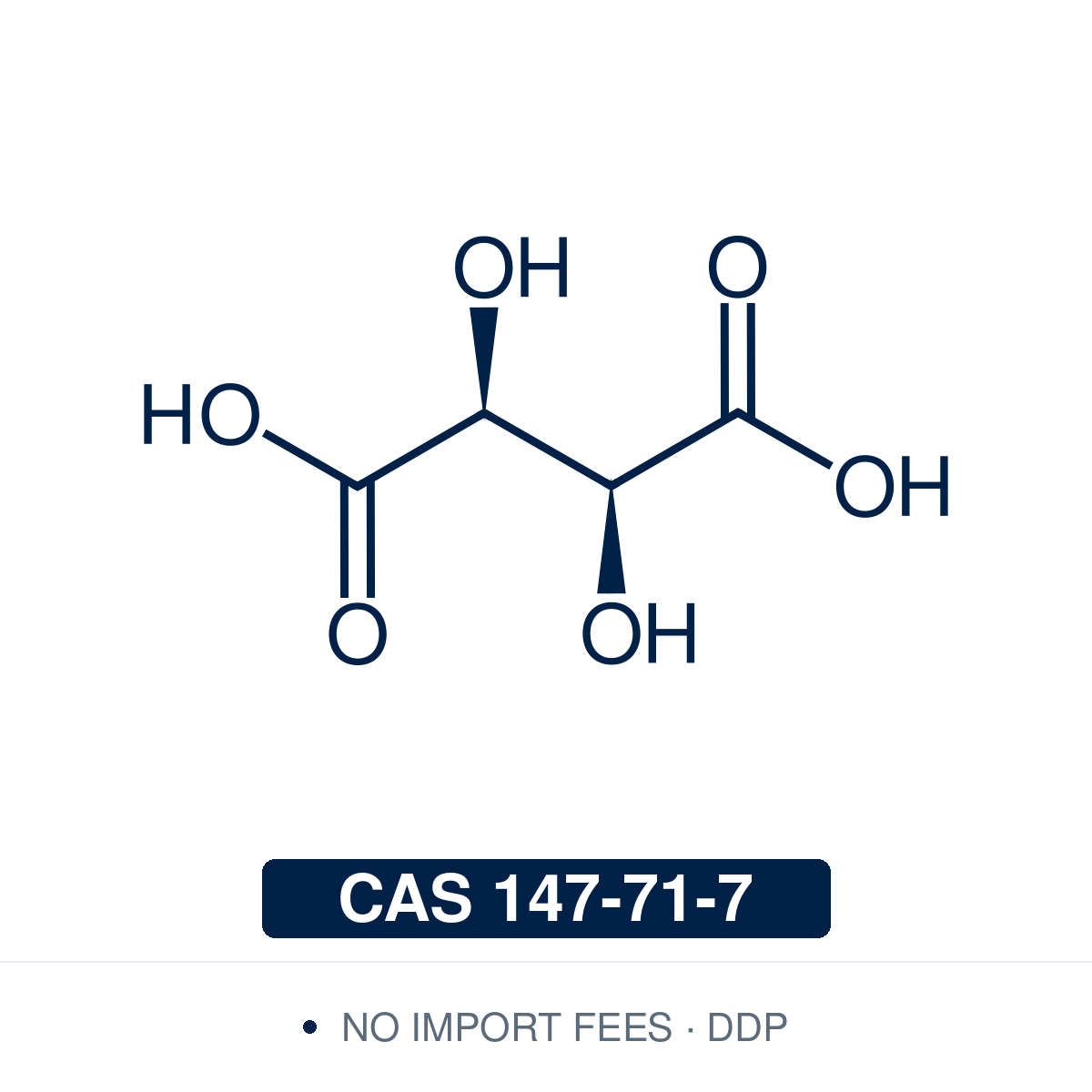
| SMILES | [C@H]([C@@H](C(=O)O)O)(C(=O)O)O |
| InChI | InChI=1S/C4H6O6/c5-1(3(7)8)2(6)4(9)10/h1-2,5-6H,(H,7,8)(H,9,10)/t1-,2-/m0/s1 |
| InChIKey | FEWJPZIEWOKRBE-LWMBPPNESA-N |
| PubChem CID | 439655 |
| Molecular Formula | C₄H₆O₆ |
| Molecular Weight | 150.09 g/mol |
| Melting Point | 172–174 °C (lit.) |
| Solubility | 1394 g/L in water (20 °C); soluble in methanol, ethanol, and DMSO |
| Purity | ≥99.0% |
| Physical Form | White crystalline powder |
| HS Code | 2918.12 |
| Country of Origin | Finland |
| Shelf Life | Retest period: 36 months from date of manufacture |
| Storage Conditions | Store in a cool, dry place in a tightly sealed container |
Product Description & Scientific Applications
D-Tartaric Acid ((2S,3S)-2,3-dihydroxybutanedioic acid, D-(−)-tartaric acid, D-threaric acid; CAS 147-71-7) is the unnatural enantiomer of tartaric acid, a chiral dicarboxylic acid bearing two carboxylic acid groups and two adjacent secondary alcohols in the (2S,3S) configuration. This arrangement allows formation of crystalline salts, esters, acetals, metal complexes, and other tartrate-derived scaffolds. It is supplied as a white to almost white crystalline solid, readily soluble in water.
Diastereomeric Salt Resolution of Racemic Bases
D-Tartaric acid is a classical acidic resolving agent for racemic bases, especially amines and amino alcohols, forming diastereomeric ammonium tartrate salts whose differing solubilities and crystal-lattice behaviour allow fractional crystallisation of an enriched salt. The choice of D- or L-tartaric acid determines which diastereomeric salt series forms, the enantiomer selected according to target configuration and crystallisation result. Solvent, concentration, stoichiometry, seeding, and cooling profile are optimised substrate by substrate. The approach suits route scouting, process development, and preparative resolution when chromatography is impractical.
Chiral-Pool Building Block for Stereocontrolled Synthesis
Its fixed absolute stereochemistry and dense oxygen functionality make D-tartaric acid a useful chiral-pool starting material. Conversion to dimethyl or diethyl tartrate, acetonide or dioxolane derivatives, and reduced diol derivatives gives enantiopure intermediates for downstream synthesis. Tartrate-derived structures feature widely in ligand and auxiliary design, including TADDOL-type diols and related hydrogen-bonding or Brønsted-acid organocatalyst frameworks.
Analytical, Separation, and Materials Research
In enantioseparation, tartaric acid and its derivatives serve in chromatographic methods (HPLC, GC, TLC) and as precursors to chiral selectors, additives, or tartrate-derived recognition motifs for method development. In materials research, D-tartaric acid appears in doped polyaniline nanotube systems for electrochemical materials and in D-tartaric acid–nicotinamide co-crystals studied as organic nonlinear optical materials.
Shipping Destinations
- EU & UK: Priority delivery, 2–5 business days.
- United States (DDP): 3–7 business days, duties and taxes prepaid.
- EFTA Countries (DDP): 3–7 business days, duties and taxes prepaid.
- Worldwide: 7–14 business days, selected locations.
Safety Information
| GHS Pictograms |

|
| Signal Word | Warning |
| Hazard Class | Not regulated for transport |
| Transport Category | Not classified as dangerous goods for transport (ADR/IATA/IMDG) |
| H-Statements | H315 - H319 - H335 |
| P-Statements | P261 - P264 - P271 - P280 - P302+P352 - P304+P340 - P305+P351+P338 - P332+P317 - P337+P317 - P403+P233 - P405 - P501 |
Documentation
| Safety Data Sheet | Download PDF |