NorrChemica™
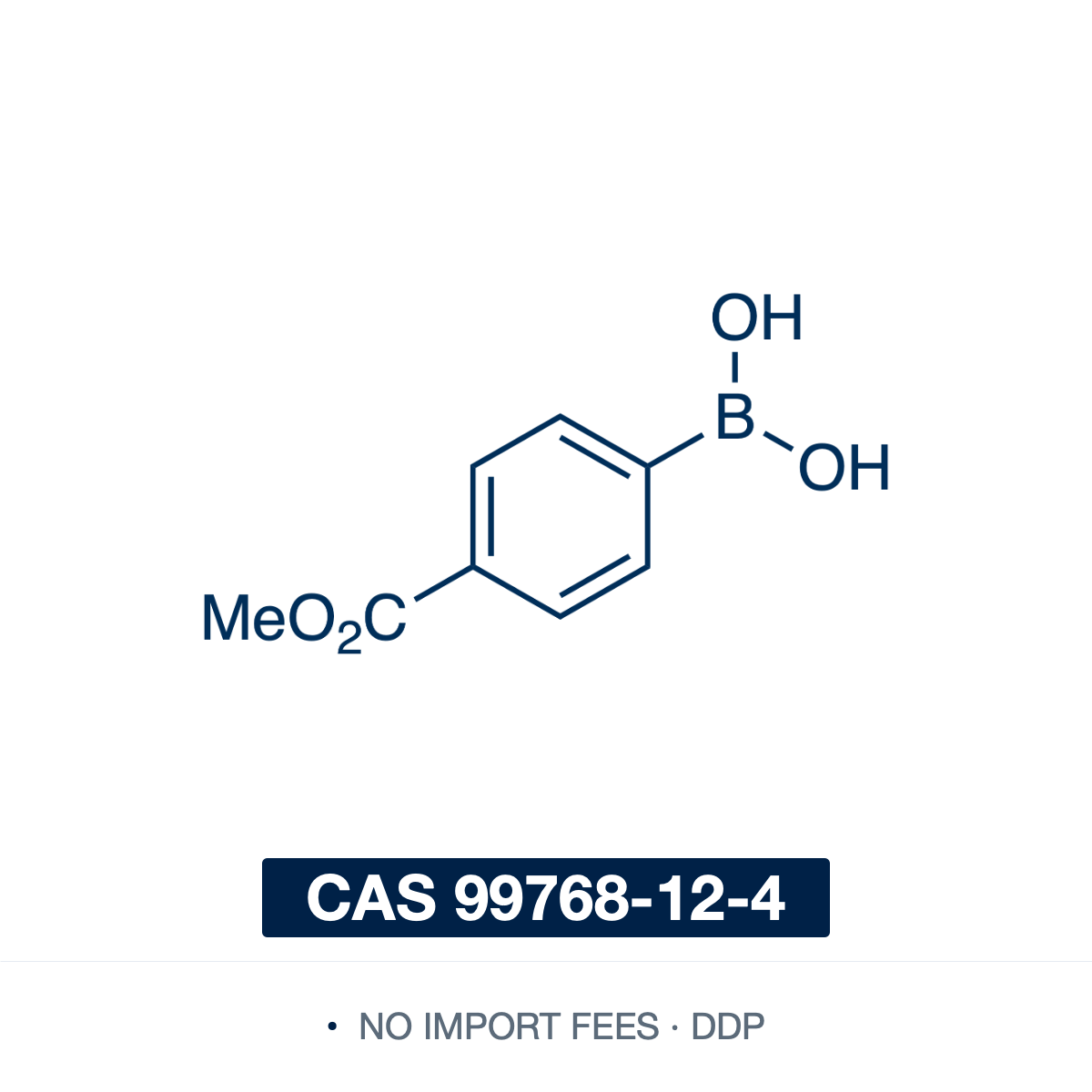
4-Methoxycarbonylphenylboronic acid
4-Methoxycarbonylphenylboronic acid | CAS 99768-12-4 | ≥98%
Couldn't load pickup availability
Technical Specifications
| CAS Number | 99768-12-4 |
| EC / EINECS Number | 619-459-9 |
| MDL Number | MFCD01632203 |
| SMILES | B(C1=CC=C(C=C1)C(=O)OC)(O)O |
| InChI | InChI=1S/C8H9BO4/c1-13-8(10)6-2-4-7(5-3-6)9(11)12/h2-5,11-12H,1H3 |
| InChIKey | PQCXFUXRTRESBD-UHFFFAOYSA-N |
| PubChem CID | 2734369 |
| Molecular Formula | C₈H₉BO₄ |
| Molecular Weight | 179.97 g/mol |
| Melting Point | 197–200 °C |
| Solubility | Soluble in methanol, ethanol, DMSO, DMF, chloroform, dichloromethane, and THF. |
| Purity | ≥98%. May contain varying amounts of the corresponding boronic acid anhydrides. |
| Physical Form | White to off-white solid powder |
| HS Code | 2931.90 |
| Country of Origin | Finland |
| Shelf Life | Retest period: 36 months from date of manufacture |
| Storage Conditions | Store in a cool, dry place in a tightly sealed container |
Product Description & Scientific Applications
4-Methoxycarbonylphenylboronic acid (methyl 4-boronobenzoate; (4-carbomethoxyphenyl)boronic acid) is a bifunctional para-substituted arylboronic acid bearing an electron-withdrawing methyl ester. The boronic acid couples under Suzuki–Miyaura conditions, and the methyl ester is a protecting group for the corresponding benzoic acid, unmasked by hydrolysis after coupling. The two orthogonal handles make it a building block for pharmaceuticals, functional materials, and carboxylate-linked coordination polymers.
May contain small amounts of the cyclic anhydride 4-methoxycarbonylphenylboroxine. Under aqueous or basic coupling conditions the two forms re-equilibrate and the impact on yield is minor.
Applications and Reactions
- Suzuki–Miyaura coupling: with aryl and heteroaryl halides under palladium catalysis to install the 4-(methoxycarbonyl)phenyl group, giving methyl biphenyl-4-carboxylates.
- Orthogonal ester handle: the methyl ester is retained under coupling and acts as a protecting group for the benzoic acid, unmasked by hydrolysis or elaborated by transesterification, amidation, or reduction.
- Carboxylate coordination linker: hydrolysis reveals the 4-carboxyphenyl motif, a carboxylate donor used as a linker in metal-organic frameworks and coordination polymers.
- Pharmaceutical building block: installs the ester-bearing aryl group into medicinal-chemistry scaffolds and biaryl intermediates.
- Chan–Lam coupling: with amines or alcohols under copper and air to form C–N or C–O bonds, the methyl ester retained.
- Oxidative ipso-hydroxylation: oxidation of the C–B bond gives methyl 4-hydroxybenzoate; the boron can also be masked as pinacol (Bpin) or MIDA boronates.
Further Reading
For boronic acids, boronic esters, organotrifluoroborates, protodeboronation, boroxine content, and Suzuki–Miyaura reagent selection, see NorrChemica's Lab Journal guide: Choosing Your Boron Source for Suzuki–Miyaura Coupling.
Shipping Destinations
- EU & UK: Priority delivery, 2–5 business days.
- United States (DDP): 3–7 business days, duties and taxes prepaid.
- EFTA Countries (DDP): 3–7 business days, duties and taxes prepaid.
- Worldwide: 7–14 business days, selected locations.
Safety Information
| GHS Pictograms |

|
| Signal Word | Warning |
| Hazard Class | Not regulated for transport |
| Transport Category | Not classified as dangerous goods for transport (ADR/IATA/IMDG) |
| H-Statements | H315 - H319 - H335 |
| P-Statements | P261 - P264 - P271 - P280 - P302+P352 - P304+P340 - P305+P351+P338 - P332+P313 - P337+P313 - P362+P364 - P501 |
Documentation
| Safety Data Sheet | Download PDF |