NorrChemica™
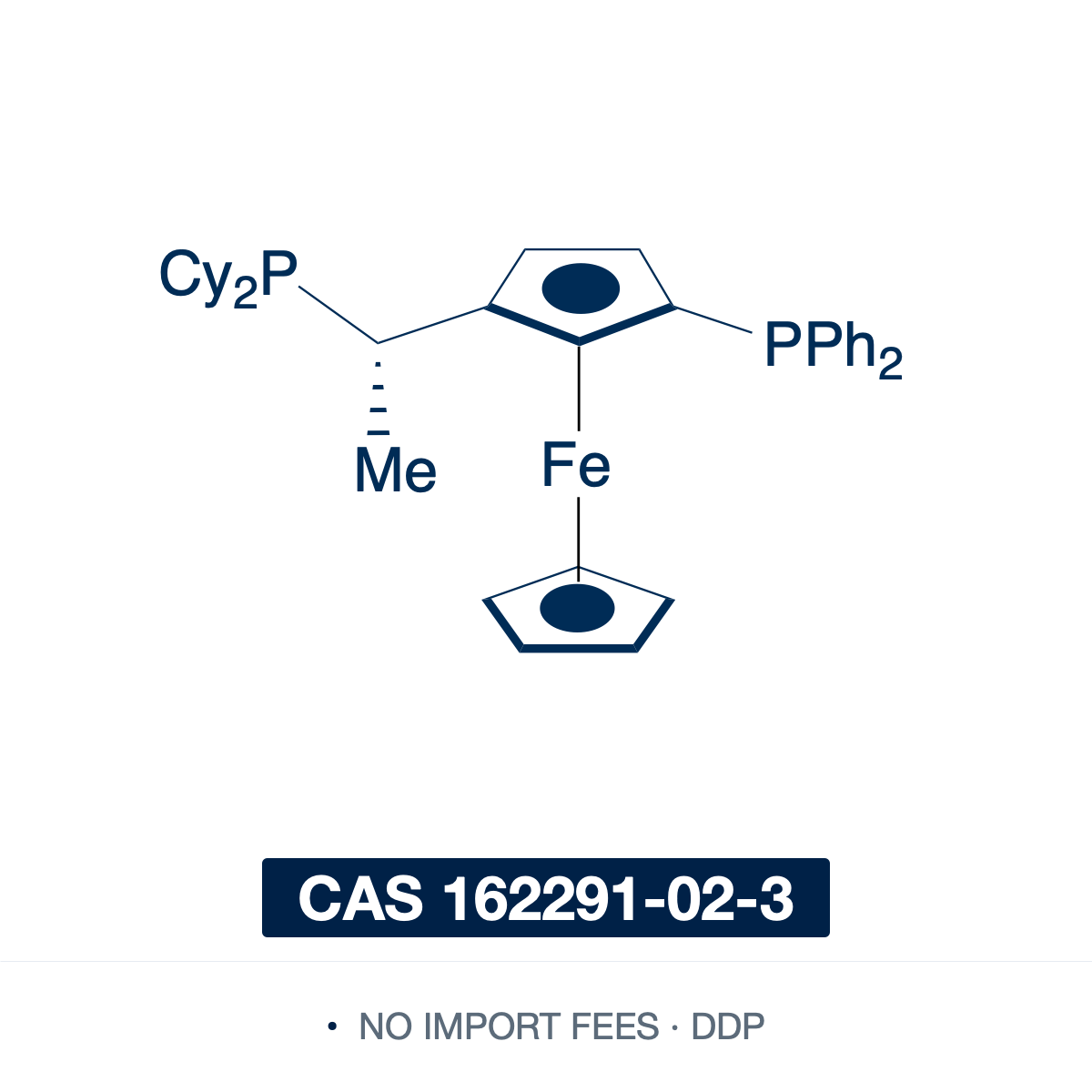
(S,Rp)-Josiphos
(S,Rp)-Josiphos | CAS 162291-02-3 | ≥98%
Couldn't load pickup availability
Technical Specifications
| CAS Number | 162291-02-3 |
| EC / EINECS Number | 813-041-1 |
| MDL Number | MFCD00800285 |
| SMILES | C[C@@H]([C]1C=CC=C1P(C2=CC=CC=C2)C3=CC=CC=C3)P(C4CCCCC4)C5CCCCC5.C1=C[CH]C=C1.[Fe] |
| InChI | InChI=1S/C31H39P2.C5H5.Fe/c1-25(32(26-15-6-2-7-16-26)27-17-8-3-9-18-27)30-23-14-24-31(30)33(28-19-10-4-11-20-28)29-21-12-5-13-22-29;1-2-4-5-3-1;/h4-5,10-14,19-27H,2-3,6-9,15-18H2,1H3;1-5H;/t25-;;/m0../s1 |
| InChIKey | HGTBZFMPHBAUCQ-WLOLSGMKSA-N |
| PubChem CID | 16218652 |
| Molecular Formula | C₃₆H₄₄FeP₂ |
| Molecular Weight | 594.53 g/mol |
| Melting Point | 95 °C (dec) |
| Purity | ≥98% |
| Physical Form | Orange to amber crystalline powder |
| HS Code | 2931.49 |
| Shelf Life | Retest period: 36 months from date of manufacture |
| Storage Conditions | Store tightly sealed under inert gas (N2 or Ar) at 2-8 °C, protected from light, air and moisture |
Product Description & Scientific Applications
Josiphos SL-J001-2 ((S)-(R)-Josiphos, (S)-1-[(Rₚ)-2-(diphenylphosphino)ferrocenyl]ethyldicyclohexylphosphine) is a central- and planar-chiral ferrocenyl diphosphine and a member of a privileged ligand family in transition-metal-catalysed asymmetric synthesis. Its chirality combines a stereogenic side-chain carbon with the planar chirality of the 1,2-disubstituted ferrocene, while the two phosphorus donors are deliberately differentiated: a diphenylphosphino group on the ferrocene ring and the stronger σ-donor dicyclohexylphosphino group on the side chain. On chelation to a metal these electronically and sterically distinct donors define an unsymmetrical, well-defined chiral pocket that is the basis for high enantiocontrol. SL-J001-2 is the antipode of SL-J001-1 — identical in constitution but opposite in both central and planar chirality — and provides the opposite-handed catalyst environment under matched reaction systems.
Modular ferrocenyl scaffold
The Josiphos architecture is built from an optically active ferrocenylethyl backbone bearing two independently variable phosphine groups, allowing the steric bulk and donor strength of each phosphorus to be tuned separately. This modularity makes the family unusually adaptable across substrate classes and metals, and underlies the standing of Josiphos ligands as privileged screening ligands for asymmetric synthesis. The contrast between the aryl- and alkyl-substituted phosphorus centres gives the two donors distinct character at the metal, which is exploited during substrate binding and turnover.
Asymmetric hydrogenation
Josiphos-type rhodium, ruthenium and iridium complexes are used in the enantioselective hydrogenation of functionalised alkenes, enamides and dehydroamino-acid derivatives, β-keto and α-keto esters, itaconates, and prochiral imines, giving access to enantioenriched amine, amino-acid, alcohol and ester building blocks. The family is especially prominent in industrial asymmetric hydrogenation: Ir/Josiphos-family imine hydrogenation underpins the large-scale manufacture of the herbicide (S)-metolachlor, one of the largest enantioselective catalytic processes operated worldwide, and Rh/tBu-Josiphos hydrogenation of a dehydro enamine intermediate is the manufacturing-scale asymmetric step in a process for the antidiabetic sitagliptin. As the antipode of SL-J001-1, SL-J001-2 provides access to the opposite-handed catalyst environment in such reductions.
Broader asymmetric catalysis
Beyond hydrogenation, Josiphos-type ligands support enantioselective transformations across rhodium, iridium, ruthenium, palladium, nickel, copper and cobalt catalysis. Representative examples include Cu/Josiphos asymmetric conjugate addition to α,β-unsaturated carbonyl compounds, including boron conjugate addition; Ru/Josiphos borrowing-hydrogen amination of 1,2-diols to β-amino alcohols; Rh/Josiphos hydroboration of vinylarenes; and Co/bisphosphine addition of silylacetylenes to 1,1-disubstituted allenes. Palladium- and nickel-based systems with Josiphos-type ligands also feature in asymmetric allylic substitution and alkylation, Heck-type arylation, and ring-opening of oxabicyclic alkenes, among other C–C and C–X bond-forming methods. SL-J001-2 is also used to assemble well-defined chiral metal complexes for mechanistic, structural and asymmetric-induction studies, and is commonly paired with SL-J001-1 when both senses of enantioselectivity are required during reaction development.
Shipping Destinations
- EU & UK: Priority delivery, 2–5 business days.
- United States (DDP): 3–7 business days, duties and taxes prepaid.
- EFTA Countries (DDP): 3–7 business days, duties and taxes prepaid.
- Worldwide: 7–14 business days, selected locations.
Safety Information
| Hazard Class | Not regulated for transport |
| Transport Category | Not classified as dangerous goods for transport (ADR/IATA/IMDG) |
Documentation
| Safety Data Sheet | Download PDF |
Share