NorrChemica™
TMAF–MeOH Adduct
TMAF–MeOH Adduct | CAS 2649021-27-0 | 91 mol% Active F⁻ (qNMR)
Couldn't load pickup availability
Technical Specifications
| CAS Number | 2649021-27-0 |
| SMILES | C[N+](C)(C)C.CO.[F-] |
| InChI | InChI=1S/C4H12N.CH4O.FH/c1-5(2,3)4;1-2;/h1-4H3;2H,1H3;1H/q+1;;/p-1 |
| InChIKey | UVUVGQOGLUMTQC-UHFFFAOYSA-M |
| PubChem CID | 161207599 |
| Molecular Formula | C₅H₁₆FNO |
| Molecular Weight | 125.19 g/mol |
| Solubility | Soluble in water (with decomposition), in alcoholic solvents, in DMSO, and in DMF |
| Purity | Active Fluoride Assay: 91 mol% (q¹H/q¹⁹F NMR, d1=30 s) |
| Physical Form | White solid |
| HS Code | 3824.99 |
| Country of Origin | Finland |
| Shelf Life | 24 months under recommended storage conditions |
| Storage Conditions | Store tightly closed in a dry, well-ventilated place at 2–8 °C, under inert atmosphere |
Product Description & Scientific Applications
TMAF–MeOH ([Me₄N]F·MeOH, the tetramethylammonium fluoride–methanol adduct) is an organic-soluble nucleophilic fluoride reagent designed to remove a central practical problem in nucleophilic fluorination: residual moisture, which causes batch-to-batch variation in fluorination yields.
The coordinated methanol balances the extreme hygroscopicity of anhydrous tetramethylammonium fluoride, raises solubility in alcoholic solvents, DMSO, and DMF, and preserves the dissociated fluoride character required for SNAr and related fluorination chemistry, giving clean, reproducible C–F bond formation.
qNMR-verified active fluoride
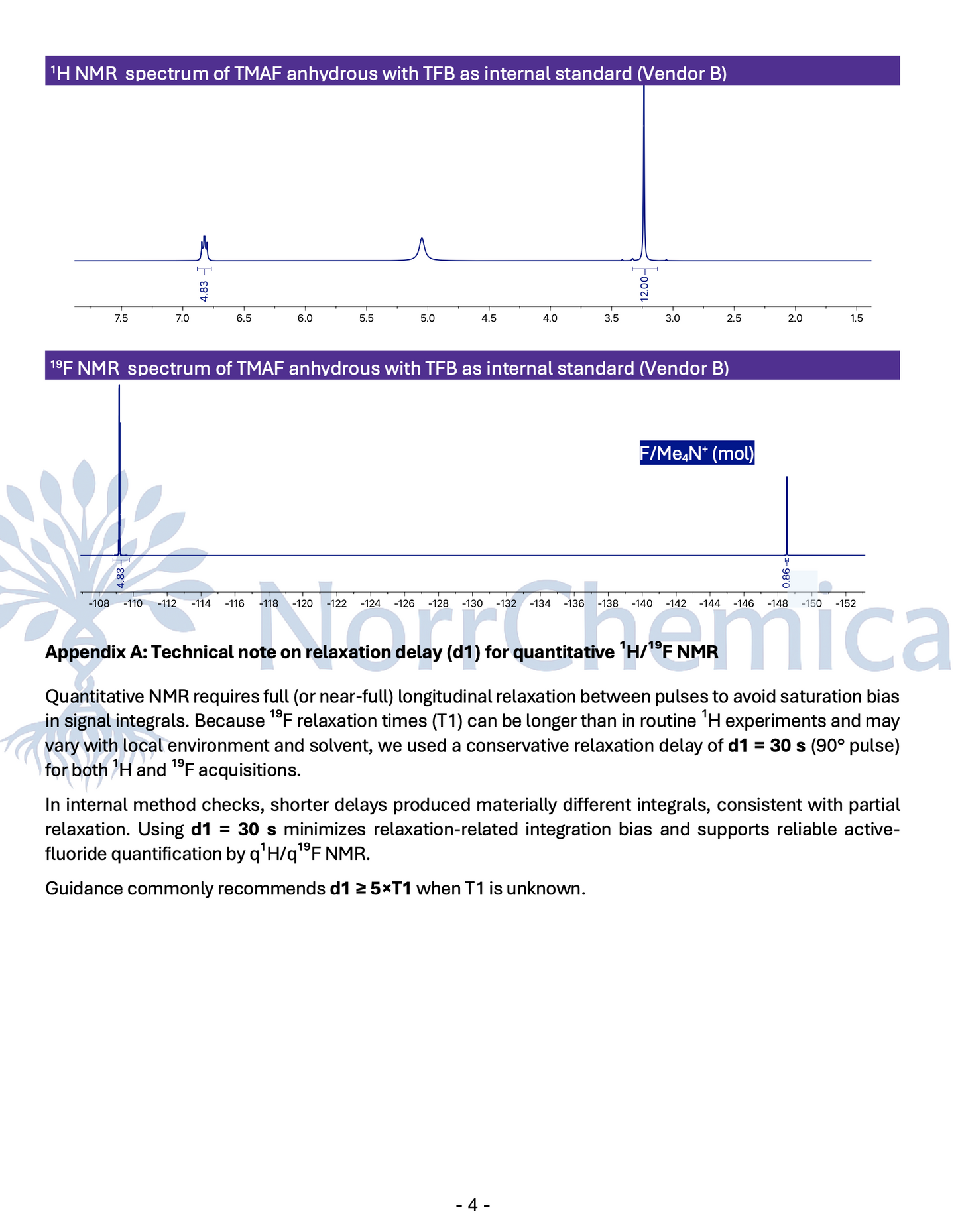
Active fluoride content is determined per batch by combined quantitative ¹H and ¹⁹F NMR in CD₃OD under fully relaxed conditions (90° pulse; d1 = 30 s for both nuclei), using 1,3,5-trifluorobenzene (TFB) as the internal reference. The result is reported as the F⁻/Me₄N⁺ ratio (mol% relative to Me₄N⁺). Current batch: 91 mol% active fluoride.
Quantitative NMR conditions and rationale
Many fluoride assay workflows use acquisition settings optimised for speed rather than quantification. Quantitative NMR requires a recycle delay of ≥5×T1 to avoid saturation bias in integrals, and ¹⁹F T1 values are often longer than the routine settings used for qualitative ¹⁹F screens. Acquiring both nuclei under fully relaxed conditions with baseline-controlled integration prevents the large apparent assay swings that occur when d1 is shortened or baseline drift is left unhandled.
Q: Why is d1 = 30 s used?A: Because ¹⁹F T1 values may be longer than typical routine settings, d1 = 30 s (90°) for both ¹H and ¹⁹F supports fully relaxed acquisition and reliable assay ratios.
Q: Why use 1,3,5-trifluorobenzene (TFB)?A: TFB gives clean, non-overlapping signals in both ¹H and ¹⁹F spectra in CD₃OD, enabling direct calculation of F⁻/Me₄N⁺ from the same solution without external calibration.
Documentation
Active Fluoride Assay Report (qNMR, PDF) — per-batch report with spectra, integrals, and F⁻/Me₄N⁺ calculation: download the report. CoA and GHS-compliant SDS supplied with every shipment.
Applications
- SNAr fluorination of activated (hetero)aromatics. Soluble, organic-phase fluoride source for nucleophilic aromatic substitution on electron-poor pyridines, pyrimidines, quinolines, nitroarenes, and halogenated heteroaromatic scaffolds. A homogeneous, alkali-metal-free alternative to KF and CsF in concerted SNAr fluorination where reproducible fluoride activity is required.
- Late-stage fluorination of complex small molecules. Established reagent for introducing fluorine at activated aromatic and heteroaromatic positions late in multi-step medicinal-chemistry and agrochemistry routes, where the fluorine substituent modulates lipophilicity, metabolic stability, dipole, and conformational preference of bioactive scaffolds.
- Base and fluoride source in transition-metal catalysis. Soluble fluoride base in palladium- and nickel-catalysed cross-coupling and C–H functionalisation, where homogeneity, controlled basicity, and a clean tetramethylammonium counterion offer practical advantages over alkali-metal carbonates, phosphates, or alkoxides.
- Synthesis of fluorinated heterocycles and building blocks. Reagent for installing fluorine on five- and six-membered nitrogen-containing heterocycles in the preparation of fluorinated intermediates for pharmaceutical, agrochemical, and functional-materials research.
- Mechanistic and physical-organic studies of fluoride nucleophilicity. Reference fluoride source in investigations of ion pairing, hydrogen-bond-assisted fluoride delivery, and the concerted SNAr mechanism in heteroaromatic substitution.
For further reading: see NorrChemica's Lab Journal — TMAF–Methanol Adduct: A Bench-Stable Nucleophilic Fluoride Source with 91 mol% Active Fluoride by Quantitative NMR.
Shipping Destinations
- EU & UK: Priority delivery, 2–5 business days.
- United States (DDP): 3–7 business days, duties and taxes prepaid.
- EFTA Countries (DDP): 3–7 business days, duties and taxes prepaid.
- Worldwide: 7–14 business days, selected locations.
Safety Information
| GHS Pictograms |

|
| Signal Word | Warning |
| Hazard Class | Not regulated as Dangerous Goods |
| Transport Category | Non-DG (standard courier permitted) |
| H-Statements | H302 - H315 - H319 - H335 |
| P-Statements | P261 – P280 – P301+P312 – P302+P352 – P305+P351+P338 |
Documentation
| Safety Data Sheet | Download PDF |