NorrChemica™
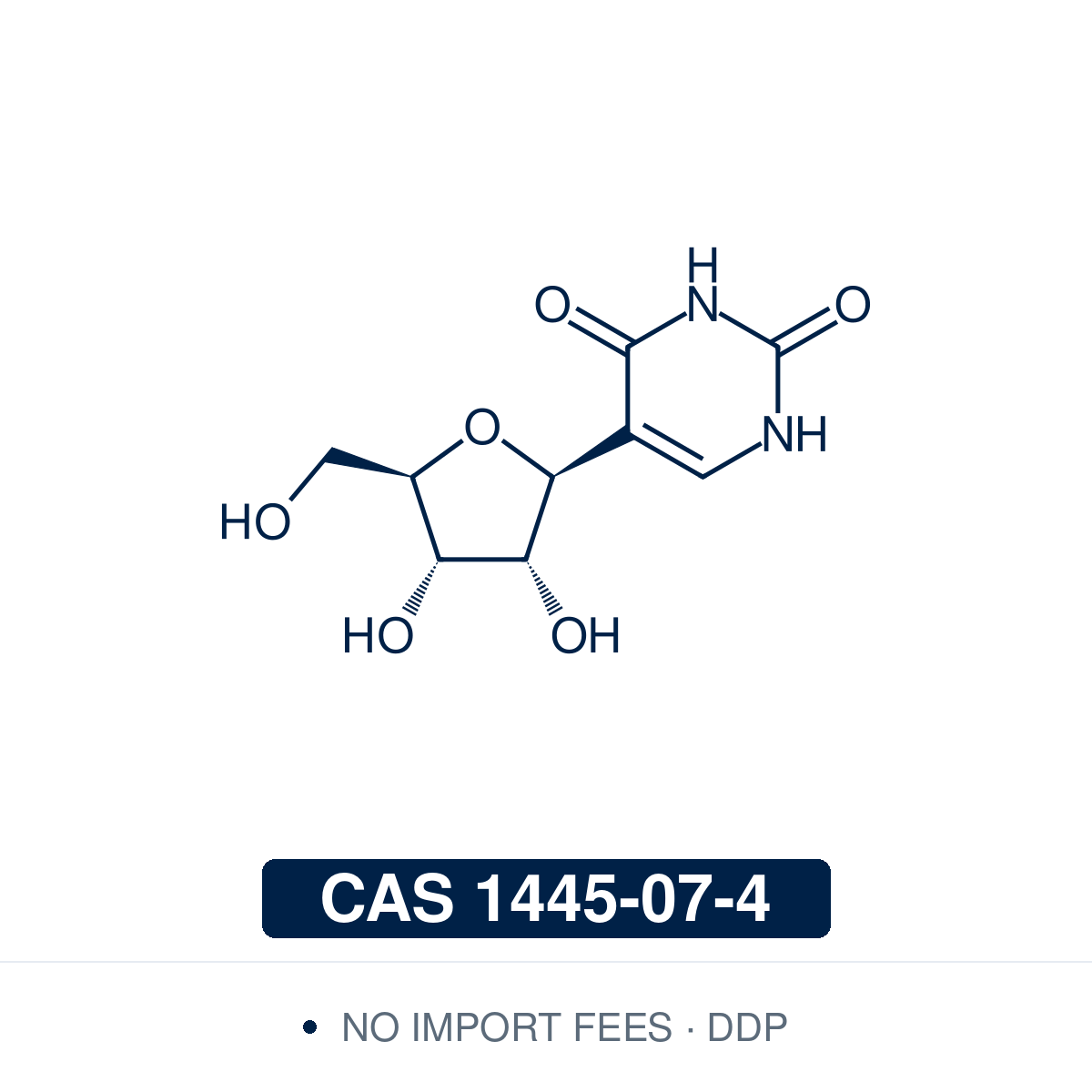
Pseudouridine
Pseudouridine | CAS 1445-07-4 | ≥98%
Pack sizes & prices
| Pack size | Excl. VAT | Incl. VAT | Add to cart |
|---|---|---|---|
| 100 mg | €69,20 | ||
| 250 mg | €98,20 | ||
| 1.0 g | €189,20 | ||
| 5.0 g | €549,20 | ||
| 10 g | €998,20 | ||
| 25 g | €1.698,20 |
Taxes and fees, e.g. VAT, included in the price. Shipping calculated at checkout.Free shipping on EU, UK and EFTA orders above €250, and above €400 to the rest of the world.
Technical Specifications
| CAS Number | 1445-07-4 |
| EC / EINECS Number | 978-484-6 |
| MDL Number | MFCD00038458 |
| SMILES | C1=C(C(=O)NC(=O)N1)[C@H]2[C@@H]([C@@H]([C@H](O2)CO)O)O |
| InChI | InChI=1S/C9H12N2O6/c12-2-4-5(13)6(14)7(17-4)3-1-10-9(16)11-8(3)15/h1,4-7,12-14H,2H2,(H2,10,11,15,16)/t4-,5-,6-,7+/m1/s1 |
| InChIKey | PTJWIQPHWPFNBW-GBNDHIKLSA-N |
| PubChem CID | 15047 |
| Molecular Formula | C₉H₁₂N₂O₆ |
| Molecular Weight | 244.20 g/mol |
| Melting Point | 231 °C (dec.) |
| Solubility | Soluble in water. |
| Purity | ≥98% |
| Physical Form | White to off-white powder |
| HS Code | 2934.99 |
| Shelf Life | Retest period: 36 months from date of manufacture |
| Storage Conditions | Store at 2–8 °C in a tightly sealed container. |
Product Description & Scientific Applications
Pseudouridine (Ψ) is an isomer of the RNA nucleoside uridine in which the uracil base is connected to C1′ of the ribose through C5 instead of N1. It is the most common modified nucleoside in cellular RNA overall, partly because it is abundant in ribosomal and transfer RNAs.
Uridine (left) and pseudouridine (right), drawn as the free nucleosides. In uridine the ribose is bound to N1 of uracil; in pseudouridine it is bound to C5. In cells, the isomerisation takes place on uridine residues within RNA strands.
Formation in RNA. Pseudouridine is formed after transcription: enzymes called pseudouridine synthases isomerise selected uridine residues within RNA strands into pseudouridine. During the maturation of eukaryotic ribosomal RNA in the nucleolus, which uridines are modified depends on short ribosomal RNA sequences that are complementary to sequences in box H/ACA small nucleolar RNAs, and genetic work in yeast showed that these small nucleolar RNAs act as guide RNAs. Pseudouridine is also present in messenger RNA. Transcriptome-wide mapping has found hundreds of pseudouridylated sites in yeast and human mRNAs, and the pseudouridylation of many of these sites is regulated in response to environmental signals, such as nutrient deprivation in yeast and serum starvation in human cells.
Effect on RNA structure. Pseudouridine stabilises RNA structure, because its N1–H is available as an extra hydrogen-bond donor and because its base stacks slightly better than that of uridine. NMR measurements on model RNA oligonucleotides indicate that pseudouridine forms a more stable base-stacking arrangement than uridine, and that this effect spreads through the helix to stabilise the stacking of neighbouring purine nucleosides. The same study concluded that this conformational stabilisation is an intrinsic property of pseudouridine at the nucleotide level.
Modified mRNA. RNA activates the human innate immune receptors TLR3, TLR7 and TLR8, but RNA that contains pseudouridine, or one of several other modified nucleosides, does not. In vitro-transcribed mRNAs that contain pseudouridine were found to have a higher translational capacity than unmodified mRNAs, in mammalian cells and in mice. In the mouse experiments, only the unmodified mRNA was immunogenic and raised serum interferon-α to high levels. The mRNA vaccines used worldwide against SARS-CoV-2 have every uridine replaced by its N1-methyl derivative, N1-methylpseudouridine. This is done by replacing UTP with N1-methylpseudouridine triphosphate during in vitro transcription.
Mapping pseudouridine in RNA. In Pseudo-seq, RNA is treated with the carbodiimide CMC (N-cyclohexyl-N′-(2-morpholinoethyl)carbodiimide metho-p-toluenesulfonate), which selectively modifies pseudouridine. The adduct stops reverse transcriptase one nucleotide 3′ to the modified site, so sequencing the stop sites locates pseudouridine at single-nucleotide resolution. Bisulfite reacts with pseudouridine differently from the way it reacts with cytidine. Its two stable end products are aromatic adducts at C1′ in which the ribose ring has opened. The major product is the (R) O-adduct; a minor (S) S-adduct forms with excess bisulfite. The addition is irreversible. Reverse transcriptases bypass the adduct during cDNA synthesis and produce a characteristic deletion. In RBS-seq, this deletion signature after bisulfite treatment is used to locate pseudouridine.
Reaction of pseudouridine with bisulfite. Both stable end products are adducts at C1′ with the ribose ring opened; R = the open sugar chain, CH(OH)–CH(OH)–CH(OH)–CH₂OH. The O-adduct (left, R configuration at C1′) is the major product; the S-adduct (right, S configuration at C1′) is a minor product formed with excess bisulfite. The configuration at C1′ is not drawn.
Marker of kidney function. Free pseudouridine accumulates in the serum of patients with renal failure, because its excretion by the kidney is impaired. Non-targeted metabolomics identified pseudouridine as a non-traditional marker of kidney function, and it has since been quantified in blood and urine by targeted liquid chromatography–mass spectrometry with stable isotope-labelled internal standards. Plasma pseudouridine has also been reported to predict the progression of type 2 diabetic kidney disease to end-stage renal disease.
Shipping Destinations
- EU & UK: Priority delivery, 2–5 business days.
- United States (DDP): 3–7 business days, duties and taxes prepaid.
- EFTA Countries (DDP): 3–7 business days, duties and taxes prepaid.
- Worldwide: 7–14 business days, selected locations.
Safety Information
| Hazard Class | Not regulated for transport |
| Transport Category | Not classified as dangerous goods for transport (ADR/IATA/IMDG) |
Documentation
| Safety Data Sheet | Download PDF |
Share