NorrChemica™
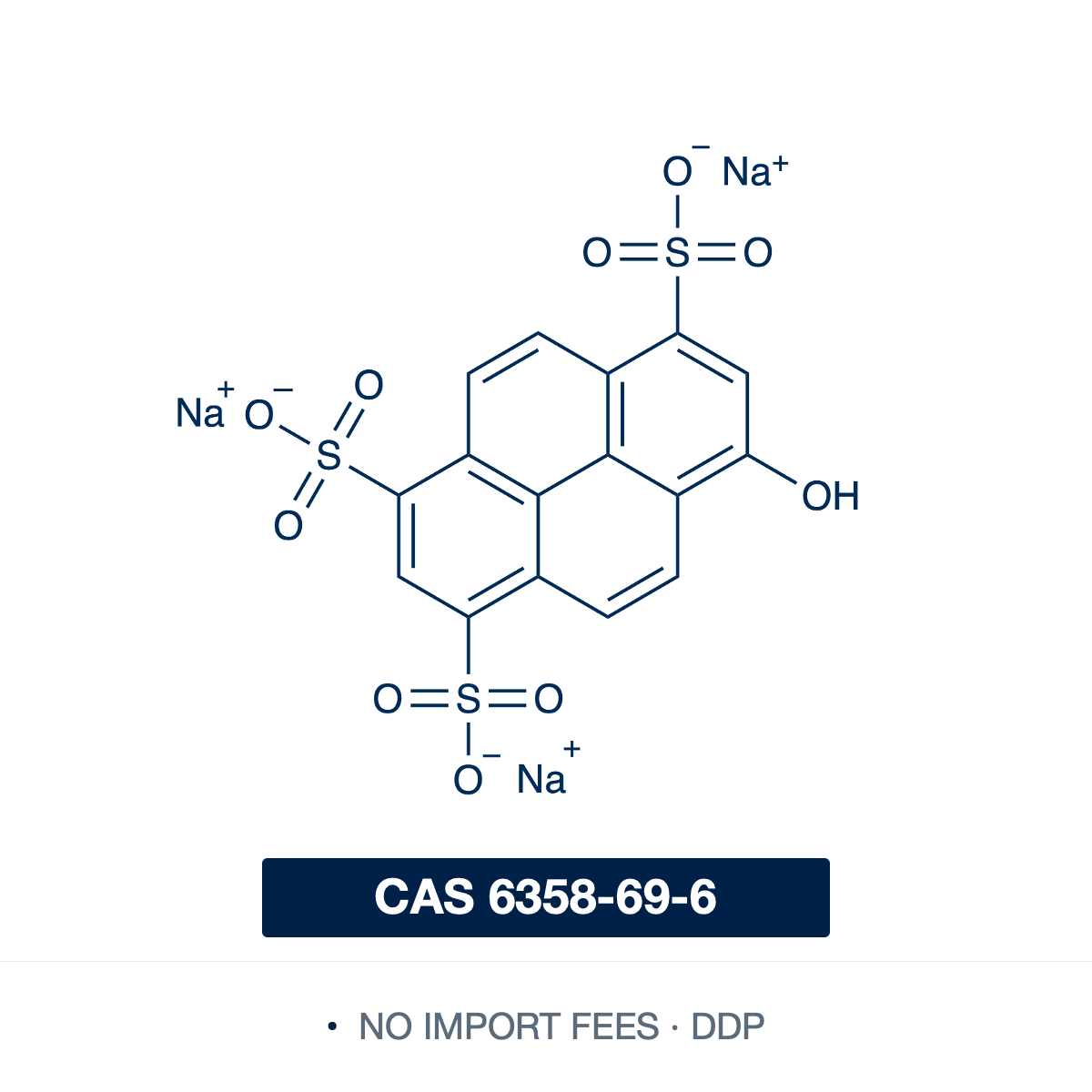
Pyranine (HPTS)
Pyranine (HPTS) | CAS 6358-69-6 | ≥85%
Couldn't load pickup availability
Technical Specifications
| CAS Number | 6358-69-6 |
| EC / EINECS Number | 228-783-6 |
| MDL Number | MFCD00037575 |
| RTECS Number | UR2700000 |
| SMILES | C1=CC2=C3C(=C(C=C2S(=O)(=O)[O-])S(=O)(=O)[O-])C=CC4=C(C=C(C1=C43)O)S(=O)(=O)[O-].[Na+].[Na+].[Na+] |
| InChI | InChI=1S/C16H10O10S3.3Na/c17-11-5-12(27(18,19)20)8-3-4-10-14(29(24,25)26)6-13(28(21,22)23)9-2-1-7(11)15(8)16(9)10;;;/h1-6,17H,(H,18,19,20)(H,21,22,23)(H,24,25,26);;;/q;3*+1/p-3 |
| InChIKey | KXXXUIKPSVVSAW-UHFFFAOYSA-K |
| PubChem CID | 61388 |
| Molecular Formula | C₁₆H₇Na₃O₁₀S₃ |
| Molecular Weight | 524.39 g/mol |
| Melting Point | >300 °C (dec.) |
| Solubility | Highly soluble in water; sparingly soluble in organic solvents |
| Purity | ≥85% |
| Physical Form | Green to dark green powder |
| HS Code | 3204.19 |
| Country of Origin | Finland |
| Shelf Life | Retest period: 36 months from date of manufacture |
| Storage Conditions | Store at room temperature in a tightly sealed container under inert atmosphere, protected from light |
Product Description & Scientific Applications
Pyranine (8-hydroxypyrene-1,3,6-trisulfonic acid trisodium salt; HPTS; C.I. 59040 / Solvent Green 7) is a water-soluble pyrene-based fluorescent dye used as both the benchmark photoacid for excited-state proton-transfer research and a long-established ratiometric pH indicator for biological and confined aqueous environments. The three sulfonate groups on the 8-hydroxypyrene scaffold confer high aqueous solubility and membrane-impermeance, while the phenolic 8-hydroxyl group defines the acid–base equilibrium underlying both the ground- and excited-state behaviour. HPTS shows two pH-dependent excitation maxima near 405 nm (protonated ROH form) and 450 nm (deprotonated RO− form), with dominant emission monitored near 510 nm, an isosbestic point near 415 nm in the absorbance/excitation spectra, and a high fluorescence quantum yield (Φf > 0.75) in water. Its ground-state pKa lies near 7.2–7.4, placing the indicator in the physiological range, while photoexcitation drops the excited-state pKa* to approximately 0.4, releasing a proton to the surrounding solvent on a picosecond timescale. The dye is supplied as a yellow to greenish-yellow crystalline powder that dissolves readily in water.
Ratiometric Fluorescent pH Measurement in Cells, Vesicles, and Confined Compartments
HPTS is one of the most widely used ratiometric fluorescent pH indicators for biological and confined aqueous compartments. The two pH-dependent excitation maxima feed a dominant emission band near 510 nm, and the I450/I405 excitation-intensity ratio gives a pH readout that is largely independent of dye loading, optical path length, and minor instrumental variation, with calibration anchored on the isosbestic point near 415 nm. Because the three sulfonate groups make the dye membrane-impermeable, cellular and organelle delivery proceeds by fluid-phase pinocytosis, microinjection, or co-encapsulation rather than passive diffusion across the bilayer. Established applications include cytosolic pH measurement after intracellular loading, endosomal and lysosomal pH determination via fluid-phase endocytic uptake, and internal pH measurement of unilamellar lipid vesicles. The same encapsulation strategy underpins liposome content-leakage and vesicle-fusion assays, in which HPTS is co-loaded with the cationic quencher DPX (p-xylene-bis-pyridinium bromide); membrane disruption or fusion-induced content mixing dilutes the quencher and dequenches HPTS fluorescence in a quantitative readout of bilayer integrity and content mixing.
Benchmark Photoacid for Excited-State Proton Transfer
HPTS is the most widely used photoacid for studies of excited-state proton transfer (ESPT) in solution and confined environments, and the canonical reference compound for the Förster-cycle framework that links ground- and excited-state acidities through the difference in absorption and emission energies. The pKa drop of approximately seven units on excitation drives proton release from the ROH* form to the surrounding water on a timescale near 110 ps, making the dye a sensitive optical reporter of local hydrogen-bond network structure, hydration-shell reorganisation, and Grotthuss-type proton diffusion. HPTS is the standard probe for confined and interfacial water in AOT reverse-micelle nanopools, lipid assemblies, polymer hydrogels, and biopolymer matrices, and is used to track proton-transfer kinetics and local hydronium-ion concentration within the nanoscopic water channels of sulfonated perfluoropolymer proton-exchange membranes used in fuel-cell research.
Fluorescent Tracer for Hydrology and Water-System Diagnostics
Pyranine is used as a fluorescent tracer in hydrogeology, environmental monitoring, and water-system flow diagnostics, where its high water solubility and bright yellow-green fluorescence under UV/blue excitation are key practical properties. Reported applications include groundwater and surface-water tracing, karst and fractured-aquifer hydrology studies, contaminant-transport investigations, flow visualisation, and leak detection in water-based plumbing and water-handling systems. Because pyranine fluorescence intensity is intrinsically pH-dependent across the relevant working range, quantitative tracer studies require pH-aware calibration so that environmental pH gradients in the test medium are not misinterpreted as changes in tracer concentration.
Fluorescent Colorant and Optical Sensor Component in Materials Research
Pyranine, indexed as Solvent Green 7 and C.I. 59040, is widely used as a fluorescent colorant and pH-responsive sensor component in materials-science and industrial research. The most prominent sensor application is in CO2-responsive optical films, where HPTS is paired with a lipophilic quaternary-ammonium counter-ion (commonly tetrabutyl- or tetraoctylammonium hydroxide) and dispersed in hydrophobic polymer matrices such as ethyl cellulose, silicone, poly(methyl methacrylate), or polyethylene; partitioning of CO2 into the film generates carbonic acid in situ, shifts the local pH, and modulates HPTS fluorescence in a quantitative response that underpins dissolved- and gaseous-CO2 optical sensors used in process monitoring, environmental analysis, and bioprocess research. The same dye is incorporated into pH-sensitive sol–gel silica and polymer microsensors for ratiometric optical pH measurement, into water-based fluorescent inks and highlighter pen formulations where its bright yellow-green fluorescence contributes the characteristic colour, and into water-based coolant and antifreeze colorant formulations.
Other Applications
- Probe for proton diffusion at membrane and protein surfaces in surface-tethered or chemisorbed forms
- Reporter for hydration-environment dynamics in protein hydrogels and biopolymer matrices
- Sensing component in viologen-based fluorescence-quenching assays for glucose and other carbohydrates
- Reagent for two-dimensional pCO2 imaging in marine sediments and overlying water columns
Shipping Destinations
- EU & UK: Priority delivery, 2–5 business days.
- United States (DDP): 3–7 business days, duties and taxes prepaid.
- EFTA Countries (DDP): 3–7 business days, duties and taxes prepaid.
- Worldwide: 7–14 business days, selected locations.
Safety Information
| Hazard Class | None — not subject to transport regulations |
| Transport Category | Not classified as dangerous goods for transport (ADR/IATA/IMDG) |
Documentation
| Safety Data Sheet | Download PDF |
Share