NorrChemica™
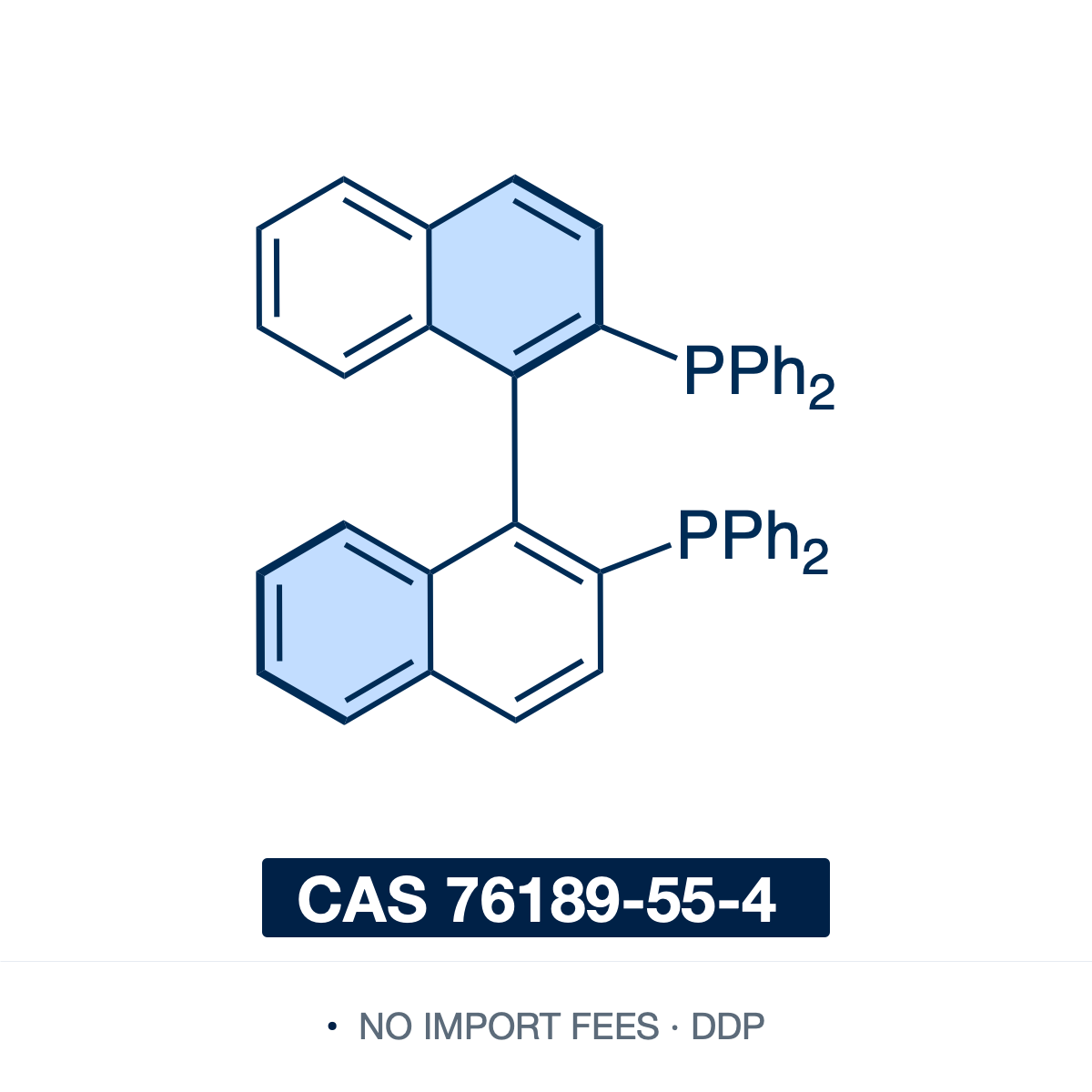
(R)-BINAP
(R)-BINAP | CAS 76189-55-4 | ≥99%
Couldn't load pickup availability
Technical Specifications
| CAS Number | 76189-55-4 |
| EC / EINECS Number | 616-304-7 |
| MDL Number | MFCD00010805 |
| SMILES | C1=CC=C(C=C1)P(C2=CC=CC=C2)C3=C(C4=CC=CC=C4C=C3)C5=C(C=CC6=CC=CC=C65)P(C7=CC=CC=C7)C8=CC=CC=C8 |
| InChI | InChI=1S/C44H32P2/c1-5-19-35(20-6-1)45(36-21-7-2-8-22-36)41-31-29-33-17-13-15-27-39(33)43(41)44-40-28-16-14-18-34(40)30-32-42(44)46(37-23-9-3-10-24-37)38-25-11-4-12-26-38/h1-32H |
| InChIKey | MUALRAIOVNYAIW-UHFFFAOYSA-N |
| PubChem CID | 634876 |
| Molecular Formula | C44H32P2 |
| Molecular Weight | 622.67 g/mol |
| Melting Point | 239-242 °C |
| Solubility | Insoluble in water, soluble in common organic solvents |
| Purity | ≥99% |
| Physical Form | White to off-white crystalline powder |
| HS Code | 2931.49 |
| Shelf Life | Retest period: 36 months from date of manufacture |
| Storage Conditions | Store in a cool, dry place in a tightly sealed container |
Product Description & Scientific Applications
(R)-BINAP ((R)-(+)-2,2'-bis(diphenylphosphino)-1,1'-binaphthyl) is a C₂-symmetric atropisomeric diphosphine and a landmark chiral ligand in asymmetric catalysis. Its chirality is axial rather than centred on a stereogenic atom: restricted rotation about the 1,1'-binaphthyl bond locks the two naphthyl units into a fixed, twisted arrangement, and on chelation to a metal the two diphenylphosphino groups define a rigid C₂-symmetric chiral pocket. (R)-BINAP is the antipode of (S)-BINAP — identical in constitution but opposite in axial sense — providing the opposite-handed catalyst environment, so the two enantiomers are commonly selected as a matched pair when either product configuration is required under a given catalyst system.
Structure and stereochemical basis
The axial chirality of BINAP is configurationally robust: computed enantiomerisation barriers exceed 200 kJ·mol⁻¹, with a calculated racemisation temperature near 490 °C, so the resolved atropisomers are configurationally stable under ordinary laboratory handling and catalytic-use conditions. On binding a metal through both phosphorus atoms, the two diphenylphosphino groups project their P-phenyl rings into a C₂-symmetric array of alternating steric quadrants around the metal centre. Because the ligand is C₂-symmetric, its two phosphorus donors are equivalent, reducing the number of competing diastereomeric substrate-binding arrangements; this quadrant-controlled steric environment is a major structural basis for BINAP's high enantioselectivity and underlies its standing as a privileged chiral ligand.
Ruthenium-catalysed asymmetric hydrogenation
Ru–BINAP complexes are central to Noyori asymmetric hydrogenation chemistry. They reduce β-keto esters to β-hydroxy esters in high enantiomeric excess and, through dynamic kinetic resolution of configurationally labile α-substituted β-keto esters, can set two stereocentres in a single operation. The scope extends to β-functionalised ketones, allylic and homoallylic alcohols — the chemoselective hydrogenation of geraniol to citronellol is a well-documented example — and to enamides and α-(acylamino)acrylates used to prepare enantioenriched amine and amino-acid derivatives, including tetrahydroisoquinoline alkaloid frameworks. Paired with a 1,2-diamine, BINAP/diamine–Ru systems hydrogenate simple and functionalised ketones chemoselectively in the presence of olefins; in optimised systems, turnover numbers above 100,000 have been reported.
Rhodium-catalysed asymmetric transformations
Rh–BINAP catalyses the enantioselective isomerisation of allylic amines to enamines; the diethylgeranylamine-to-citronellal-enamine transformation is the key asymmetric step in an industrial route to (−)-menthol, reported with high enantioselectivity and turnover numbers above 400,000. Rh–BINAP systems also feature in the asymmetric hydrogenation of enamides and in Hayashi–Miyaura-type asymmetric 1,4-addition of aryl- and alkenylboronic acids to enones and other α,β-unsaturated carbonyl compounds.
Palladium-catalysed asymmetric catalysis
Pd–BINAP systems mediate asymmetric allylic substitution and amination through chiral η³-allylpalladium intermediates; the allylation of unsymmetrical 1,3-diketones to chiral 2,2-dialkyl-1,3-diketones is a representative example. They are also prominent in asymmetric Heck chemistry, including intramolecular cyclisations where alkene carbopalladation forms C–C bonds and can establish tertiary or all-carbon quaternary stereocentres. Pd–BINAP was likewise among the first-generation catalyst systems for Buchwald–Hartwig C–N coupling, joining aryl halides and triflates with amines.
Gold and broader asymmetric catalysis
Beyond the group 8–10 metals, binuclear gold(I)–BINAP complexes are among the most-studied catalysts for enantioselective π-acid transformations, including cycloisomerisations of 1,n-enynes, cyclopropanations, and alkene hydrofunctionalisations. More broadly, BINAP is a parent scaffold for a family of axially chiral diphosphines — including tolyl- and xylyl-substituted variants tuned for steric bulk and electronic donation — and a reference ligand for assembling well-defined chiral metal complexes in mechanistic, structural, and asymmetric-induction studies. Its rigid C₂-symmetric pocket and broad metal compatibility make it a common reference ligand in catalyst screening for chiral alcohol, amine, and carbonyl-derived building blocks, typically deployed alongside (S)-BINAP when both senses of enantioselectivity are required.
Shipping Destinations
- EU & UK: Priority delivery, 2–5 business days.
- United States (DDP): 3–7 business days, duties and taxes prepaid.
- EFTA Countries (DDP): 3–7 business days, duties and taxes prepaid.
- Worldwide: 7–14 business days, selected locations.
Safety Information
| Hazard Class | Not regulated for transport |
| Transport Category | Not classified as dangerous goods for transport (ADR/IATA/IMDG) |
Documentation
| Safety Data Sheet | Download PDF |
Share