NorrChemica™
Resazurin Sodium Salt
Resazurin Sodium Salt | CAS 62758-13-8 | ≥90.0%
Couldn't load pickup availability
Technical Specifications
| CAS Number | 62758-13-8 |
| EC / EINECS Number | 263-718-5 |
| MDL Number | MFCD00005036 |
| RTECS Number | SP7700000 |
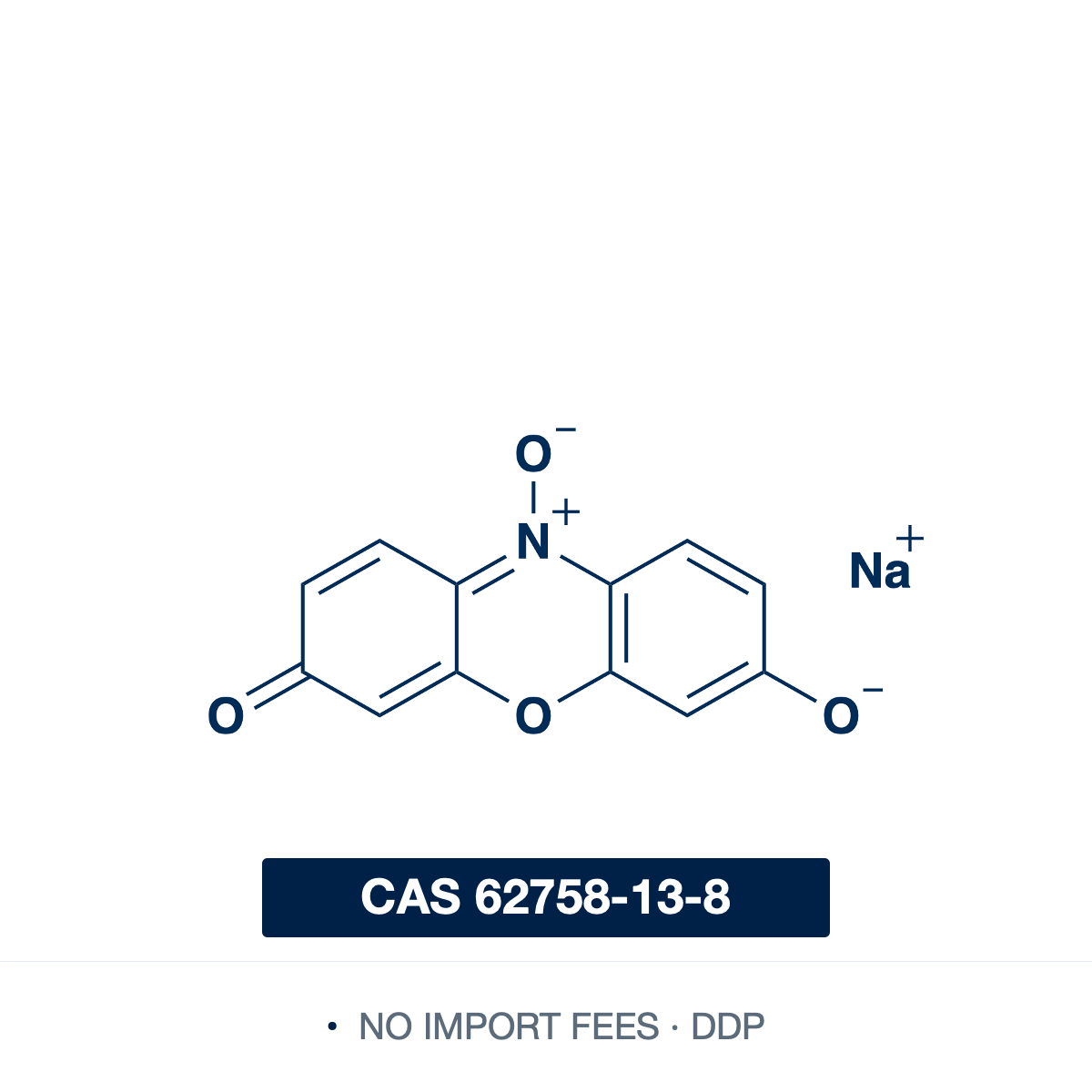
| SMILES | C1=CC2=C(C=C1[O-])OC3=CC(=O)C=CC3=[N+]2[O-].[Na+] |
| InChI | InChI=1S/C12H7NO4.Na/c14-7-1-3-9-11(5-7)17-12-6-8(15)2-4-10(12)13(9)16;/h1-6,14H;/q;+1/p-1 |
| InChIKey | IVGPGQSSDLDOLH-UHFFFAOYSA-M |
| PubChem CID | 112939 |
| Molecular Formula | C₁₂H₆NNaO₄ |
| Molecular Weight | 251.17 g/mol |
| Solubility | Soluble in water (~10 mg/mL); soluble in DMSO |
| Purity | ≥90.0% |
| Physical Form | Purple-Blue powder |
| HS Code | 3204.90 |
| Country of Origin | Finland |
| Shelf Life | Retest period: 24 months from date of manufacture. |
| Storage Conditions | Store in a cool, dry place in a tightly sealed container, protected from light. |
Product Description & Scientific Applications
Resazurin Sodium Salt (CAS 62758-13-8) is a water-soluble phenoxazine N-oxide dye used as a fluorogenic oxidation-reduction indicator. Its defining chemistry is the resazurin-resorufin-dihydroresorufin redox sequence: under reducing biological or chemical conditions blue-violet resazurin is converted to pink/red-fluorescent resorufin, while stronger reducing conditions can further convert it to colourless, non-fluorescent dihydroresorufin. Resazurin has an absorption maximum around 598–602 nm with weak fluorescence, whereas resorufin absorbs around 570–575 nm and emits strongly near 585–590 nm, a high-contrast signal. This fluorescence is pH-dependent: below resorufin's pKa of approximately 6.0, absorbance shifts and quantum yield fall. Intense or prolonged excitation can cause photobleaching.
Cell Viability, Proliferation, and Cytotoxicity Research
In viable cells, resazurin reduction reports intracellular reducing capacity, not membrane integrity alone, and is associated with NADH- and NADPH-linked oxidoreductase activity in cytosolic and mitochondrial compartments. Widely used to estimate viable mammalian cells in 96- and 384-well formats, it is cell-permeable, non-lytic, and yields soluble resorufin, avoiding the formazan solubilisation required by MTT-style tetrazolium reagents. Calibrated assays support concentration-response analysis, IC50 determination, and proliferation monitoring.
Microbial Viability and Growth-Inhibition Research
It is a metabolic indicator with low cytotoxicity for bacterial, yeast, fungal, and mycobacterial viability; metabolically active organisms reduce it to resorufin for visual, absorbance, or fluorescence readouts. This suits low-density, slow-growing, biofilm-associated, or weakly turbid systems where optical density is insensitive, supporting antimicrobial profiling, MIC determination, and growth-inhibition kinetics.
Enzymology, Anaerobic Indicator Use, and Electroanalysis
In coupled enzymatic assays, resazurin serves as the fluorogenic reporter. A target reaction generates NADH or NADPH, and a diaphorase or related reductase then uses it to reduce resazurin to resorufin, which allows continuous monitoring of dehydrogenase-linked activity. A structurally related phenoxazine, 10-acetyl-3,7-dihydroxyphenoxazine, behaves similarly: in the presence of horseradish peroxidase it reacts stoichiometrically with hydrogen peroxide to give the same resorufin chromophore, extending the phenoxazine scaffold to oxidase- and peroxidase-coupled assays. In anaerobic culture, the dye's colour reports the redox state of the medium — pink or red indicates oxygen exposure or insufficiently reducing conditions, while white or colourless indicates strongly reducing, anaerobic conditions. Its phenoxazine N-oxide structure is also redox-active, making resazurin a probe for electroanalysis.
Other Applications
- Classical microbial-contamination and milk-quality research
- Environmental microbiology, water-quality, sediment, and wastewater redox studies
- Reproductive-biology research
Shipping Destinations
- EU & UK: Priority delivery, 2–5 business days.
- United States (DDP): 3–7 business days, duties and taxes prepaid.
- EFTA Countries (DDP): 3–7 business days, duties and taxes prepaid.
- Worldwide: 7–14 business days, selected locations.
Safety Information
| GHS Pictograms |

|
| Signal Word | Warning |
| Hazard Class | None — not subject to transport regulations |
| Transport Category | Not classified as dangerous goods for transport (ADR/IATA/IMDG) |
| H-Statements | H315 - H319 - H335 |
| P-Statements | P233 - P261 - P264 - P270 - P271 - P280 - P301+P312 - P302+P352 - P304+P340 - P305+P351+P338 - P312 - P332+P313 - P337+P313 - P362+P364 - P403+P233 - P405 - P501 |
Documentation
| Safety Data Sheet | Download PDF |