NorrChemica™
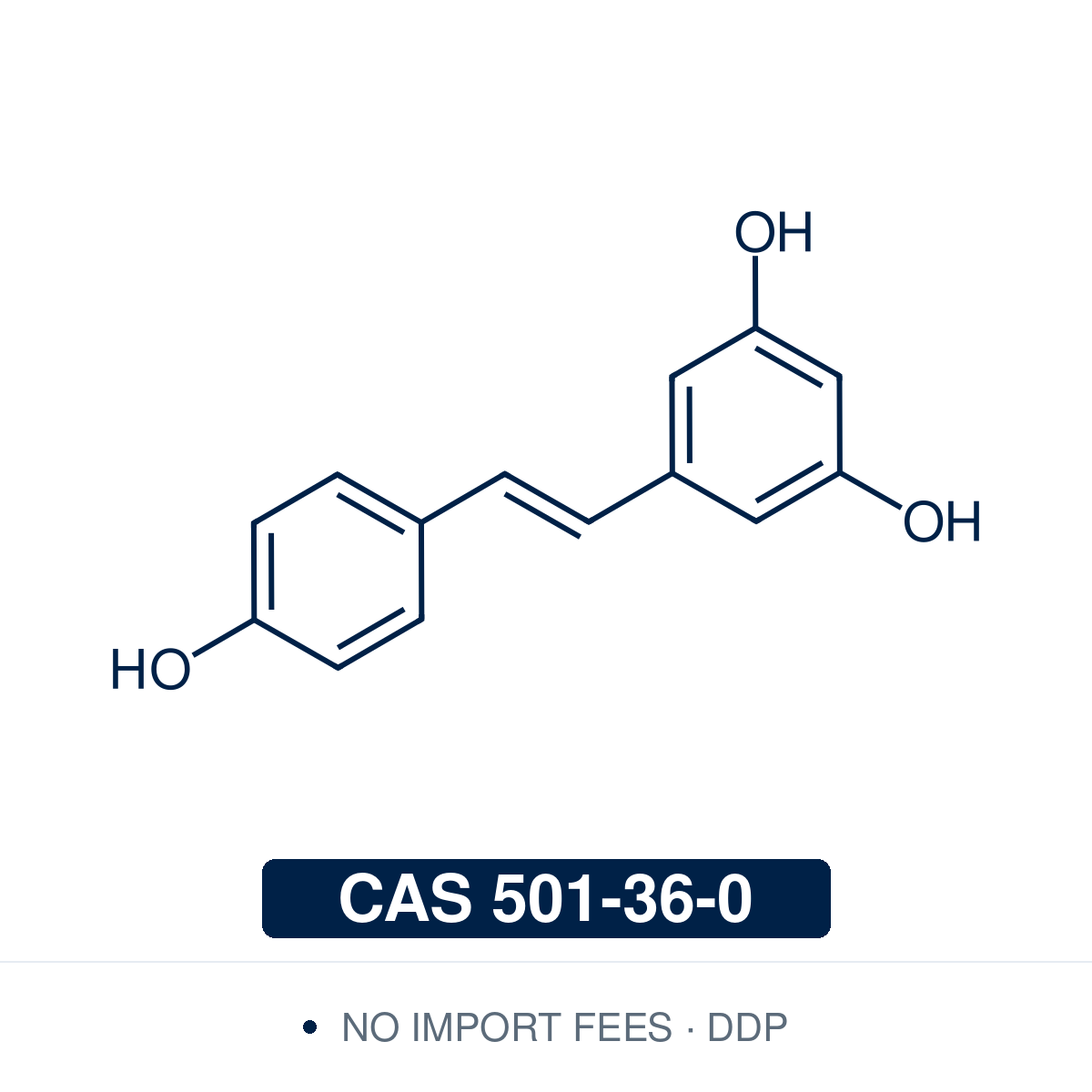
trans-Resveratrol
trans-Resveratrol | CAS 501-36-0 | >99.0%
Couldn't load pickup availability
Technical Specifications
| CAS Number | 501-36-0 |
| EC / EINECS Number | 610-504-8 |
| MDL Number | MFCD00005765 |
| SMILES | C1=CC(=CC=C1/C=C/C2=CC(=CC(=C2)O)O)O |
| InChI | InChI=1S/C14H12O3/c15-12-5-3-10(4-6-12)1-2-11-7-13(16)9-14(17)8-11/h1-9,15-17H/b2-1+ |
| InChIKey | LUKBXSAWLPMMSZ-OWOJBTEDSA-N |
| PubChem CID | 445154 |
| Molecular Formula | C₁₄H₁₂O₃ |
| Molecular Weight | 228.24 g/mol |
| Melting Point | 253–257 °C |
| Solubility | ~30 mg/L in water (25 °C); soluble in ethanol, DMSO, acetone |
| Log Pow | 3.1 |
| Purity | ≥99.0% |
| Physical Form | Off-white to light beige crystalline powder |
| HS Code | 2932.99 |
| Country of Origin | Finland |
| Shelf Life | Retest period: 24 months from date of manufacture. |
| Storage Conditions | Store frozen (−20 °C) in a tightly sealed container, protected from light and moisture. |
Product Description & Scientific Applications
trans-Resveratrol (3,5,4′-trihydroxy-trans-stilbene) is a naturally occurring stilbenoid polyphenol and classical phytoalexin found in grapevine, Japanese knotweed, and peanut. The trans-isomer is the common research form and is light-sensitive, photoisomerising to cis-resveratrol under UV.
UV chromophore and photoisomerisation. The trans-stilbene chromophore shows strong UV absorption around 305–308 nm, with ε ≈ 3.0 × 10⁴ M⁻¹cm⁻¹ at 308 nm in ethanol; solvent- and medium-dependent bands around 320 nm have also been reported. UV irradiation gives cis-resveratrol (λmax ≈ 286–288 nm), the trans/cis ratio depending on wavelength, exposure time, concentration, medium, and light source — supporting photostability and isomer-separation studies.
Stilbene phytoalexin biosynthesis. It is formed by stilbene synthase (STS; EC 2.3.1.95), a type III polyketide synthase that condenses one 4-coumaroyl-CoA starter and three malonyl-CoA extender units by decarboxylative condensation and cyclises the resulting linear tetraketide by an aldol route. STS and chalcone synthase share these substrates and intermediate but differ in ring closure (resveratrol vs naringenin chalcone). STS expression and resveratrol accumulation are induced by biotic, UV, and abiotic stress — a model in plant-defence and metabolic-engineering studies.
Antioxidant comparator polyphenol. Its three phenolic hydroxyls on a conjugated stilbene make it a widely used comparator in DPPH, ABTS, FRAP, and ORAC antioxidant-assay studies, where no single assay gives a universal capacity ranking.
Chemical-biology probe. It is used in SIRT1, AMPK, PGC-1α, autophagy, COX-1, and NF-κB research; direct SIRT1 activation is substrate-dependent, with documented reliance on fluorophore-modified peptide substrates, so it is best treated as a benchmark probe rather than a single-target standard.
Analytical standard and SAR scaffold. It is quantified by HPLC, UHPLC, LC-MS/MS, and fluorescence methods in plant, food, and beverage matrices (trans/cis separation and light protection matter), and serves as a reference scaffold for structure–property comparison with pterostilbene, piceatannol, and oxyresveratrol.
Shipping Destinations
- EU & UK: Priority delivery, 1–2 business days
-
EFTA Countries (DDP): 1–2 business days, duties and taxes prepaid.
Safety Information
| GHS Pictograms |

|
| Signal Word | Warning |
| Hazard Class | None — not subject to transport regulations |
| Transport Category | Not classified as dangerous goods for transport (ADR/IATA/IMDG) |
| H-Statements | H319 |
| P-Statements | P261 - P264 - P270 - P280 - P305+P351+P338 - P337+P313 - P403+P233 - P501 |
Documentation
| Safety Data Sheet | Download PDF |