NorrChemica™
Rhodamine 6G
Rhodamine 6G | CAS 989-38-8 | Dye Content ≥90%
Couldn't load pickup availability
Technical Specifications
| CAS Number | 989-38-8 |
| EC / EINECS Number | 213-584-9 |
| MDL Number | MFCD00012665 |
| RTECS Number | DH0175000 |
| SMILES | CCNC1=CC2=C(C=C1C)C(=C3C=C(C(=[NH+]CC)C=C3O2)C)C4=CC=CC=C4C(=O)OCC.[Cl-] |
| InChI | InChI=1S/C28H30N2O3.ClH/c1-6-29-23-15-25-21(13-17(23)4)27(19-11-9-10-12-20(19)28(31)32-8-3)22-14-18(5)24(30-7-2)16-26(22)33-25;/h9-16,29H,6-8H2,1-5H3;1H |
| InChIKey | VYXSBFYARXAAKO-UHFFFAOYSA-N |
| PubChem CID | 13806 |
| Molecular Formula | C₂₈H₃₁ClN₂O₃ |
| Molecular Weight | 479.01 g/mol |
| Melting Point | >229.4 °C (ECHA) |
| Solubility | ~77.9 g/L in water (20 °C, ECHA) |
| Log Pow | 0.1 (24 °C, ECHA) |
| Purity | Dye Content ≥90% |
| Physical Form | Dark green crystalline powder |
| HS Code | 3204.13 |
| Country of Origin | Finland |
| Shelf Life | Retest period: 36 months from date of manufacture |
| Storage Conditions | Store refrigerated (2–8 °C) in a tightly sealed container, protected from light |
Product Description & Scientific Applications
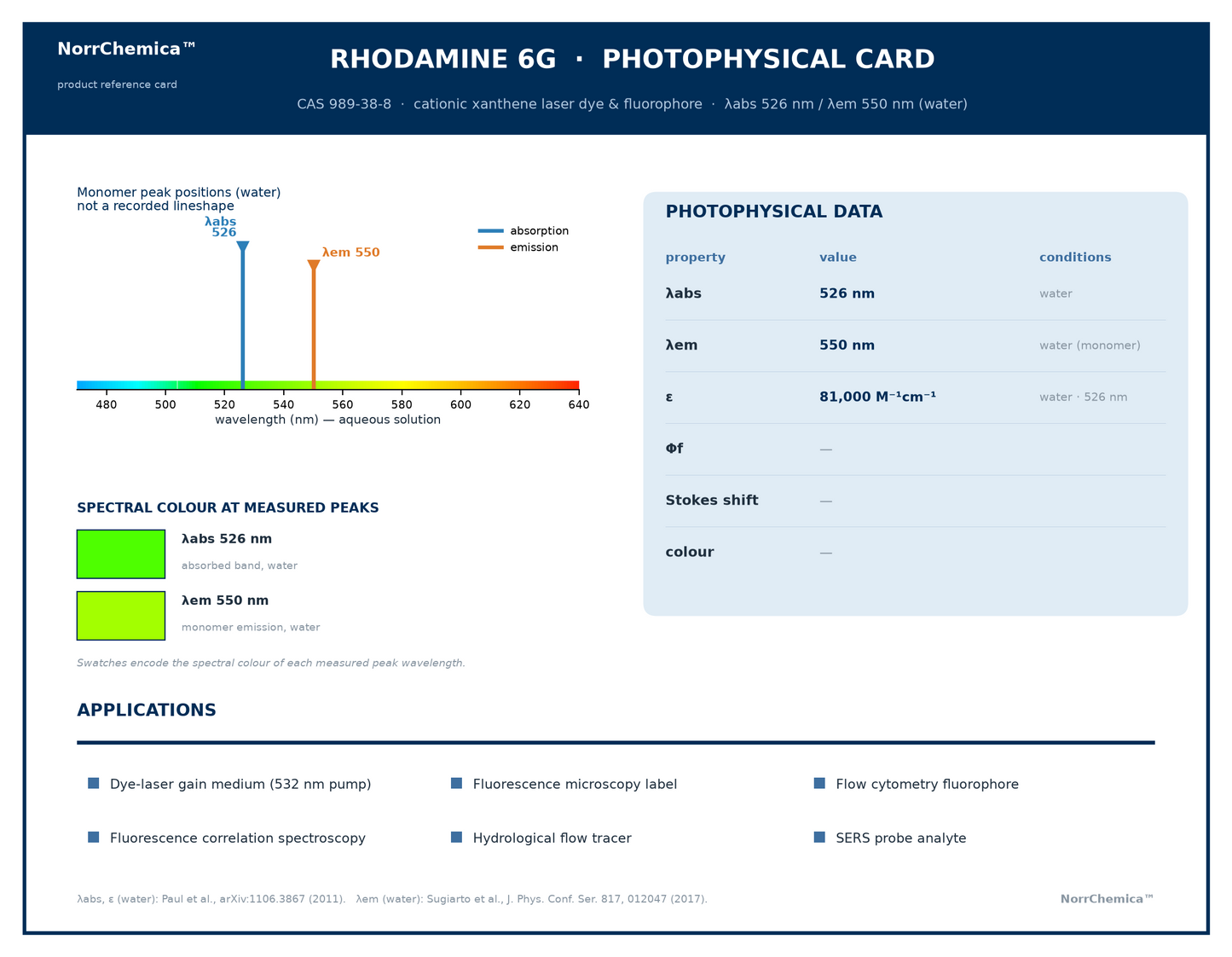
Rhodamine 6G (R6G; Basic Red 1) is a cationic xanthene dye used as a high-brightness fluorophore, classical dye-laser gain medium, and reference/test probe in fluorescence photophysics, SERS, bioanalytical, and materials research. In ethanol it shows a visible absorption maximum near 530 nm, emission near 552 nm, ε ≈ 116 000 M⁻¹cm⁻¹, and a fluorescence quantum yield close to 0.95 — making it an important quantum-yield reference standard, alongside fluorescein and quinine sulfate. It is also highly photostable.
Tunable dye lasers and quantitative photophysics. R6G is a classical gain medium for tunable liquid dye lasers in the yellow-orange. The emission window is system-dependent (solvent, dye salt, concentration, pump, cavity), typically centred 560–610 nm with peaks near 575–590 nm. It combines strong pump absorption matching common sources (frequency-doubled Nd:YAG 532 nm, copper-vapour 511 nm, argon-ion 514 nm), high fluorescence efficiency, broad emission bandwidth, and good photostability — supporting high-resolution atomic and molecular spectroscopy, laser-induced fluorescence, beam diagnostics, and work needing continuous wavelength tunability. It is also a standard in fluorescence-correlation-spectroscopy calibration and diffusion-coefficient method development.
Mitochondrial membrane potential and ABC-transporter research. As a lipophilic cation, R6G accumulates in mitochondria in a membrane-potential-dependent manner, supporting ΔΨm-linked bioenergetics readouts; rhodamine 123, TMRM, and TMRE are the more standard ΔΨm probes, with TMRM and TMRE showing lower potential-independent binding than R6G, and as with all cationic potential-sensitive dyes, accumulation, quenching, efflux, concentration, and cell-type effects demand calibration and controls. It is also a fluorescent substrate for ATP-binding-cassette transporters including P-glycoprotein/ABCB1 and MRP1, supporting flow-cytometric, imaging, and kinetic characterisation of dye accumulation and efflux; MRP1-mediated transport is glutathione-dependent in living cells, useful in mechanistic transporter and substrate-modulator studies.
SERS, TERS, and plasmonic substrate characterisation. R6G is the benchmark SERS analyte: strong visible absorption compatible with resonant or near-resonant 514/532 nm excitation, while 633 nm is also widely used in R6G SERS; high resonance-Raman/SERRS response; and a well-characterised vibrational fingerprint of multiple distinct intense peaks. It is routinely used to evaluate silver and gold colloids; electrodeposited, printed/flexible, nanoimprinted, or lithographically patterned substrates; plasmonic metasurfaces; and TERS systems, comparing enhancement factors, hot-spot behaviour, reproducibility, and detection limits. Foundational single-molecule SERS and modern ultrasensitive demonstrations use R6G as test analyte; reported enhancements and detection limits — including sub-femtomolar (~10⁻¹⁶ M) on optimised silver colloids — are strongly substrate-dependent, not intrinsic to the dye.
Tracer, photocatalysis, and materials research. Its intense fluorescence makes R6G a convenient visible-light tracer in microfluidics, environmental hydraulics, flow visualisation, mixing, and droplet analysis, and a latent-fingerprint visualisation reagent in forensic surface-treatment workflows. It is also a model cationic dye in adsorption, photocatalytic-degradation, and dye-removal studies on TiO₂, ZnO and other metal oxides, activated carbons, clays, MOF-based materials, and engineered nanomaterials, giving convenient absorbance or fluorescence readouts for degradation kinetics, adsorption capacity, surface interaction, and catalyst-performance comparison.
Shipping Destinations
- EU & UK & Switzerland only: 3–7 business days.
Safety Information
| GHS Pictograms |


|
| Signal Word | Danger |
| Hazard Class | UN2811 — Toxic solid, organic, n.o.s. (Class 6.1, PG III) |
| Transport Category | DG — Class 6.1, PG III (ADR/IATA/IMDG) |
| H-Statements | H301 - H317 - H318 - H410 |
| P-Statements | P261 - P273 - P280 - P301+P310 - P302+P352 - P305+P351+P338 - P391 - P501 |
Documentation
| Safety Data Sheet | Download PDF |