NorrChemica™
Rhodamine B
Rhodamine B | CAS 81-88-9 | ≥97%
| Pack size | Excl. VAT | Incl. VAT | Add to cart |
|---|---|---|---|
| 5.0 g | €29,90 | ||
| 10 g | €34,20 | ||
| 25 g | €43,20 | ||
| 50 g | €69,20 | ||
| 100 g | €98,20 |
Taxes and fees, e.g. VAT, included in the price. Shipping calculated at checkout.Free shipping on EU, UK and EFTA orders above €250, and above €400 to the rest of the world.
Technical Specifications
| CAS Number | 81-88-9 |
| EC / EINECS Number | 201-383-9 |
| MDL Number | MFCD00011931 |
| RTECS Number | BP3675000 |
| SMILES | CCN(CC)C1=CC2=C(C=C1)C(=C3C=CC(=[N+](CC)CC)C=C3O2)C4=CC=CC=C4C(=O)O.[Cl-] |
| InChI | InChI=1S/C28H30N2O3.ClH/c1-5-29(6-2)19-13-15-23-25(17-19)33-26-18-20(30(7-3)8-4)14-16-24(26)27(23)21-11-9-10-12-22(21)28(31)32;/h9-18H,5-8H2,1-4H3;1H |
| InChIKey | PYWVYCXTNDRMGF-UHFFFAOYSA-N |
| PubChem CID | 6694 |
| Molecular Formula | C₂₈H₃₁ClN₂O₃ |
| Molecular Weight | 479.0 g/mol |
| Melting Point | 210–211 °C (dec.) |
| Solubility | Soluble in water, benzene and ethanol. Slightly soluble in acetone, hydrochloric acid, sodium hydroxide, methyl cellosolve and alcohol. |
| Purity | ≥97% |
| Physical Form | Green crystals or reddish-violet powder |
| HS Code | 3204.13 |
| Shelf Life | Retest period: 36 months from date of manufacture |
| Storage Conditions | Store at room temperature. Keep container tightly closed in a dry, cool and well-ventilated place |
Product Description & Scientific Applications
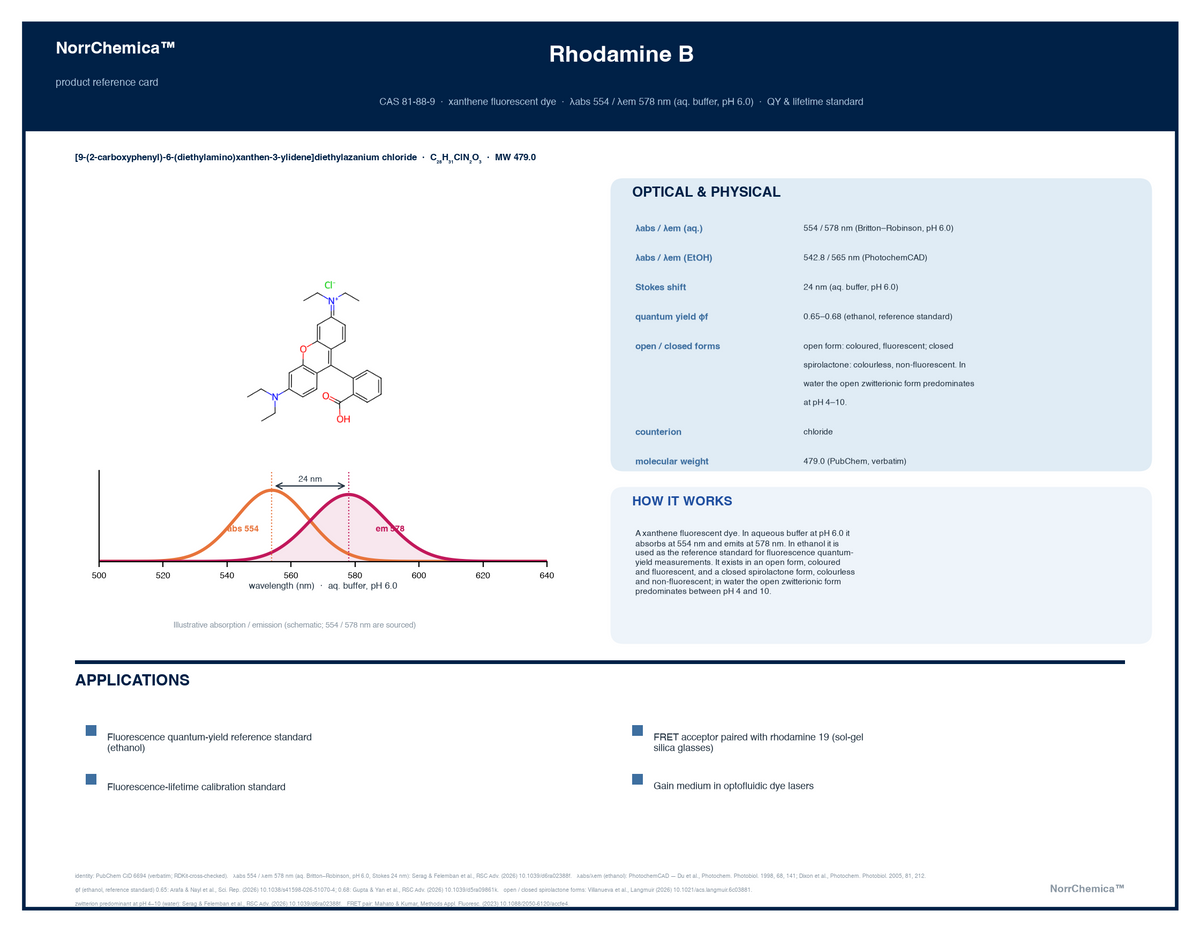
Rhodamine B (C.I. 45170; Basic Violet 10) is a xanthene fluorescent dye. In ethanol it absorbs at 542.8 nm and emits at 565 nm. In aqueous Britton–Robinson buffer at pH 6.0 it absorbs at 554 nm and emits at 578 nm. At high concentration its fluorescence quantum yield decreases considerably, which is attributed to the formation of dimers.
Open and closed forms. Rhodamine B exists in an open form, which is coloured and fluorescent, and in a closed spirolactone form, which is colourless and non-fluorescent. In aqueous solution the open, zwitterionic form predominates between pH 4 and 10.
Fluorescence standards. In ethanol, rhodamine B is used as the reference standard for relative fluorescence quantum-yield measurements, with reported quantum yields of 0.65–0.68. It is also one of the fluorescence-lifetime standards, established by measurements in nine laboratories, that are used to calibrate or test time-domain and frequency-domain instruments.
Temperature sensing. Among seven water-soluble rhodamine dyes characterised for laser-induced fluorescence thermometry, rhodamine B showed the largest temperature sensitivity: its emission intensity falls as temperature rises. Its absorption spectrum does not change with temperature, so the sensitivity is attributed to changes in quantum yield.
Donor–acceptor pairs. With rhodamine 19 as the donor, rhodamine B is the acceptor in sol-gel silica glasses used to study FRET efficiency and antenna-effect efficiency.
Ion chemosensors. Rhodamine-based probes switch their fluorescence on when metal-ion binding opens their spirolactam ring. In a rhodamine B-based probe for the selective detection of Fe³⁺, this ring opening changes the solution from colourless to deep pink.
Polymer nanoparticles. Rhodamine B conjugated to poly(ε-caprolactone) stably labels self-assembled polymeric nanoparticles. The label is detected quantitatively by UPLC, so the fate of these drug-delivery carriers can be followed in vitro and in vivo.
Optofluidic lasers. Rhodamine B is a gain medium for optofluidic dye lasers. In aqueous solution, the surfactant sodium dodecylbenzene sulfonate prevents the dye from self-associating, which raises its fluorescence quantum yield and gives a low lasing threshold in a whispering-gallery-mode fibre laser.
Water tracing. Rhodamine B is used as a fluorescent water tracer.
Shipping Destinations
- EU & UK: Priority delivery, 2–5 business days.
- United States (DDP): 3–7 business days, duties and taxes prepaid.
- EFTA Countries (DDP): 3–7 business days, duties and taxes prepaid.
- Worldwide: 7–14 business days, selected locations.
Safety Information
| GHS Pictograms |


|
| Signal Word | Danger |
| Hazard Class | Not classified as dangerous goods |
| Transport Category | Not dangerous goods (ADR/IATA/IMDG) |
| H-Statements | H302 - H318 - H412 |
| P-Statements | P264 - P270 - P273 - P280 - P305+P351+P338 - P310 - P330 - P403 - P501 |
Documentation
| Safety Data Sheet | Download PDF |