NorrChemica™
Rose Bengal Sodium
Rose Bengal Sodium | CAS 632-69-9 | Dye Content ≥80%
Couldn't load pickup availability
Technical Specifications
| CAS Number | 632-69-9 |
| EC / EINECS Number | 211-183-3 |
| MDL Number | MFCD00005043 |
| RTECS Number | LM5920000 |
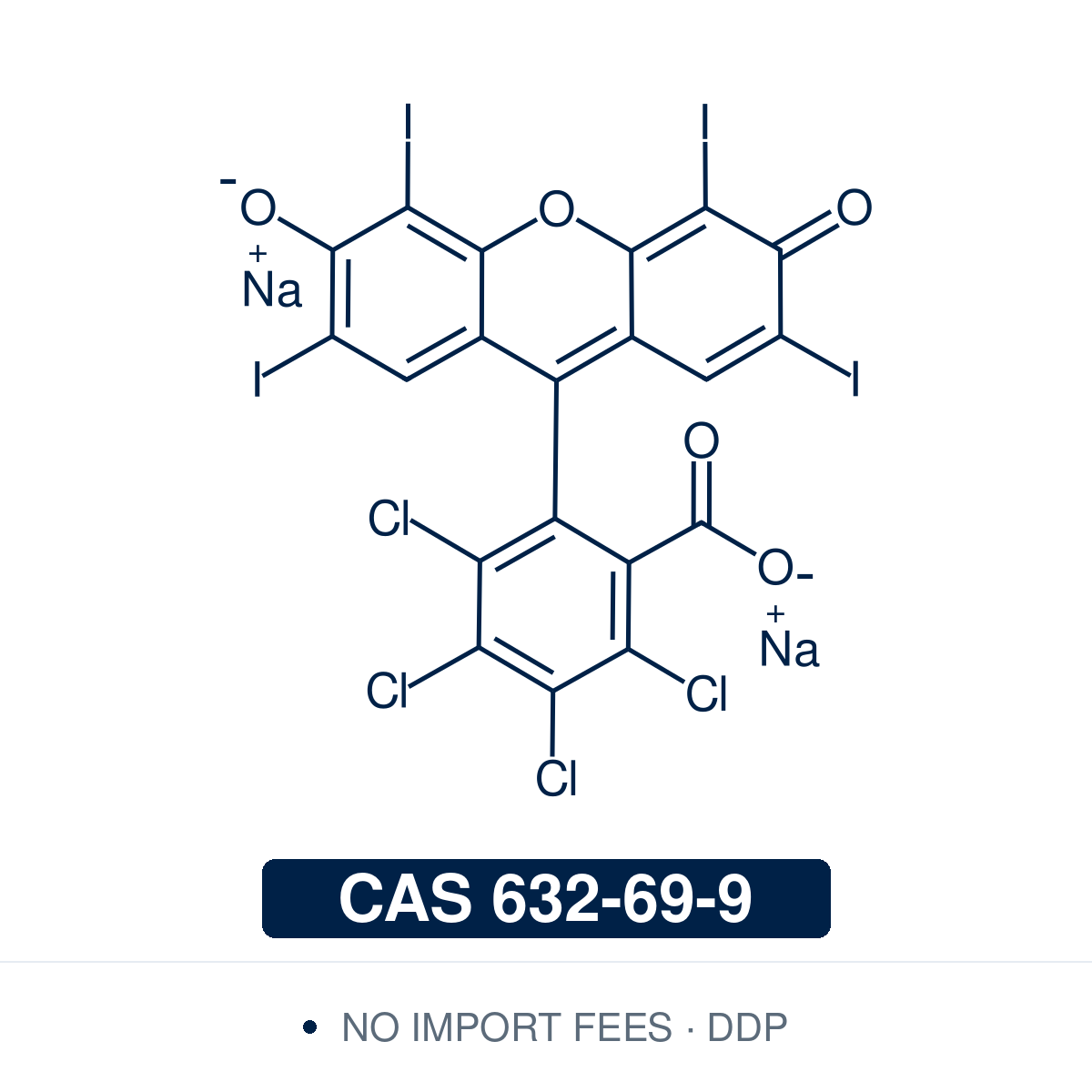
| SMILES | C1=C2C(=C3C=C(C(=O)C(=C3OC2=C(C(=C1I)[O-])I)I)I)C4=C(C(=C(C(=C4Cl)Cl)Cl)Cl)C(=O)[O-].[Na+].[Na+] |
| InChI | InChI=1S/C20H4Cl4I4O5.2Na/c21-10-8(9(20(31)32)11(22)13(24)12(10)23)7-3-1-5(25)16(29)14(27)18(3)33-19-4(7)2-6(26)17(30)15(19)28;;/h1-2,29H,(H,31,32);;/q;2*+1/p-2 |
| InChIKey | UWBXIFCTIZXXLS-UHFFFAOYSA-L |
| PubChem CID | 32343 |
| Molecular Formula | C₂₀H₂Cl₄I₄Na₂O₅ |
| Molecular Weight | 1017.64 g/mol |
| Melting Point | >300 °C (dec.) |
| Solubility | Soluble in water, methanol, ethanol, DMSO |
| Purity | ≥80% (Dye Content) |
| Physical Form | Red to dark-violet crystalline powder |
| HS Code | 3204.90 |
| Shelf Life | Retest period: 36 months from date of manufacture |
| Storage Conditions | Store at room temperature in a tightly sealed container under inert atmosphere, protected from light |
Product Description & Scientific Applications
Rose Bengal Sodium is an anionic xanthene dye, the most heavily halogenated fluorescein — four chlorines on the benzoate ring, four iodines on the xanthene chromophore. The heavy iodines drive intersystem crossing (heavy-atom effect) to a long-lived triplet that sensitises O₂ to singlet oxygen (¹O₂); the tetrachloro/tetraiodo framework red-shifts absorption relative to fluorescein and eosin Y. In water it absorbs near 548 nm and emits near 567 nm.
Reference photosensitizer for singlet oxygen. Under green light it is a high-yield ¹O₂ sensitiser, Φ(¹O₂) ≈ 0.75 in water. A benchmark alongside methylene blue and porphyrins for calibrating photosensitizers and determining ¹O₂ quantum yields by phosphorescence at 1270 nm. As a ¹O₂ source it drives [4+2] cycloaddition to endoperoxides, ene reactions to allylic hydroperoxides, and oxidation of sulfides, phenols, and electron-rich heteroaromatics. Solutions are light-sensitive.
Visible-light organophotocatalyst. A metal-free, low-cost organophotocatalyst whose triplet is the reactive species under green-LED, mediating aerobic hydroxylation of organoboron compounds, C–H functionalisation of tertiary amines via α-amino radicals, sulfonylations, and thiol-ene additions through oxidative/reductive quenching, energy transfer, or singlet-oxygen pathways. Complements rather than replaces ruthenium and iridium polypyridyl photocatalysts, which cover different redox territory.
Radical photoinitiator. A visible-light photoinitiator component for radical photopolymerisation, including thiol-ene and acrylate formulations.
Biological stain. In mycology it is the selective agent in Rose Bengal–Chloramphenicol Agar for enumerating yeasts and moulds, restricting mould spreading while chloramphenicol suppresses bacteria. In marine biology it is the traditional protoplasm stain for benthic foraminifera, distinguishing cytoplasm-containing from empty tests — though dead or preserved cytoplasm also retains stain, so staining is not proof of living status.
Model anionic dye. A visible-absorbing anionic test dye for adsorption, membrane, and photodegradation studies, tracked by UV–vis; as a ¹O₂ sensitiser its own degradation includes self-sensitised photodegradation, not only external photocatalysis.
Shipping Destinations
- EU & UK: Priority delivery, 2–5 business days.
- United States (DDP): 3–7 business days, duties and taxes prepaid.
- EFTA Countries (DDP): 3–7 business days, duties and taxes prepaid.
- Worldwide: 7–14 business days, selected locations.
Safety Information
| Hazard Class | None — not subject to transport regulations |
| Transport Category | Not classified as dangerous goods for transport (ADR/IATA/IMDG) |
Documentation
| Safety Data Sheet | Download PDF |
Share