NorrChemica™
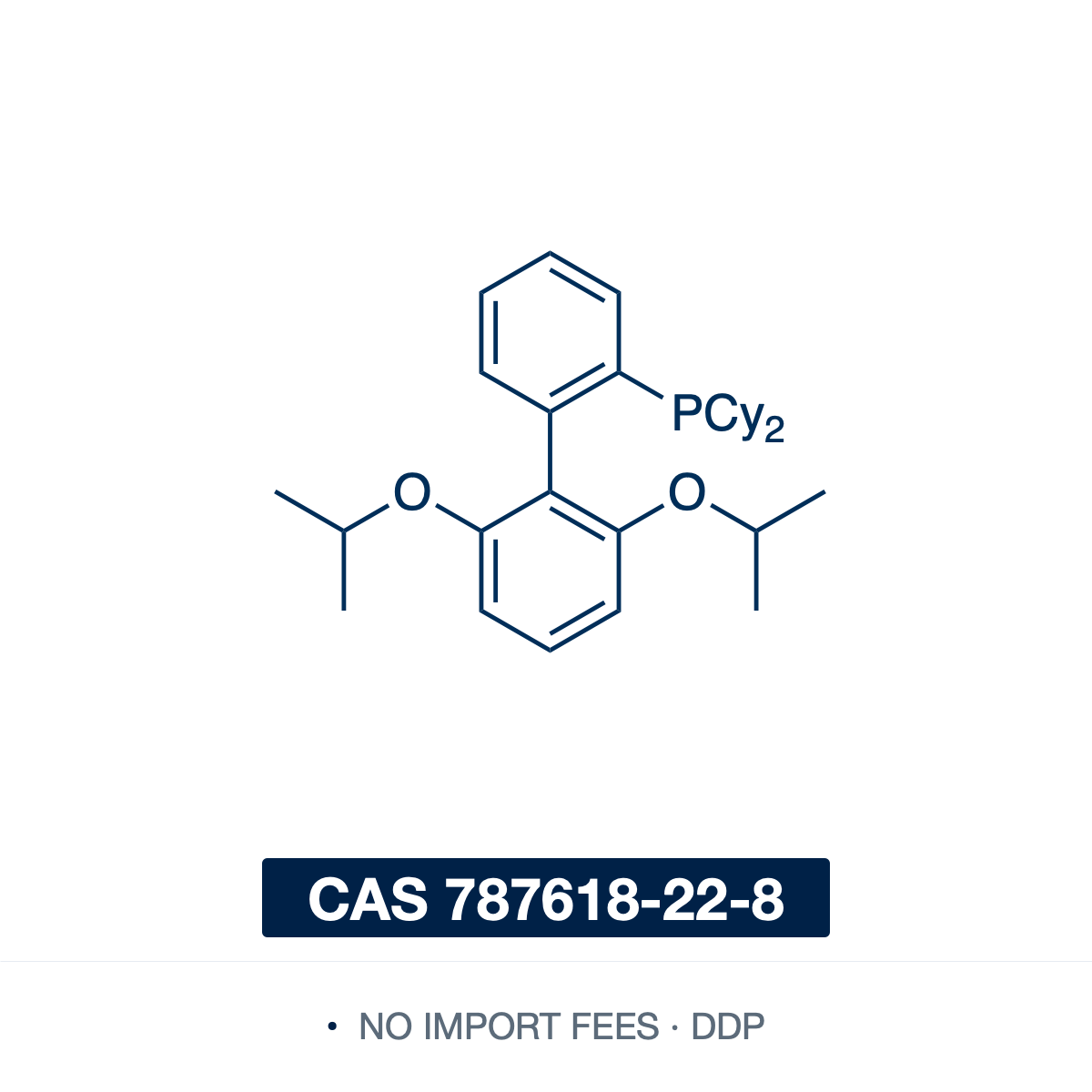
RuPhos
RuPhos | CAS 787618-22-8 | ≥97%
Couldn't load pickup availability
Technical Specifications
| CAS Number | 787618-22-8 |
| EC / EINECS Number | 616-653-5 |
| MDL Number | MFCD06798294 |
| SMILES | CC(C)OC1=C(C(=CC=C1)OC(C)C)C2=CC=CC=C2P(C3CCCCC3)C4CCCCC4 |
| InChI | InChI=1S/C30H43O2P/c1-22(2)31-27-19-13-20-28(32-23(3)4)30(27)26-18-11-12-21-29(26)33(24-14-7-5-8-15-24)25-16-9-6-10-17-25/h11-13,18-25H,5-10,14-17H2,1-4H3 |
| InChIKey | MXFYYFVVIIWKFE-UHFFFAOYSA-N |
| PubChem CID | 16217985 |
| Molecular Formula | C₃₀H₄₃O₂P |
| Molecular Weight | 466.64 g/mol |
| Melting Point | 123-126 °C |
| Solubility | Soluble in THF, 1,4-dioxane, toluene, dichloromethane and ethyl acetate; practically insoluble in water. Air-sensitive in solution — prepare in degassed solvents under inert atmosphere. |
| Purity | ≥97% |
| Physical Form | Solid |
| HS Code | 2931.49 |
| Shelf Life | Retest period: 36 months from date of manufacture |
| Storage Conditions | Store in a cool, dry place in a tightly sealed container, protected from air and moisture |
Product Description & Scientific Applications
RuPhos (2-dicyclohexylphosphino-2′,6′-diisopropoxybiphenyl) is a Buchwald dialkylbiaryl monophosphine ligand for palladium-catalysed cross-coupling. The electron-rich dicyclohexylphosphino group sits on a biphenyl backbone carrying 2′,6′-diisopropoxy substituents — the feature that distinguishes RuPhos from its dimethoxy analogue SPhos. It is a single-phosphorus (monodentate) ligand, paired with a palladium source such as Pd(OAc)₂ or Pd₂(dba)₃, and is also supplied as air-stable palladium precatalysts (the RuPhos Pd G1–G4 series) that generate the active catalyst reproducibly without a glovebox.
Mechanistic basis. Strong σ-donation from the dialkylphosphine combined with the steric bulk of the biaryl scaffold generates a highly active, low-coordinate LPd(0) species. The electron density accelerates oxidative addition into strong C–X bonds, bringing aryl chlorides and other less reactive electrophiles into range; the bulk favours the monoligated palladium centre and assists reductive elimination of the product. RuPhos-based catalysts have been shown to form the active monoligated Pd(0) complex quantitatively under the reaction conditions.
Applications and Reactions
- Negishi coupling. The catalyst on which RuPhos was introduced: with a palladium source it couples organozinc reagents with aryl halides, enabling efficient synthesis of hindered tri- and tetra-ortho-substituted biaryls at low catalyst loadings, with broad functional-group tolerance and compatibility with heterocyclic substrates.
- Buchwald–Hartwig amination. One of two ligands (with BrettPhos) that together cover most palladium-catalysed C–N couplings: RuPhos is the ligand of choice for secondary amines, coupling functionalised aryl and heteroaryl halides at low loadings and short reaction times in robust, glovebox-free reactions.
- Suzuki–Miyaura coupling. Forms C–C bonds between boron nucleophiles and aryl or heteroaryl chlorides; in the coupling of potassium alkyltrifluoroborates with aryl and heteroaryl chlorides, RuPhos ranked among the most effective ligands examined.
- Palladium precatalysts. Supplied as the RuPhos Pd G1–G4 precatalysts, which deliver a defined 1:1 ligand-to-palladium ratio and generate the active species rapidly and reproducibly for coupling and screening work.
Further reading: For phosphine-ligand selection, palladium sources and precatalysts, and Suzuki–Miyaura and Buchwald–Hartwig reagent choice, see NorrChemica's Lab Journal guide: Phosphine Ligands for Cross-Coupling.
Shipping Destinations
- EU & UK: Priority delivery, 2–5 business days.
- United States (DDP): 3–7 business days, duties and taxes prepaid.
- EFTA Countries (DDP): 3–7 business days, duties and taxes prepaid.
- Worldwide: 7–14 business days, selected locations.
Safety Information
| GHS Pictograms |

|
| Signal Word | Warning |
| Hazard Class | Not regulated for transport |
| Transport Category | Not classified as dangerous goods for transport (ADR/IATA/IMDG) |
| H-Statements | H315 - H319 - H335 |
| P-Statements | P262 - P280 - P305+P351+P338 - P403+P233 - P501 |
Documentation
| Safety Data Sheet | Download PDF |