NorrChemica™
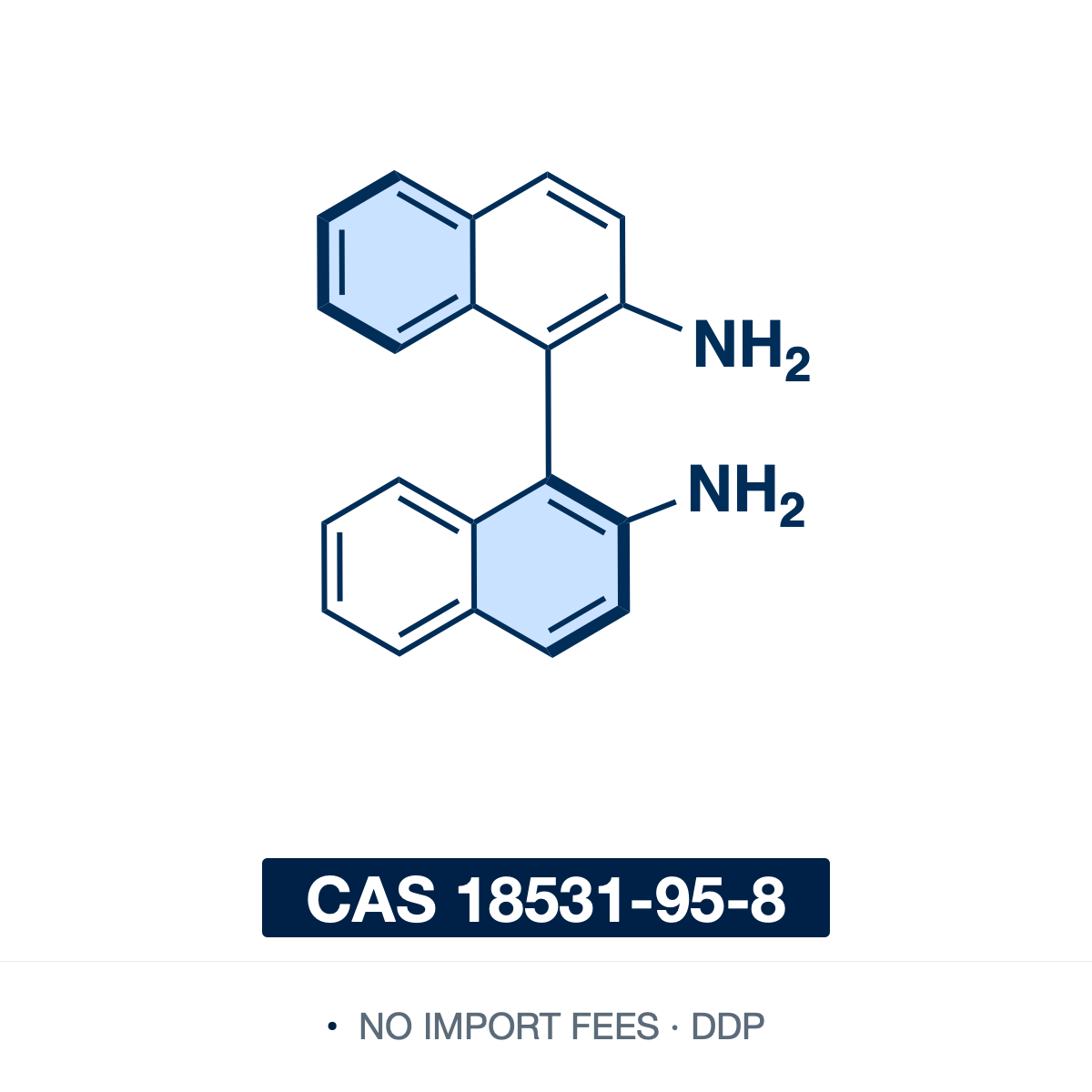
(S)-1,1′-Binaphthyl-2,2′-diamine
(S)-1,1′-Binaphthyl-2,2′-diamine | CAS 18531-95-8 | ≥98%
Couldn't load pickup availability
Technical Specifications
| CAS Number | 18531-95-8 |
| EC / EINECS Number | 627-240-4 |
| MDL Number | MFCD00145204 |
| RTECS Number | DU3090000 |
| SMILES | NC1=C(C2=C(C=CC=C2)C=C1)C1=C(N)C=CC2=C1C=CC=C2 |
| InChI | InChI=1S/C20H16N2/c21-17-11-9-13-5-1-3-7-15(13)19(17)20-16-8-4-2-6-14(16)10-12-18(20)22/h1-12H,21-22H2 |
| InChIKey | DDAPSNKEOHDLKB-UHFFFAOYSA-N |
| PubChem CID | 20571 |
| Molecular Formula | C₂₀H₁₆N₂ |
| Molecular Weight | 284.36 g/mol |
| Melting Point | 242-244 °C |
| Solubility | Slightly soluble in water. Soluble in pyridine. |
| Purity | ≥98% |
| Physical Form | White to light brown powder |
| HS Code | 2921.59 |
| Shelf Life | Retest period: 36 months from date of manufacture |
| Storage Conditions | Room Temperature (Recommended in a cool and dark place, <15 °C) |
Product Description & Scientific Applications
(S)-(−)-1,1′-Binaphthyl-2,2′-diamine (S-BINAM; S-DABN) is an axially chiral, C₂-symmetric aromatic diamine: two naphthalene units joined at their 1,1′ positions, each with an amino group at the adjacent 2-position. It has no stereogenic carbon. Its handedness arises from hindered rotation about that 1,1′ bond, which holds the two ring systems at a large dihedral angle and locks the molecule into (R)- and (S)-atropisomers. The flanking amino groups raise the rotational barrier, which substituent size governs rather than solvent or electronics, and the same crowding allows the two forms to be separated. It is the diamine counterpart of BINOL and, with BINOL and BINAP, one of the privileged binaphthyl scaffolds of asymmetric synthesis.
Configurational stability and controlled racemization. At ordinary working temperatures the enantiomer does not racemize, and so acts as a permanent source of chirality in a ligand or reagent. Recently it has been proved that the barrier can be lowered on demand: BINAM racemizes at 30–40 °C under blue light with an Ir(dF(CF₃)ppy)₂(dtbpy)PF₆ photocatalyst and N,N-dimethylaniline, in 99% yield and <1% ee (Org. Lett. 2025, 27, 1912–1917). The photocatalyst oxidises BINAM to a radical cation, which rotates freely; dimethylaniline then reduces it back to racemic BINAM. The same work reports that “dynamic kinetic resolution was also achieved with 80% enantioselectivity”.
Ligand scaffold. The amino groups present a rigid chelating pocket that transmits the axial chirality to a bound metal. S-BINAM is the diamine half of chiral salen and salan ligands: condensation with two equivalents of a salicylaldehyde gives a binaphthyl-bridged bis-imine, the privileged ligand class behind much of asymmetric metal catalysis. It is likewise elaborated into sulfonamide, phosphoramide and thiophosphoramide derivatives, and into other chiral diimines and diamines.
Use in enantioselective catalysis. Complexes built on the S-BINAM backbone are applied across asymmetric transformations — hydrogenation, cyclopropanation, the addition of dialkylzinc reagents to aldehydes, and the construction of chiral lactones. Salen–metal complexes derived from chiral diamines extend the same principle to enantioselective epoxidation and related oxidations: the metal and the aldehyde component are tuned independently while the binaphthyl core fixes the sense of induction.
Place in the binaphthyl family. Replacing the two hydroxyls of BINOL with amino groups exchanges a hard-oxygen donor set for a softer nitrogen one, shifting metal affinity and opening the imine and amide chemistry the diol cannot access, while the axis relays chirality as in BINOL and BINAP. The mixed amino–hydroxy congener NOBIN is a related chiral building block. The binaphthyl diamines are durable tools for chiral ligand design and enantioselective recognition.
Shipping Destinations
- EU & UK: Priority delivery, 2–5 business days.
- United States (DDP): 3–7 business days, duties and taxes prepaid.
- EFTA Countries (DDP): 3–7 business days, duties and taxes prepaid.
- Worldwide: 7–14 business days, selected locations.
Safety Information
| GHS Pictograms |

|
| Signal Word | Warning |
| Hazard Class | Not regulated for transport |
| Transport Category | Not classified as dangerous goods for transport (ADR/IATA/IMDG) |
| H-Statements | H315 - H319 - H335 |
| P-Statements | P264 - P270 - P280 - P301+P312 - P305+P351+P338 - P310 - P330 - P501 |
Documentation
| Safety Data Sheet | Download PDF |