NorrChemica™
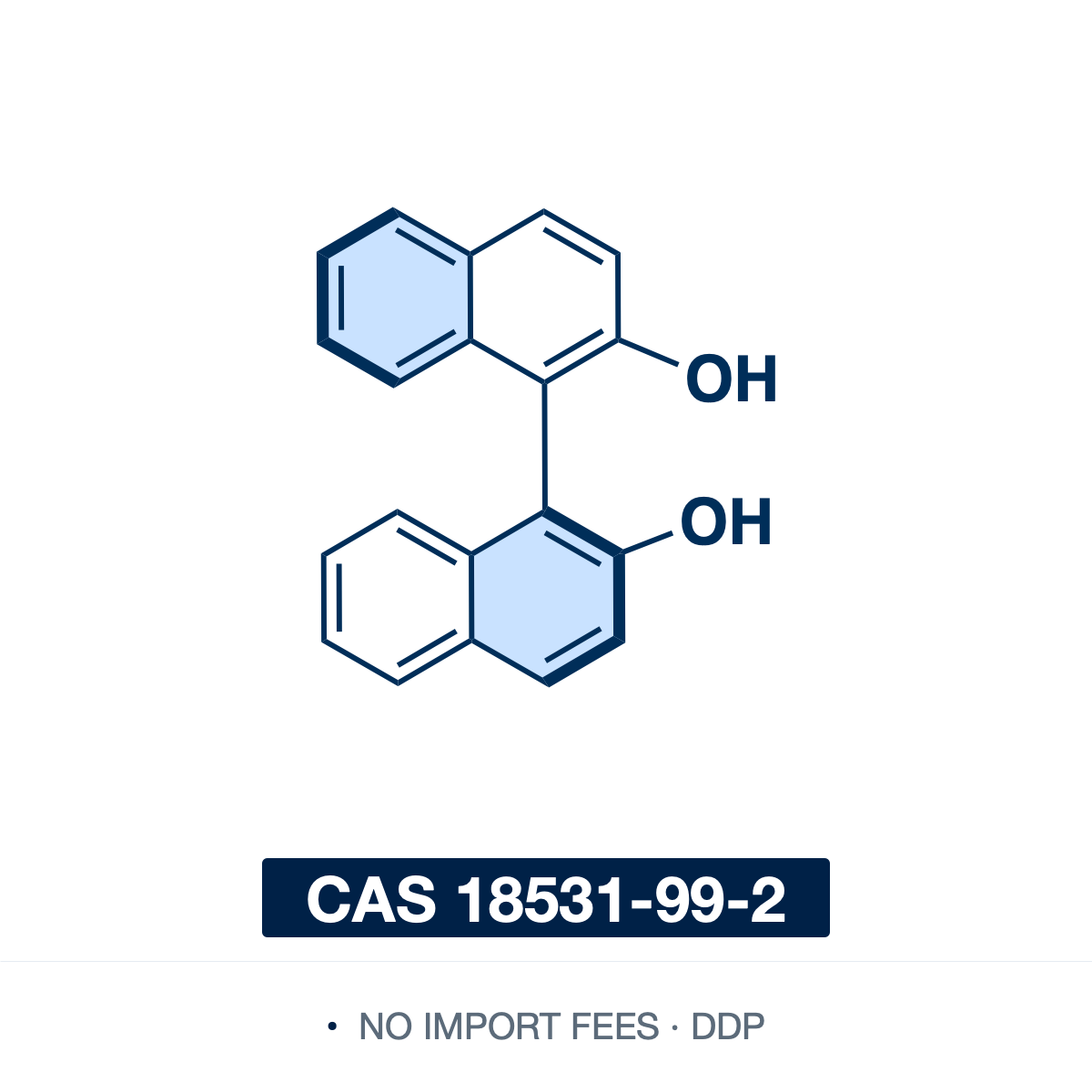
(S)-1,1′-Bi-2-naphthol
CAS 18531-99-2
≥98%
(S)-1,1′-Bi-2-naphthol | CAS 18531-99-2 | ≥98%
| Pack size | Excl. VAT | Incl. VAT | Add to cart |
|---|---|---|---|
| 5.0 g | €57,20 | ||
| 10 g | €74,20 | ||
| 25 g | €89,20 | ||
| 50 g | €129,20 | ||
| 100 g | €174,20 | ||
| 250 g | €309,20 |
Taxes and fees, e.g. VAT, included in the price. Shipping calculated at checkout.Free shipping on EU, UK and EFTA orders above €250, and above €400 to the rest of the world.
Technical Specifications
| CAS Number | 18531-99-2 |
| EC / EINECS Number | 606-050-5 |
| MDL Number | MFCD00004068 |
| RTECS Number | DU3106100 |
| SMILES | OC=1C=CC=2C=CC=CC2C1C3=C(O)C=CC=4C=CC=CC43 |
| InChI | InChI=1S/C20H14O2/c21-17-11-9-13-5-1-3-7-15(13)19(17)20-16-8-4-2-6-14(16)10-12-18(20)22/h1-12,21-22H |
| InChIKey | PPTXVXKCQZKFBN-UHFFFAOYSA-N |
| PubChem CID | 11762 |
| Molecular Formula | C₂₀H₁₄O₂ |
| Molecular Weight | 286.33 g/mol |
| Melting Point | 208-210 °C |
| Solubility | Soluble in ethanol and tetrahydrofuran. Slightly soluble in toluene. Insoluble in water. |
| Purity | ≥98% |
| Physical Form | White crystalline solid |
| HS Code | 2907.29.00 |
| Shelf Life | Retest period: 36 months from date of manufacture |
| Storage Conditions | Store at room temperature in a tightly sealed container, protected from light and moisture. |
Product Description & Scientific Applications
(S)-1,1′-Bi-2-naphthol (BINOL) is a biaryl diol with axial chirality.
-
Titanium catalysis. With titanium(IV) isopropoxide it forms a BINOL–Ti complex that catalyses the asymmetric addition of alkynylzinc reagents to unactivated ketones. A titanium(IV) catalyst of (S)-BINOL also gives enantioselective aryl transfer from triaryl(tetrahydrofuran)aluminium reagents to ketones.+R″C≡C–Zn(S)-BINOL, Ti(OiPr)4⟶
General reaction: ketone + alkynylzinc → tertiary propargylic alcohol.
- Chiral Lewis acid catalysis. A chiral bis-titanium(IV) oxide is prepared by treating bis(triisopropoxy)titanium oxide with (S)-BINOL. This catalyst activates aldehyde carbonyls and allows the enantioselective allylation of aldehydes with allyltributyltin.
-
Chiral phosphoric acids. Phosphoric acids derived from BINOL are used as chiral organocatalysts. These acids catalyse the asymmetric allylboration of aldehydes.phosphorylation⟶
General structure: BINOL → BINOL-derived phosphoric acid.
-
Phosphoramidite ligands. An (S)-BINOL-derived phosphoramidite with a rhodium precatalyst effects enantioselective cyclisation of aromatic ketimines by directed C–H bond activation.phosphoramidite⟶formation
General structure: BINOL → BINOL-derived phosphoramidite ligand (NMe2 shown).
- Chiral recognition. BINOL is used to construct chiral fluorescent sensors for the enantioselective recognition of amino alcohols, α-hydroxycarboxylic acids and amino acid derivatives. A BINOL-based bis(naphthylimine) probe responds differently at two emission wavelengths to chiral diamines, amino alcohols and amino acids.
Shipping Destinations
- EU & UK: Priority delivery, 2–5 business days.
- United States (DDP): 3–7 business days, duties and taxes prepaid.
- EFTA Countries (DDP): 3–7 business days, duties and taxes prepaid.
- Worldwide: 7–14 business days, selected locations.
Safety Information
| GHS Pictograms |

|
| Signal Word | Warning |
| Hazard Class | Not regulated for transport |
| Transport Category | Not classified as dangerous goods for transport (ADR/IATA/IMDG) |
| H-Statements | H315 - H319 |
| P-Statements | P264 - P280 - P302+P352 - P305+P351+P338 - P332+P313 - P337+P313 - P501 |
Documentation
| Safety Data Sheet | Download PDF |