NorrChemica™
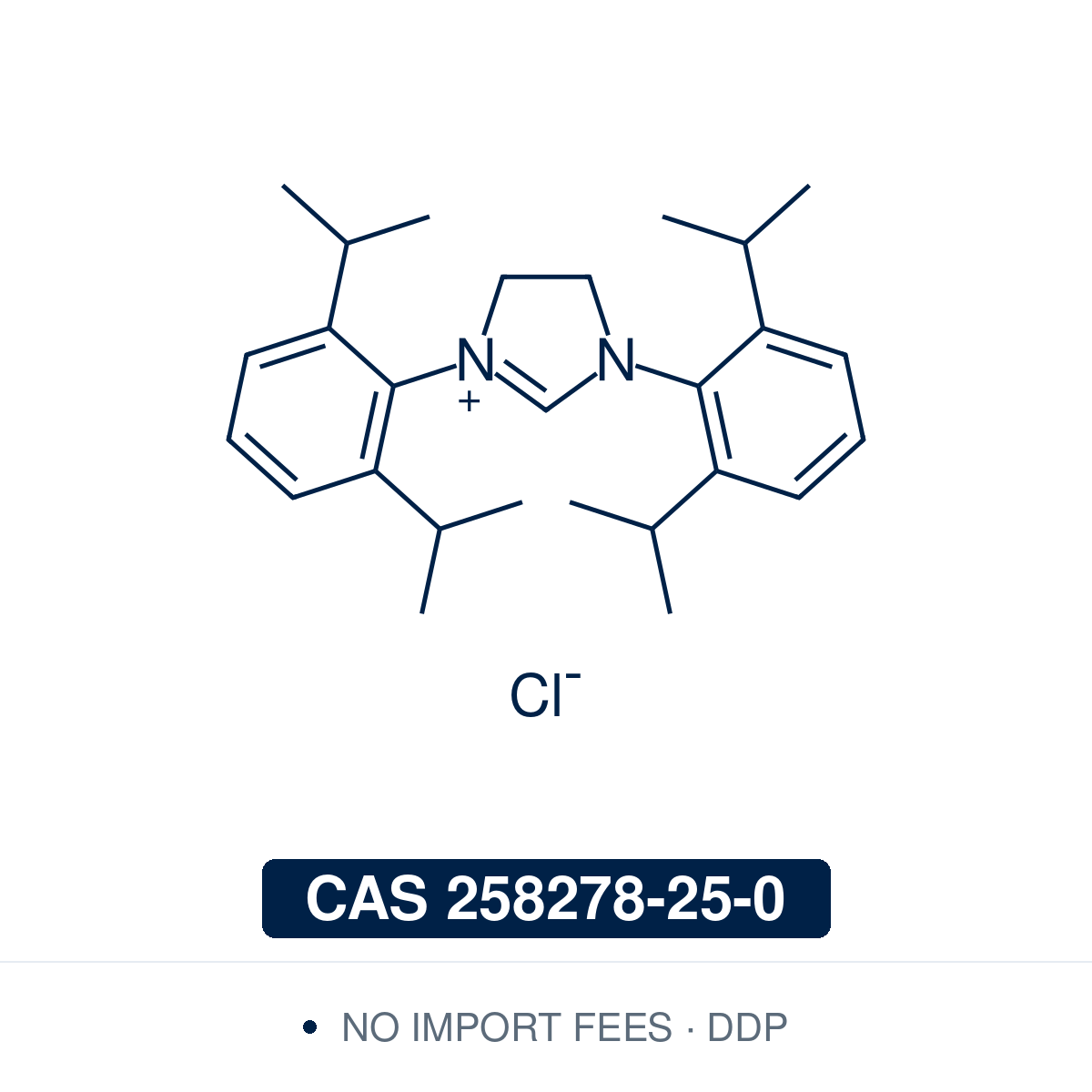
SIPr·HCl
SIPr·HCl | CAS 258278-25-0 | ≥95%
| Pack size | Excl. VAT | Incl. VAT | Add to cart |
|---|---|---|---|
| 250 mg | €34,20 | ||
| 1.0 g | €49,20 | ||
| 5.0 g | €74,20 | ||
| 10 g | €98,20 | ||
| 25 g | €179,80 | ||
| 50 g | €349,20 | ||
| 100 g | €64.920,00 |
Taxes and fees, e.g. VAT, included in the price. Shipping calculated at checkout.Free shipping on EU, UK and EFTA orders above €250, and above €400 to the rest of the world.
Technical Specifications
| CAS Number | 258278-25-0 |
| EC / EINECS Number | 627-991-8 |
| MDL Number | MFCD07369796 |
| SMILES | CC(C)C1=C(C(=CC=C1)C(C)C)N2CC[N+](=C2)C3=C(C=CC=C3C(C)C)C(C)C.[Cl-] |
| InChI | InChI=1S/C27H39N2.ClH/c1-18(2)22-11-9-12-23(19(3)4)26(22)28-15-16-29(17-28)27-24(20(5)6)13-10-14-25(27)21(7)8;/h9-14,17-21H,15-16H2,1-8H3;1H/q+1;/p-1 |
| InChIKey | LWPXTYZKAWSRIP-UHFFFAOYSA-M |
| PubChem CID | 2734918 |
| Molecular Formula | C₂₇H₃₉ClN₂ |
| Molecular Weight | 427.1 g/mol |
| Melting Point | 289–293 °C (lit.) |
| Solubility | Soluble in methanol. |
| Purity | ≥95% |
| Physical Form | White to off-white crystalline powder |
| HS Code | 2933.29 |
| Shelf Life | Retest period: 36 months from date of manufacture |
| Storage Conditions | Store in a cool, dry place in a tightly sealed container, protected from light. |
Product Description & Scientific Applications
SIPr·HCl (1,3-bis(2,6-diisopropylphenyl)imidazolinium chloride) is a precursor to the free N-heterocyclic carbene (NHC) 1,3-bis(2,6-diisopropylphenyl)-2-imidazolidinylidene (SIPr). SIPr is a saturated NHC ligand. The salt is also used to form catalysts in situ for a variety of reactions, for example amination, Heck coupling, ring-opening metathesis polymerisation (ROMP) and hydrogenation. It has been used in a one-pot synthesis of N-heterocyclic carbene–allylpalladium complexes.
General reaction: SIPr·HCl + base → SIPr (free carbene).
N-Arylation of indoles. In a study of palladium/imidazolium salt systems for amination reactions, less reactive indoles were converted to N-aryl indoles with SIPr·HCl as the supporting ligand. The palladium(II) acetate/SIPr·HCl/sodium hydroxide system was efficient for the N-arylation of diverse indoles with aryl bromides.
General reaction: indole + Ar–Br → N-aryl indole; Ar = aryl.
Suzuki–Miyaura coupling with aryldiazonium salts. In one study, SIPr·HCl with palladium(II) acetate, without added base, was used as the catalyst to cross-couple aryl, vinyl and alkyl boronic acids and boronates with aryldiazonium tetrafluoroborates. Diazonium ions formed in situ also took part in the coupling.
General reaction: Ar–N₂⁺ BF₄⁻ + R–B(OH)₂ → Ar–R; R = aryl, vinyl or alkyl; boronates also react.
Mizoroki–Heck coupling with aryldiazonium salts. In a related study, the same combination of SIPr·HCl and palladium(II) acetate, without added base, gave Heck coupling products from olefins and aryldiazonium tetrafluoroborates. Diazonium ions formed in situ directly from anilines also coupled.
General reaction: Ar–N₂⁺ BF₄⁻ + olefin → Heck coupling product.
α-Arylation of esters. In one study, palladium(0) with an imidazolinium salt of SIPr as the carbene precursor mediated the coupling of aryl halides with ester enolates to give α-aryl esters. In the same study, the tert-butyl esters of naproxen and flurbiprofen were prepared from tert-butyl propionate and aryl bromides with Pd(dba)₂ and the same carbene precursor.
General reaction: Ar–X + ester (as its enolate) → α-aryl ester; X = halide.
Iron-catalysed biaryl coupling. In one study, iron fluorides in combination with SIPr catalysed the cross-coupling of aryl chlorides with aryl Grignard reagents to give biaryls. The authors describe the metal fluoride/NHC combinations in this work as a route to unsymmetrical biaryls without palladium catalysts or phosphine ligands.
General reaction: Ar–MgBr + Ar′–Cl → Ar–Ar′ (unsymmetrical biaryl).
Chemoselective Suzuki–Miyaura coupling. In the palladium-catalysed Suzuki–Miyaura coupling of chloroaryl triflates, one study found that SIPr as ligand led to selective coupling at the chloride. With SIMes, the related carbene with 2,4,6-trimethylphenyl groups, the coupling was selective for the triflate.
General reaction: Cl–Ar–OTf + Ar′–B(OH)₂ → Ar′–Ar–OTf; with SIPr, coupling is selective for the chloride.
Shipping Destinations
- EU & UK: Priority delivery, 2–5 business days.
- United States (DDP): 3–7 business days, duties and taxes prepaid.
- EFTA Countries (DDP): 3–7 business days, duties and taxes prepaid.
- Worldwide: 7–14 business days, selected locations.
Safety Information
| GHS Pictograms |

|
| Signal Word | Warning |
| Hazard Class | Not regulated for transport |
| Transport Category | Not classified as dangerous goods for transport (ADR/IATA/IMDG) |
| H-Statements | H315 - H319 - H335 |
| P-Statements | P261 - P264 - P271 - P280 - P302+P352 - P304+P340 - P305+P351+P338 - P332+P313 - P337+P313 - P362+P364 - P501 |
Documentation
| Safety Data Sheet | Download PDF |