NorrChemica™
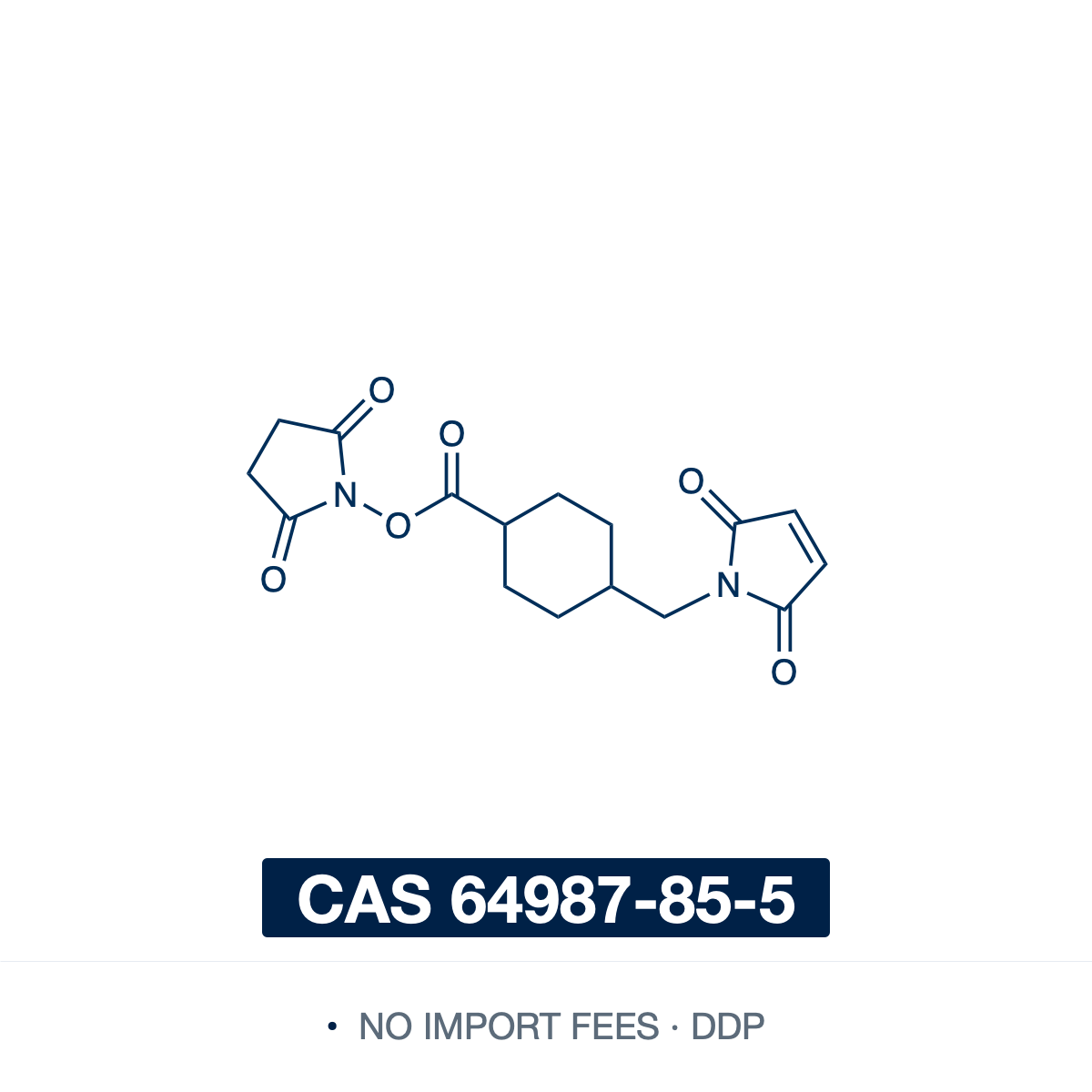
SMCC
SMCC | CAS 64987-85-5 | ≥97%
Couldn't load pickup availability
Technical Specifications
| CAS Number | 64987-85-5 |
| EC / EINECS Number | 613-734-7 |
| MDL Number | MFCD00009634 |
| SMILES | C1CC(CCC1CN2C(=O)C=CC2=O)C(=O)ON3C(=O)CCC3=O |
| InChI | InChI=1S/C16H18N2O6/c19-12-5-6-13(20)17(12)9-10-1-3-11(4-2-10)16(23)24-18-14(21)7-8-15(18)22/h5-6,10-11H,1-4,7-9H2 |
| InChIKey | JJAHTWIKCUJRDK-UHFFFAOYSA-N |
| PubChem CID | 125175 |
| Molecular Formula | C₁₆H₁₈N₂O₆ |
| Molecular Weight | 334.32 g/mol |
| Melting Point | 174–178 °C |
| Solubility | Insoluble in water. Soluble in DMF, DMSO, and acetonitrile. |
| Purity | ≥97% |
| Physical Form | White to off-white powder |
| HS Code | 2925.19 |
| Shelf Life | Retest period: 36 months from date of manufacture when stored desiccated at −20 °C. |
| Storage Conditions | Store desiccated at −20 °C in a tightly sealed container, protected from moisture. |
Product Description & Scientific Applications
SMCC (succinimidyl 4-(N-maleimidomethyl)cyclohexane-1-carboxylate) is a heterobifunctional crosslinker: an amine-reactive NHS ester at one end, a thiol-reactive maleimide at the other, joined by a cyclohexane spacer. It is the standard reagent for coupling an amine-bearing molecule to a thiol-bearing one in two controlled steps.
Amine-reactive end. The NHS ester acylates primary amines — lysine side chains and the N-terminus — to form a stable amide bond. It also hydrolyses in water, so it competes with amine coupling and is used in excess; unreacted ester is quenched with hydroxylamine or removed before the second step.
Thiol-reactive end. The maleimide adds sulfhydryl groups by 1,4-Michael addition to form a thioether. This reaction is thiol-selective between pH 6.5 and 7.5, running about 1000-fold faster with thiols than with amines at pH 7; above this range selectivity drops as amines begin to compete and the ring hydrolyses to a non-reactive maleamic acid. The resulting thiosuccinimide can slowly reverse by retro-Michael exchange with other thiols, but SMCC's sterically hindered cyclohexyl ring limits both hydrolysis and thiol exchange relative to simple aliphatic maleimides — a reason it is chosen where the conjugate must stay intact.
Stepwise use. An amine-bearing protein is first activated with the NHS ester and freed of excess reagent, then reacted with the thiol-bearing partner. Using the two distinct reactivities in sequence minimises homo-crosslinking and aggregation, the main drawback of one-pot homobifunctional reagents.
Applications. SMCC is a mainstay of protein bioconjugation:
- Peptide–protein and hapten–carrier conjugates for immunogen preparation;
- Antibody–enzyme conjugates for immunoassays;
- immunotoxins;
- antibody–drug conjugates (ADCs).
Its best-known use is the approved ADC trastuzumab emtansine (Kadcyla): the NHS ester couples to lysines on trastuzumab and the maleimide binds the free thiol of the maytansinoid DM1, giving a non-cleavable thioether linkage at an average of about 3.5 drugs per antibody (a heterogeneous mixture, 0–8). The drug is released only after the antibody is internalised and degraded in the lysosome, yielding a lysine–MCC–DM1 catabolite. SMCC links several other maytansinoid ADCs directed at CD37, CD22, and EGFRvIII.
Handling. The reagent is hydrophobic and the first coupling step often needs an organic cosolvent such as DMSO; the sulfonated analogue sulfo-SMCC is water-soluble. Both reactive groups are moisture-sensitive, so SMCC is best kept dry and cold and used promptly.
Shipping Destinations
- EU & UK: Priority delivery, 1–2 business days.
-
- EFTA Countries (DDP): 1–2 business days, duties and taxes prepaid.
Safety Information
| GHS Pictograms |

|
| Signal Word | Warning |
| Hazard Class | Not regulated for transport |
| Transport Category | Not classified as dangerous goods for transport (ADR/IATA/IMDG) |
| H-Statements | H315 - H319 - H335 |
| P-Statements | P261 - P264 - P271 - P280 - P302+P352 - P304+P340 - P305+P351+P338 - P332+P313 - P337+P313 - P362+P364 - P403+P233 - P405 - P501 |
Documentation
| Safety Data Sheet | Download PDF |