NorrChemica™
1,1'-Sulfonyldiimidazole (SDI)
1,1'-Sulfonyldiimidazole (SDI) | CAS 7189-69-7 | ≥98%
Couldn't load pickup availability
Technical Specifications
| CAS Number | 7189-69-7 |
| EC / EINECS Number | 230-554-0 |
| MDL Number | MFCD00015893 |
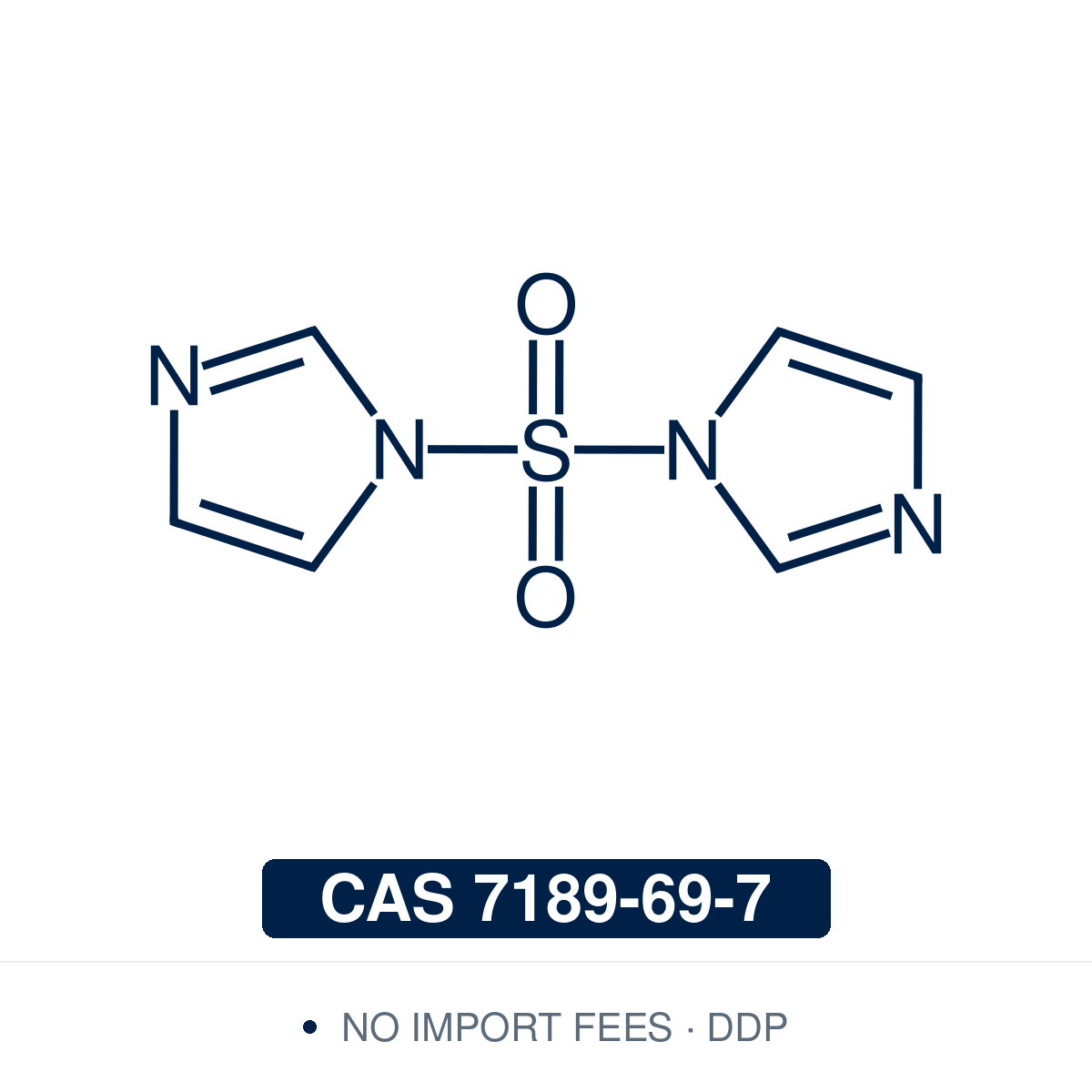
| SMILES | C1=CN(C=N1)S(=O)(=O)N2C=CN=C2 |
| InChI | InChI=1S/C6H6N4O2S/c11-13(12,9-3-1-7-5-9)10-4-2-8-6-10/h1-6H |
| InChIKey | ZLKNPIVTWNMMMH-UHFFFAOYSA-N |
| PubChem CID | 81609 |
| Molecular Formula | C₆H₆N₄O₂S |
| Molecular Weight | 198.2 g/mol |
| Melting Point | 138–142 °C |
| Solubility | Soluble in DMF, DMSO, acetonitrile, THF; reacts slowly with water (hydrolysis) |
| Purity | ≥98% |
| Physical Form | White to cream crystalline powder |
| HS Code | 2933.29 |
| Shelf Life | Retest period: 36 months from date of manufacture |
| Storage Conditions | Store at room temperature in a tightly sealed container under inert atmosphere, protected from moisture |
Product Description & Scientific Applications
Sulfonylation and activation of alcohols — SDI is widely used as a sulfonylating agent to convert hydroxyl groups into imidazolylsulfonate leaving groups. These activated intermediates undergo clean nucleophilic displacement with a range of nucleophiles including azides, halides, thiols, and amines, enabling stereochemical inversion at the carbon centre. This reactivity makes SDI a practical alternative to mesyl chloride or tosyl chloride in cases where mild conditions and neutral byproducts (imidazole) are preferred.
Synthesis of anhydronucleosides — SDI is a key reagent for the preparation of 2,3’-anhydro-2’-deoxyribonucleosides via intramolecular cyclisation. Treatment of a nucleoside with SDI activates the sugar hydroxyl as an imidazolylsulfonate, which is then displaced by a neighbouring nucleobase nitrogen or oxygen to form the anhydro bridge. This transformation is important in the synthesis of modified nucleosides for antiviral and anticancer drug development, and in the preparation of locked nucleic acid (LNA) building blocks.
Diazo transfer reagent precursor — SDI is the direct precursor to imidazole-1-sulfonyl azide, a modern and safer alternative to trifluoromethanesulfonyl azide (triflyl azide) for diazo transfer reactions. The azide salt is prepared by treating SDI with sodium azide and is typically isolated as its hydrochloride or hydrogen sulfate salt for safe handling. This reagent converts primary amines to azides in high yield under mild conditions, a transformation central to click chemistry and bioorthogonal conjugation workflows (Goddard-Borger and Stick, Org. Lett. 2007, 9, 3797).
Activation of boronic acids for Suzuki coupling — SDI has been reported to activate arylboronic acids in one-pot Suzuki–Miyaura cross-coupling reactions. The sulfonyl group converts the boronic acid into a more reactive intermediate, facilitating palladium-catalysed biaryl formation under mild conditions. This application connects directly to the broader field of organoboron chemistry and transition-metal-catalysed cross-coupling.
Preparation of benziodoxole complexes — SDI is used in the preparation of stable 1:1 complexes with benziodoxole reagents, which are important hypervalent iodine-based oxidants and group-transfer reagents in modern synthetic methodology. These complexes serve as bench-stable sources of reactive intermediates for trifluoromethylation, alkynylation, and other transformations.
Battery electrolyte additive — recent research has identified SDI as a functional additive in lithium-ion and lithium-metal battery electrolytes. SDI promotes the formation of sulfur- and nitrogen-rich solid electrolyte interphase (SEI) layers on anode surfaces, improving ionic transport, suppressing dendrite formation, and enhancing cycle life under aggressive cycling conditions. This emerging application positions SDI at the intersection of organic chemistry and energy storage materials science.
Sulfonamide and sulfamide synthesis — SDI reacts with primary and secondary amines to form sulfonamides and sulfamides under mild conditions. The imidazole byproduct is easily removed by aqueous wash, making workup straightforward. This reactivity is exploited in medicinal chemistry for the preparation of sulfonamide-containing pharmacophores and in the derivatisation of amine-functionalised biomolecules.
Shipping Destinations
- EU & UK: Priority delivery, 2–5 business days.
- United States (DDP): 3–7 business days, duties and taxes prepaid.
- EFTA Countries (DDP): 3–7 business days, duties and taxes prepaid.
- Worldwide: 7–14 business days, selected locations.
Safety Information
| GHS Pictograms |

|
| Signal Word | Warning |
| Hazard Class | None — not subject to transport regulations |
| Transport Category | Not classified as dangerous goods for transport (ADR/IATA/IMDG) |
| H-Statements | H315 - H319 - H335 |
| P-Statements | P261 - P264 - P271 - P280 - P302+P352 - P304+P340 - P305+P351+P338 - P332+P313 - P337+P313 - P362+P364 - P501 |
Documentation
| Safety Data Sheet | Download PDF |