NorrChemica™
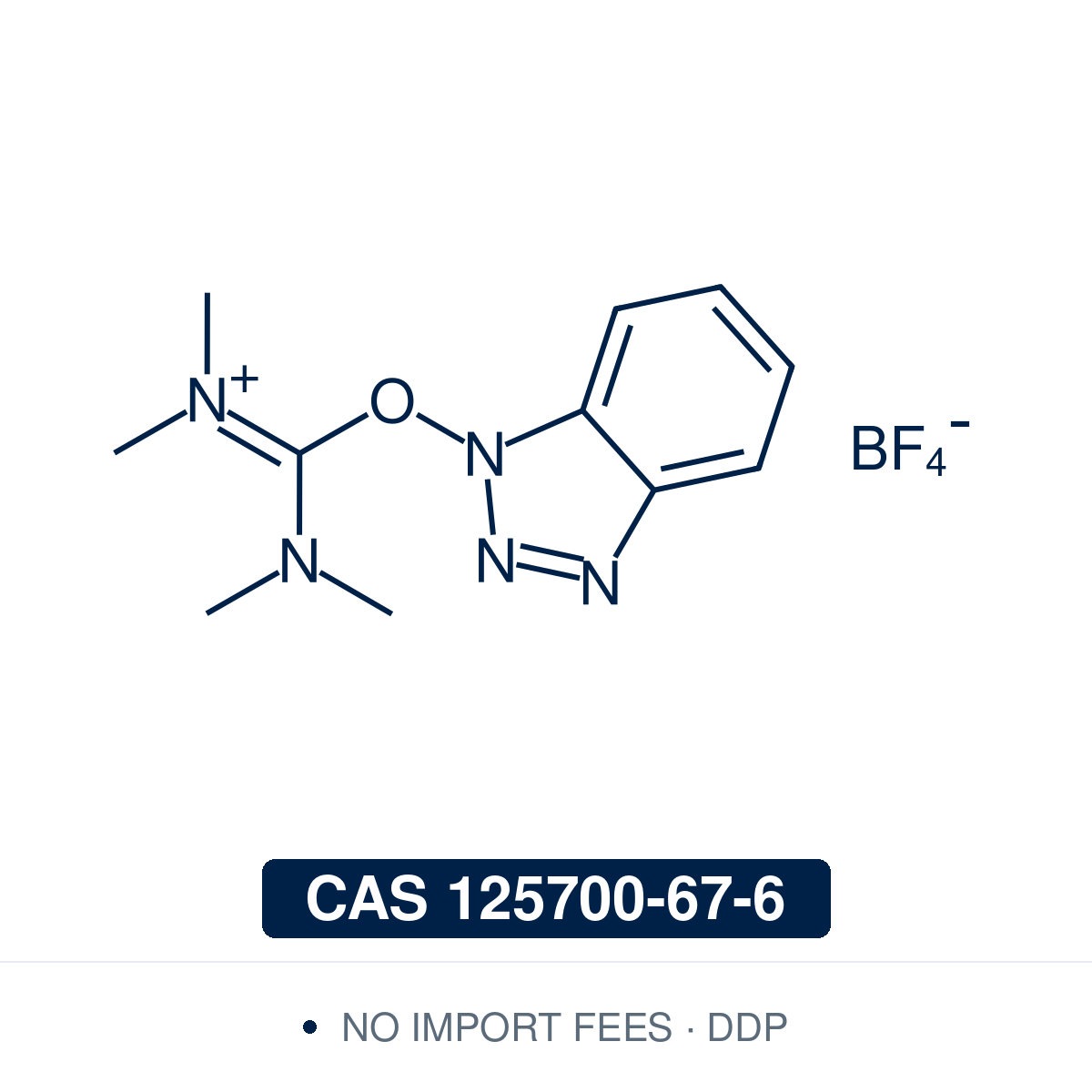
TBTU
TBTU | CAS 125700-67-6 | ≥98%
| Pack size | Excl. VAT | Incl. VAT | Add to cart |
|---|---|---|---|
| 5 g | €39,90 | ||
| 10 g | €49,20 | ||
| 25 g | €69,20 | ||
| 50 g | €98,20 | ||
| 100 g | €129,20 |
Taxes and fees, e.g. VAT, included in the price. Shipping calculated at checkout.Free shipping on EU, UK and EFTA orders above €250, and above €400 to the rest of the world.
Technical Specifications
| CAS Number | 125700-67-6 |
| EC / EINECS Number | 423-040-4 |
| MDL Number | MFCD00077413 |
| SMILES | [B-](F)(F)(F)F.CN(C)C(=[N+](C)C)ON1C2=CC=CC=C2N=N1 |
| InChI | InChI=1S/C11H16N5O.BF4/c1-14(2)11(15(3)4)17-16-10-8-6-5-7-9(10)12-13-16;2-1(3,4)5/h5-8H,1-4H3;/q+1;-1 |
| InChIKey | JKEKMBGUVUKMQB-UHFFFAOYSA-N |
| PubChem CID | 2733207 |
| Molecular Formula | C₁₁H₁₆BF₄N₅O |
| Molecular Weight | 321.08 g/mol |
| Melting Point | 195–199 °C (dec.) |
| Solubility | Soluble in DMF, NMP, DMSO; insoluble in water, diethyl ether |
| Purity | ≥98% |
| Physical Form | White to pale cream powder |
| HS Code | 2933.99 |
| Country of Origin | Finland |
| Shelf Life | Retest period: 36 months from date of manufacture |
| Storage Conditions | Store refrigerated (2–8 °C) in a tightly sealed container, protected from moisture and light |
Product Description & Scientific Applications
TBTU (O-(benzotriazol-1-yl)-N,N,N′,N′-tetramethyluronium tetrafluoroborate) is a benzotriazole-based uronium/guanidinium coupling reagent for Fmoc and Boc peptide synthesis and general amide-bond formation. It activates carboxylic acids as benzotriazol-1-yl (OBt) active esters under mild, base-promoted conditions, giving high coupling yields with low racemisation.
Fmoc and Boc Solid-Phase Peptide Synthesis
TBTU is one of the most widely used coupling reagents for both Fmoc- and Boc-based SPPS. In the activation step, TBTU reacts with the carboxylic acid of the incoming protected amino acid in the presence of a tertiary amine base (DIPEA or NMM) to generate a benzotriazolyl active ester intermediate, which undergoes rapid aminolysis with the resin-bound free amine to form the peptide bond. Like HBTU, TBTU exists as the guanidinium N-oxide (aminium) form in the solid state, and the two reagents behave essentially identically in coupling reactions — differing only in the counterion (BF₄⁻ for TBTU vs PF₆⁻ for HBTU).
Knorr et al. (Tetrahedron Lett. 1989, 30, 1927) introduced TBTU as a highly efficient coupling reagent with low racemisation, and it has since become one of the standard reagents in both academic and industrial peptide synthesis. Hachmann and Lebl (Biopolymers 2006, 84, 340) included TBTU in a systematic comparative study of ten phosphonium and uronium coupling reagents, confirming its reliable performance across a range of peptide sequences.
General reaction: TBTU converts the carboxylic acid into a benzotriazol-1-yl (OBt) active ester, releasing tetramethylurea; the active ester is then aminolysed by the amine to give the amide.
Solution-Phase Peptide Synthesis and Fragment Condensation
TBTU is equally effective in solution-phase peptide synthesis, where its high solubility in polar aprotic solvents — DMF, NMP, and DMSO — facilitates homogeneous reaction conditions. The BF₄⁻ counterion confers slightly higher solubility in some solvent systems compared to the PF₆⁻ salt (HBTU), which can be advantageous when working at high substrate concentrations or with poorly soluble peptide fragments.
In fragment condensation reactions, TBTU provides efficient coupling between large protected peptide segments with minimal epimerisation, although — like all uronium/aminium reagents — it should not be used in large excess to avoid the guanidination side reaction that can cap free amino groups.
Synthesis of 1,2,4-Oxadiazoles
Beyond peptide chemistry, TBTU has been employed as an activating agent for the synthesis of 1,2,4-oxadiazoles — five-membered heterocyclic ring systems with broad pharmacological relevance, including antimicrobial, anti-inflammatory, and anticancer activity. Poulain et al. (Tetrahedron Lett. 2001, 42, 1495) demonstrated that TBTU efficiently activates carboxylic acids for cyclodehydration with amidoximes, providing 1,2,4-oxadiazoles in good yields under mild conditions. This application exploits the same carboxylic acid activation mechanism used in peptide synthesis but redirects it towards heterocycle formation.
General reaction: the TBTU-activated acid O-acylates the amidoxime; the O-acylamidoxime then cyclodehydrates to the 3,5-disubstituted 1,2,4-oxadiazole.
Selective Esterification and Glycodendrimer Synthesis
TBTU enables controllably selective esterification of carboxylic acids with alcohols — a transformation that is typically difficult with standard coupling reagents due to the lower nucleophilicity of alcohols compared to amines. Twibanire and Grindley (Org. Lett. 2011, 13, 2988) demonstrated efficient and selective preparation of esters using TBTU, including the synthesis of acid-based T-antigen glycodendrimers — multivalent carbohydrate-presenting structures used in cancer immunology research. The ability of TBTU to mediate both amide and ester bond formation makes it a versatile tool for the construction of complex biomolecular architectures.
General reaction: the same benzotriazol-1-yl active ester is intercepted by an alcohol instead of an amine, giving the ester.
Cost-Effective HBTU Alternative
TBTU is generally less expensive than HBTU due to the lower cost of the tetrafluoroborate counterion compared to hexafluorophosphate. For laboratories and manufacturing facilities where coupling reagent cost is a significant consideration — particularly in large-scale GMP peptide production requiring thousands of coupling cycles per campaign — TBTU offers an economically attractive alternative with no loss of coupling performance. The two reagents can be used interchangeably in virtually all protocols, and TBTU has been validated in the synthesis of numerous therapeutically active peptides including peptaibols, opioid analogues, and trehalose-based glycolipids.
The only practical distinction is that TBTU is classified as a flammable solid (H228) for transport, requiring appropriate packaging and shipping as dangerous goods — a consideration that may influence procurement logistics but does not affect synthetic performance.
Further Reading. For guidance on selecting between carbodiimides, aminium/uronium salts, phosphonium salts, and other reagent classes for amide and peptide bond formation, see NorrChemica's Lab Journal guide: Choosing a Coupling Reagent for Amide and Peptide Bond Formation.
Shipping Destinations
- EU & UK only: 3–7 business days.
- Classified as dangerous goods — shipping restrictions apply outside the EU/UK.
Safety Information
| GHS Pictograms |


|
| Signal Word | Danger |
| Hazard Class | UN 1325 — Flammable solid, organic, n.o.s. (TBTU) (Class 4.1, PG II) |
| Transport Category | DG — Class 4.1, PG II (ADR/IATA/IMDG) |
| H-Statements | H228 - H315 - H319 - H335 |
| P-Statements | P210 - P240 - P241 - P261 - P264 - P271 - P280 - P302+P352 - P305+P351+P338 - P312 - P332+P313 - P337+P313 - P370+P378 - P501 |
Documentation
| Safety Data Sheet | Download PDF |