NorrChemica™
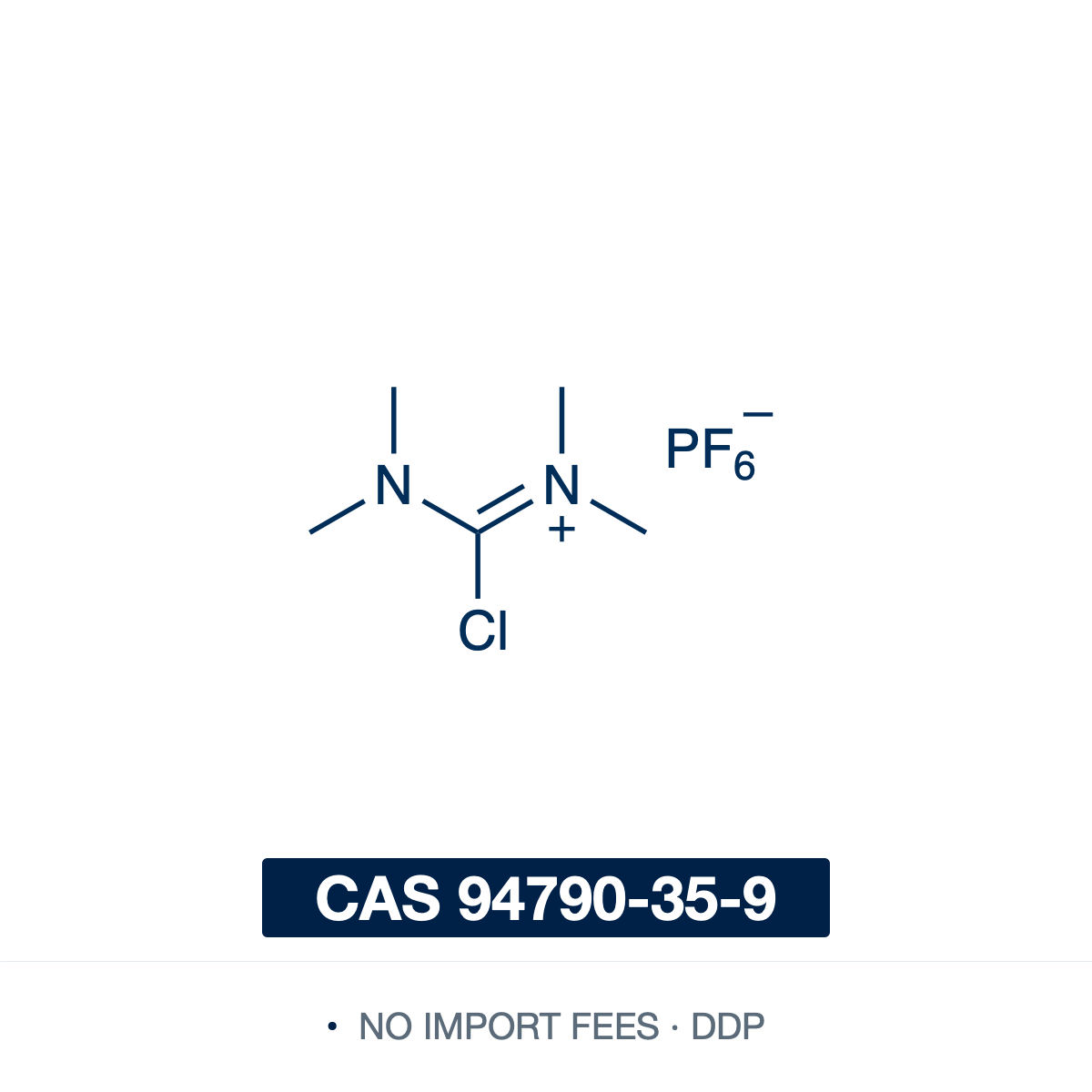
TCFH
TCFH | CAS 94790-35-9 | ≥98%
Couldn't load pickup availability
Technical Specifications
| CAS Number | 94790-35-9 |
| EC / EINECS Number | 627-919-5 |
| MDL Number | MFCD01862891 |
| SMILES | CN(C)C(=[N+](C)C)Cl.F[P-](F)(F)(F)(F)F |
| InChI | InChI=1S/C5H12ClN2.F6P/c1-7(2)5(6)8(3)4;1-7(2,3,4,5)6/h1-4H3;/q+1;-1 |
| InChIKey | CUKNPSDEURGZCO-UHFFFAOYSA-N |
| PubChem CID | 10989639 |
| Molecular Formula | C₅H₁₂ClF₆N₂P |
| Molecular Weight | 280.58 g/mol |
| Melting Point | 99–112 °C |
| Solubility | Soluble in acetonitrile, DMF, and dichloromethane; insoluble in water and diethyl ether. |
| Purity | ≥98% |
| Physical Form | White to off-white crystalline powder |
| HS Code | 2925.29 |
| Shelf Life | Retest period: 36 months from date of manufacture |
| Storage Conditions | Store refrigerated (2–8 °C) in a tightly sealed container, protected from moisture. |
Product Description & Scientific Applications
TCFH — N,N,N′,N′-tetramethylchloroformamidinium hexafluorophosphate — is a chloroformamidinium coupling reagent for amide, ester and thioester bond formation. Used with N-methylimidazole (NMI), it activates carboxylic acids through in situ N-acyl imidazolium formation, giving a highly reactive acylating intermediate that then acylates amines or alcohols; this species offers reactivity comparable to an acid chloride with the operational ease of a uronium reagent. The TCFH–NMI combination couples hindered carboxylic acids and weakly nucleophilic amines — including anilines and heteroaryl amines — under mild conditions, often with retention of adjacent stereocentres, and with examples run under air. TCFH is supplied as a white crystalline solid, soluble in acetonitrile, dichloromethane, DMF and THF; store cold and dry.
Common Scientific Applications
- Amide bond formation (TCFH–NMI): with N-methylimidazole, TCFH activates carboxylic acids through an N-acyl imidazolium intermediate for direct amide coupling.
- Hindered and weakly nucleophilic partners: effective for difficult couplings of sterically hindered acids with poorly nucleophilic amines such as anilines and heteroaryl amines, with examples run under air.
- Stereoretentive coupling: couples α-chiral acids with retention of the adjacent stereocentre in many cases, limiting epimerisation.
- Peptide coupling: activates carboxylic acids for peptide bond formation in solution-phase synthesis.
- Esterification and thioesterification: beyond amides, TCFH promotes esterification and thioesterification of carboxylic acids, expanding the same activation chemistry to alcohol and thiol nucleophiles.
- Bioconjugation and amide-linked RNA: reported in bioconjugation contexts, including difficult ester formation, and used in automated synthesis of amide-linked RNA.
Further Reading
For guidance on selecting between carbodiimides, aminium/uronium salts, phosphonium salts and other reagent classes for amide and peptide bond formation, see NorrChemica's Lab Journal guide: Choosing a Coupling Reagent for Amide and Peptide Bond Formation.
Shipping Destinations
- EU & UK: Priority delivery, 2–5 business days.
- United States (DDP): 3–7 business days, duties and taxes prepaid.
- EFTA Countries (DDP): 3–7 business days, duties and taxes prepaid.
- Worldwide: 7–14 business days, selected locations.
Safety Information
| GHS Pictograms |

|
| Signal Word | Warning |
| Hazard Class | Not regulated for transport |
| Transport Category | Not classified as dangerous goods for transport (ADR/IATA/IMDG) |
| H-Statements | H315 - H319 |
| P-Statements | P264 - P280 - P302+P352 - P305+P351+P338 - P332+P313 - P337+P313 - P362+P364 - P501 |
Documentation
| Safety Data Sheet | Download PDF |