NorrChemica™
TEMPO
TEMPO | CAS 2564-83-2 | ≥97%
| Pack size | Excl. VAT | Incl. VAT | Add to cart |
|---|---|---|---|
| 10 g | €69,20 | ||
| 25 g | €94,20 |
Taxes and fees, e.g. VAT, included in the price. Shipping calculated at checkout.Free shipping on EU, UK and EFTA orders above €250, and above €400 to the rest of the world.
Technical Specifications
| CAS Number | 2564-83-2 |
| EC / EINECS Number | 219-888-8 |
| MDL Number | MFCD00009599 |
| RTECS Number | TN8991900 |
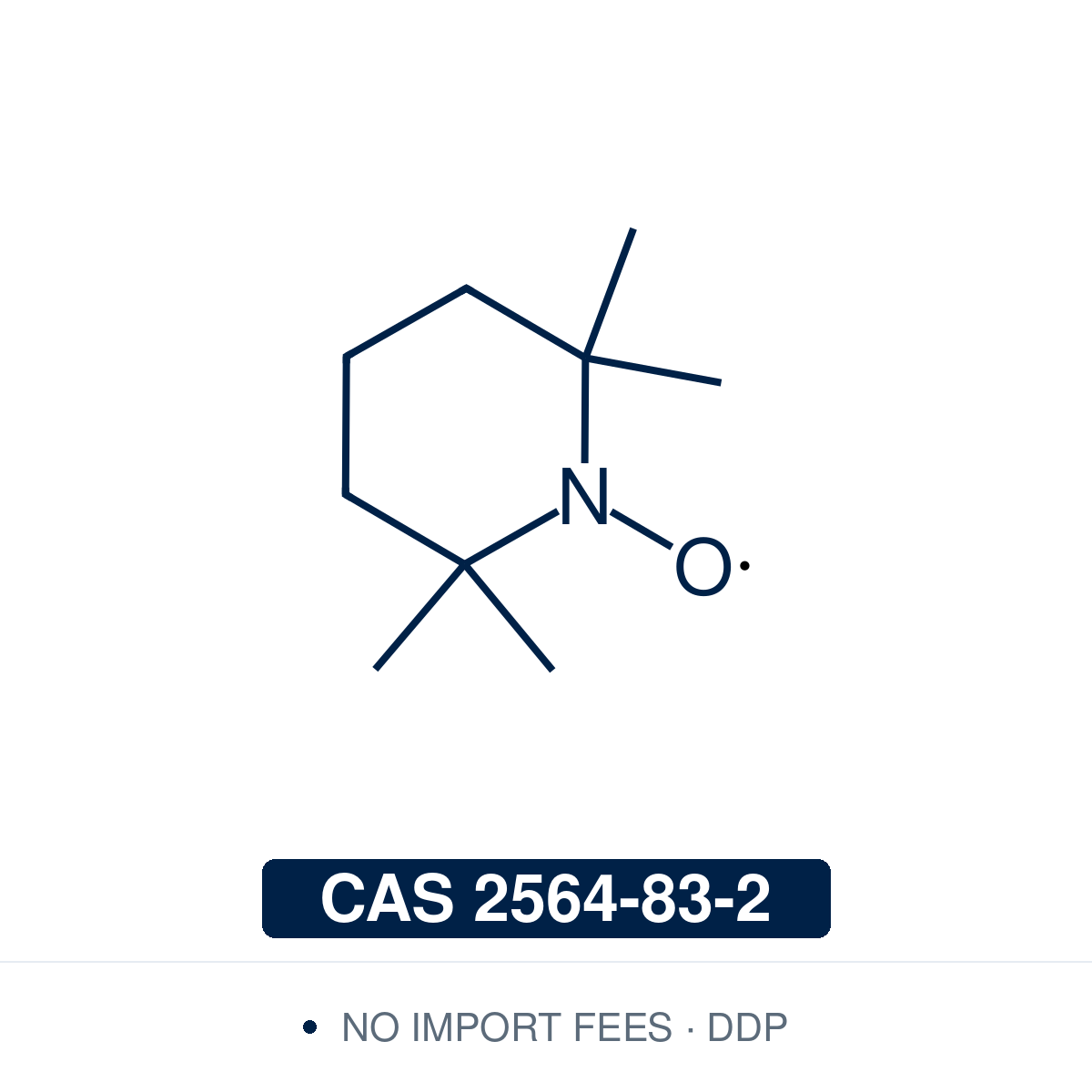
| SMILES | CC1(CCCC(N1[O])(C)C)C |
| InChI | InChI=1S/C9H18NO/c1-8(2)6-5-7-9(3,4)10(8)11/h5-7H2,1-4H3 |
| InChIKey | QYTDEUPAUMOIOP-UHFFFAOYSA-N |
| PubChem CID | 2724126 |
| Molecular Formula | C₉H₁₈NO |
| Molecular Weight | 156.25 g/mol |
| Melting Point | 36-38 °C (lit.) |
| Solubility | Insoluble in water, soluble in common organic solvents |
| Purity | ≥97% |
| Physical Form | Orange to red crystalline solid powder |
| HS Code | 2933.39 |
| Shelf Life | Retest period: 36 months from date of manufacture |
| Storage Conditions | Store refrigerated (2–8 °C) in a tightly sealed container under protected from light |
Product Description & Scientific Applications
TEMPO (2,2,6,6-tetramethylpiperidine 1-oxyl) is a stable aminoxyl radical. Nitroxides of this class are established catalysts for alcohol oxidation.
Oxoammonium catalytic cycle. TEMPO undergoes reversible oxidation to the oxoammonium cation. That cation is generally proposed to act as the active oxidant. It abstracts a hydride from the alcohol to form the aldehyde, regenerating TEMPO. The nitroxide is therefore used in catalytic quantity with a stoichiometric terminal oxidant.
Anelli–Montanari oxidation. Catalytic TEMPO with sodium hypochlorite and potassium bromide oxidises primary alcohols to aldehydes. NaOCl oxidises TEMPO to the N-oxoammonium ion directly, and indirectly through HOBr formed by hypochlorite-induced bromide oxidation. Sodium chlorite alone with TEMPO and KBr also oxidises the alcohol directly to the aldehyde.
TEMPO/BAIB oxidation. Catalytic TEMPO with [bis(acetoxy)iodo]benzene oxidises primary hydroxyls regioselectively, in the presence of secondary ones. The reaction runs in tert-butanol, dichloromethane and water and reaches the aldehyde or the carboxylic acid. The system is standard for uronic acid formation on protected sugars and polyols.
Cu/TEMPO aerobic oxidation. Copper salts and copper polypyridyl complexes with TEMPO oxidise benzylic and primary alcohols under oxygen or air. Copper, TEMPO and the amine or pyridyl ligand are all used at single-figure mol% loadings. Oxygen is the terminal oxidant, so the only stoichiometric by-product is water.
Cellulose nanomaterials. TEMPO oxidation converts the C6 primary hydroxyls of cellulose to carboxylates. Coupled with mechanical blending it disintegrates cellulose into nanofibrils. Electrochemical oxidation with a TEMPO catalyst gives cellulose nanocrystals.
Nitroxide-mediated polymerisation. TEMPO mediates styrene polymerisation at 120 °C through reversible alkoxyamine homolysis. The homolysis equilibrium constant of the TEMPO–styryl alkoxyamine is the reference value for the method.
Radical trapping. TEMPO intercepts carbon-centred radicals as isolable alkoxyamine adducts. Suppression or marked inhibition of a reaction on adding TEMPO is used as evidence for a radical pathway. Isolation of the adduct identifies the intermediate directly.
Amine oxidation. Used stoichiometrically rather than catalytically, TEMPO oxidises amines.
EPR spin labelling. Nitroxide radicals such as TEMPO serve as spin labels in EPR studies. They also act as single-electron probes.
MRI contrast research. TEMPO is the reference nitroxide for the development of stable radicals as fully organic, metal-free contrast agents that shorten the water proton T₁. Reduction to the diamagnetic hydroxylamine by ascorbate removes the paramagnetic character and ends the contrast effect. More hindered analogues are prepared against that benchmark.
Redox-flow catholytes. Nitroxyl radicals such as TEMPO show reversible N–O to N=O⁺ redox chemistry. That reversibility underpins their interest as catholyte materials.
Shipping Destinations
- EU & UK: Priority delivery, 3–5 business days.
- Switzerland (DDP): 3–7 business days, duties and taxes prepaid.
Safety Information
| GHS Pictograms |

|
| Signal Word | Danger |
| Hazard Class | UN 3263 — Corrosive solid, basic, organic, n.o.s. (2,2,6,6-tetramethylpiperidinyl-1-oxyl (free radical)) (Class 8, PG III) |
| Transport Category | Class 8, PG III (ADR/IATA/IMDG) |
| H-Statements | H314 |
| P-Statements | P260 - P280 - P301+P330+P331 - P303+P361+P353 - P304+P340+P310 - P305+P351+P338+P310 - P501 |
Documentation
| Safety Data Sheet | Download PDF |