NorrChemica™
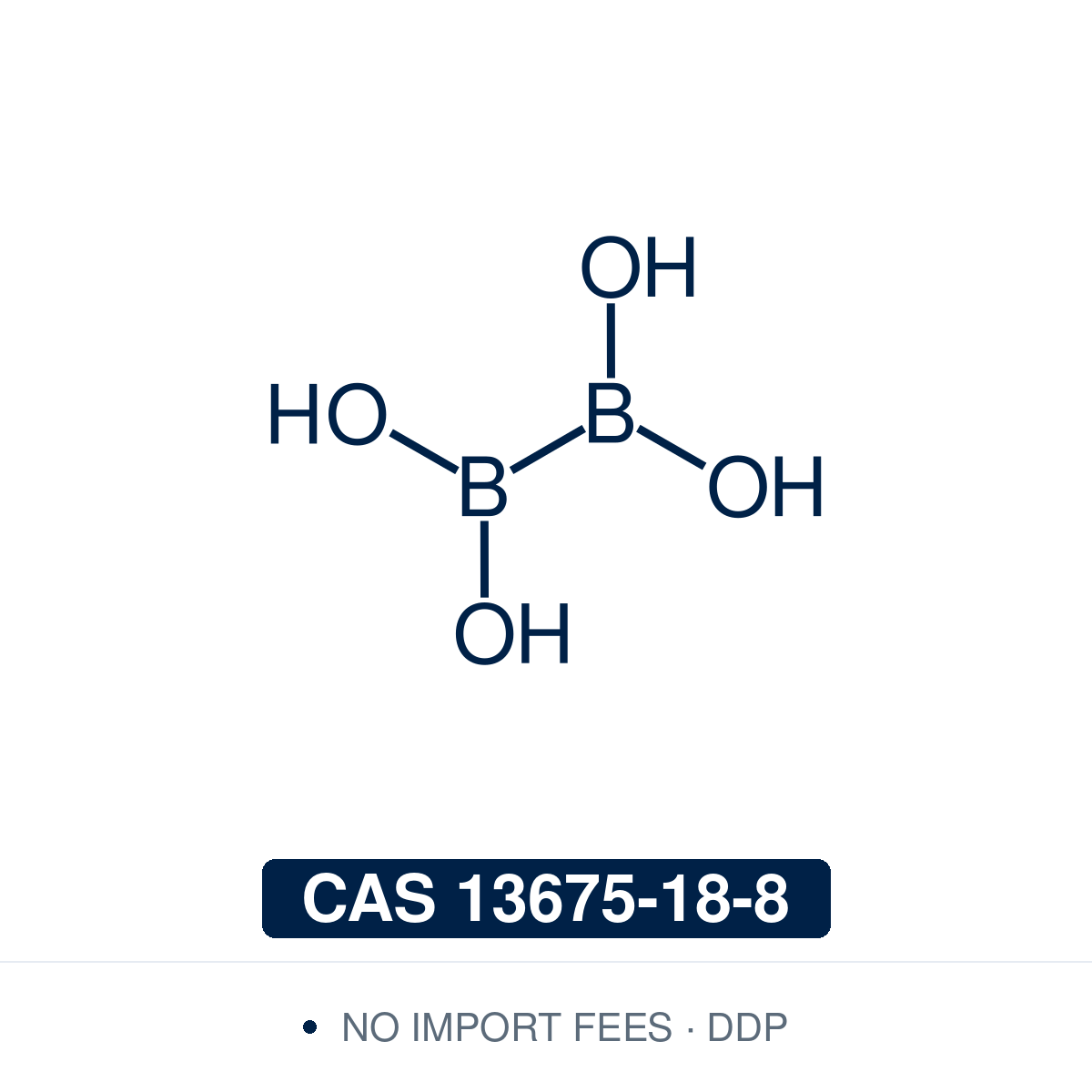
Tetrahydroxydiboron (BBA)
Tetrahydroxydiboron (BBA) | CAS 13675-18-8 | ≥97%
Couldn't load pickup availability
Technical Specifications
| CAS Number | 13675-18-8 |
| EC / EINECS Number | 694-407-6 |
| MDL Number | MFCD05663888 |
| SMILES | B(B(O)O)(O)O |
| InChI | InChI=1S/B2H4O4/c3-1(4)2(5)6/h3-6H |
| InChIKey | SKOWZLGOFVSKLB-UHFFFAOYSA-N |
| PubChem CID | 10986154 |
| Molecular Formula | B₂H₄O₄ |
| Molecular Weight | 89.66 g/mol |
| Melting Point | > 385 °C |
| Solubility | Very soluble in water; soluble in methanol, ethanol, DMF, DMSO and DMA |
| Purity | ≥97% |
| Physical Form | White crystalline solid |
| HS Code | 2810.00 |
| Shelf Life | Retest period: 24 months from date of manufacture |
| Storage Conditions | Store at room temperature in a tightly sealed container, protected from light and moisture |
Product Description & Scientific Applications
Tetrahydroxydiboron (BBA, bis-boric acid, hypodiboric acid, diboronic acid) is the free acid of the diboron reagents, four hydroxyls on a boron–boron bond. It dissolves in methanol, ethanol, dimethylformamide, dimethyl sulfoxide and dimethylacetamide, and hydrolyses to boric acid in aqueous acid.
Most borylation methods use boronate esters, usually bis(pinacolato)diboron, and therefore give boronate esters as products. This reagent gives the boronic acid directly, which can then be taken on to esters and trifluoroborates. It is also cheaper than the pinacol ester and far more atom-economical, since none of the boron is carried as a diol that must later be removed.
Applications and Reactions
- Miyaura borylation of aryl halides: Palladium catalysis converts aryl chlorides, bromides and iodides to arylboronic acids, which can be taken through to aryltrifluoroborates without workup or isolation. A Bedford-type palladacycle runs the reaction in water. Nickel catalysis extends the scope to heteroaryl halides and pseudohalides and works at room temperature. Adding ethylene glycol during borylation traps heteroaryl products as the more stable boronate esters in situ.
- Borylation of anilines through the diazonium: Diazotisation with sodium nitrite and hydrochloric acid, then borylation, converts arylamines to arylboronic acids in one pot without isolating the diazonium intermediate. The sequence runs in water or methanol at room temperature, needs no cryogenic or anhydrous conditions, and completes in under 35 minutes.
- Transfer hydrogenation without hydrogen gas: Under palladium catalysis it reduces alkenes and alkynes to the saturated hydrocarbons in high yield, with water as the hydrogen source. It is the most atom-economical of the diboron(4) reductants used this way. Running the deuterated version of the same reaction installs deuterium from D2O.
- Reduction of nitro compounds and halides: With 4,4′-bipyridine as organocatalyst it converts aromatic nitro compounds to the anilines in water at ambient temperature. With N-methylmorpholine it reduces aryl halides, alkenes and aldehydes, taking aldehydes to alcohols while leaving ketones untouched.
- Deoxygenation: It reduces pyridine N-oxides, and converts 1-hydroxybenzotriazoles to benzotriazoles under mild conditions across a broad substrate range.
- Arylacetaldehyde synthesis: Used at 5–25 mol% as co-catalyst with an iridium bisphosphine complex, it supports the arylation of vinylene carbonate by arylboronic acids.
- Hydrogen generation: Catalysed hydrolysis releases hydrogen, both atoms of which come from the water rather than the reagent. The rate rises in sulfuric acid and is rapid in sodium hydroxide.
Mechanistically, the boron–boron bond adds oxidatively to palladium(0) to give the palladium(II) intermediate that carries the borylation.
Shipping Destinations
- EU & UK: Priority delivery, 3–5 business days.
- United States (DDP): 3–7 business days, duties and taxes prepaid.
- EFTA Countries (DDP): 3–7 business days, duties and taxes prepaid.
- Worldwide: 7–14 business days, selected locations.
Safety Information
| GHS Pictograms |

|
| Signal Word | Warning |
| Hazard Class | Not regulated for transport |
| Transport Category | Not classified as dangerous goods for transport (ADR/IATA/IMDG) |
| H-Statements | H302+H332 - H315 - H319 - H335 |
| P-Statements | P261 - P264 - P301+P312 - P302+P352 - P304+P340+P312 - P305+P351+P338 |
Documentation
| Safety Data Sheet | Download PDF |