NorrChemica™
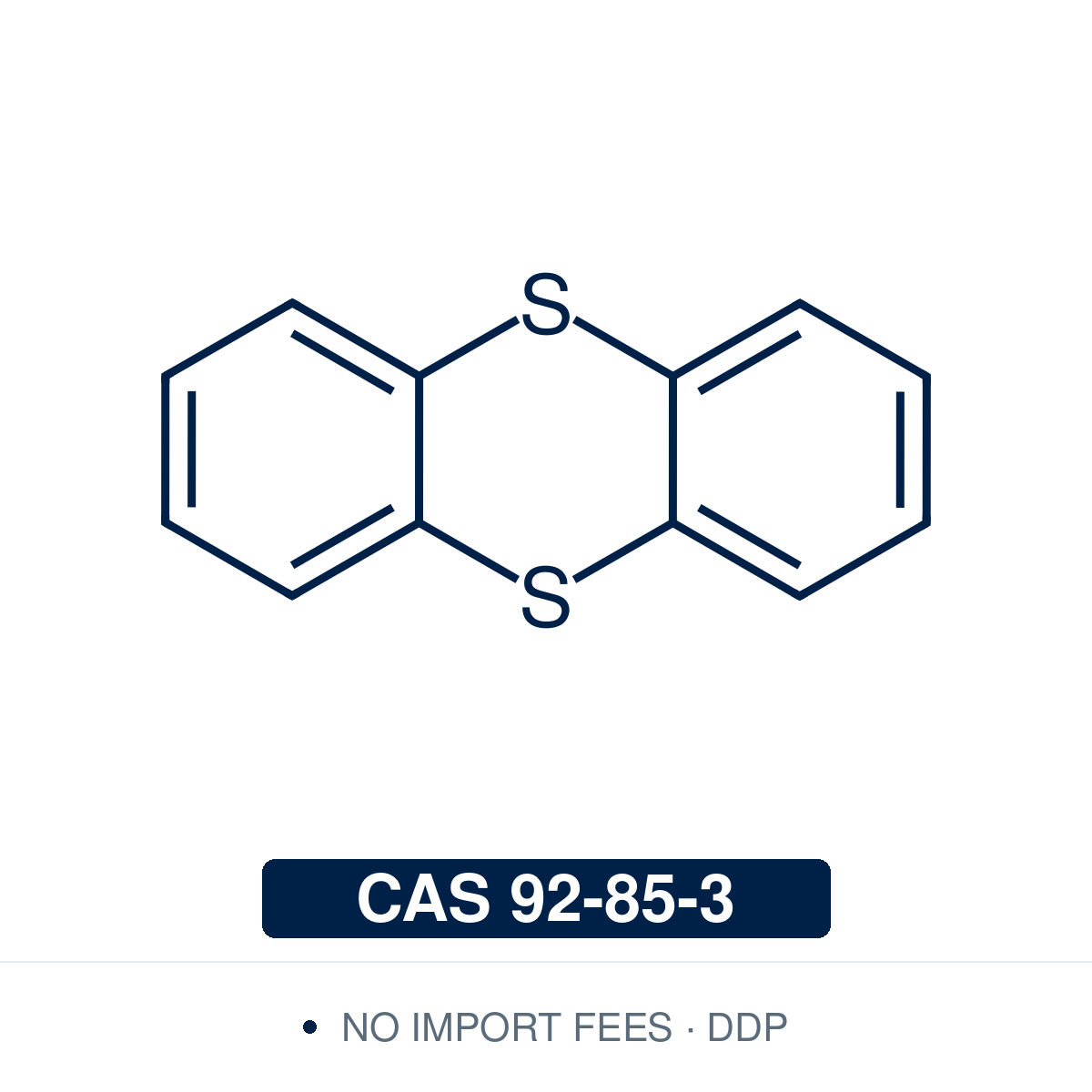
Thianthrene
Thianthrene | CAS 92-85-3 | ≥98%
Couldn't load pickup availability
Technical Specifications
| CAS Number | 92-85-3 |
| EC / EINECS Number | 202-197-0 |
| MDL Number | MFCD00005065 |
| SMILES | C1=CC=C2C(=C1)SC3=CC=CC=C3S2 |
| InChI | InChI=1S/C12H8S2/c1-2-6-10-9(5-1)13-11-7-3-4-8-12(11)14-10/h1-8H |
| InChIKey | GVIJJXMXTUZIOD-UHFFFAOYSA-N |
| PubChem CID | 7109 |
| Molecular Formula | C12H8S2 |
| Molecular Weight | 216.32 g/mol |
| Melting Point | 151–155 °C |
| Solubility | Soluble in chloroform, dichloromethane, toluene, benzene, and warm ethanol; insoluble in water. |
| Purity | ≥98% |
| Physical Form | Pale yellow to off-white crystalline solid |
| HS Code | 2934.99 |
| Country of Origin | Finland |
| Shelf Life | Retest period: 36 months from date of manufacture |
| Storage Conditions | Store in a cool, dry place in a tightly sealed container |
Product Description & Scientific Applications
Site-Selective Aryl-Group Transfer via Thianthrenium Salts. Thianthrene reacts with arenes under mild electrophilic conditions — through its sulfoxide derivative activated by triflic anhydride — to give arylthianthrenium triflate salts in which the aryl group is bound to a sulfonium centre as a competent leaving group for downstream chemistry. This C–H thianthrenation methodology, pioneered by the Ritter group, exhibits unusually high site-selectivity governed by steric accessibility and electronic activation of the substrate, often favouring the para position of simple monosubstituted arenes and the most electron-rich, least sterically hindered site in complex pharmaceutical scaffolds. The resulting aryl-TT+ salts are bench-stable surrogates for diazonium and aryl-halide cross-coupling partners and undergo a wide range of metal-catalysed and photoredox-promoted transformations, including amination, Suzuki–Miyaura and Negishi-type biaryl couplings, Pd-catalysed deuteration and tritiation for isotope labelling, borylation, trifluoromethylation, and conversion to aryl radicals under photoredox or copper-mediated conditions. The methodology has recently been extended to meta-selective functionalisation via Catellani-type strategies using norbornene as a relay. The borylation manifold provides access from complex arenes to aryl boronate derivatives that can enter Suzuki–Miyaura chemistry, complementary to the arylboronic acid building blocks supplied separately by NorrChemica. Related thianthrene chemistry has also been extended to olefin substrates, with alkenyl-thianthrenium salts and dicationic alkene-thianthrene adducts emerging as linchpins for cyclopropanation, aminofunctionalisation, and allylic functionalisation.
Radical Cation Chemistry and Electrochemical Research. The well-characterised one-electron oxidation of thianthrene to a persistent radical cation (TT•+), first detected in 1957 and extensively mapped in subsequent work, makes the compound a benchmark substrate in organic electrochemistry and a model system for sulfur-centred radical cations, charge-transfer complexes, and persistent open-shell species. Isolable thianthrene radical cation tetrafluoroborate is itself a useful one-electron oxidant in synthesis, with reported reactivity toward organometallic substrates including dialkylmercurials and organotin compounds. The radical cation also acts as an in situ-generated SET mediator in photoredox-coupled transformations, including thiocyanation and selenocyanation of aryl thianthrenium salts and radical-coupling protocols where it shuttles electrons between substrate and photoredox cycle. The butterfly-shaped neutral compound serves as a model system in studies of conformational dynamics, with reported inter-ring dihedral angles around 128–142° and an inversion barrier near 4 kcal mol−1 in classical structural studies, as well as in computational and crystallographic studies of through-space sulfur–sulfur interactions and lone-pair orbital overlap across the central 1,4-dithiine ring.
Donor Architecture for Organic Optoelectronics and Energy-Storage Materials. Thianthrene and its oxidised derivatives are documented motifs in organic optoelectronic and energy-storage materials. As a rigid donor/spacer unit in thermally activated delayed fluorescence (TADF) emitter design, the thianthrene fragment contributes butterfly geometry and bulky three-dimensional architecture that can separate donor and acceptor frontier orbitals, suppress aggregation-caused quenching, and support a small singlet–triplet energy gap (ΔEST) for reverse intersystem crossing. Reported blue-emitting TADF systems include DPS-2CzTE and DPS-2Cz2TE, in which thianthrene is inserted as a rigid bridge between carbazole donors and a diphenylsulfone acceptor. In energy-storage applications, thianthrene-based polymeric mediators provide 4 V-class redox-active organic units for hybrid redox-targeting reactions with LiMn2O4 in flow battery architectures, exploiting the reversible TT/TT•+ couple at potentials accessible to high-voltage lithium chemistries. Oxidised thianthrene derivatives such as thianthrene-5,5,10,10-tetraoxide (TTO) serve as acceptor units in donor–acceptor conjugated polymers for visible-light photocatalytic hydrogen evolution, and thianthrenium-salt cationic photoinitiators provide UV-curable polymerisation formulations that avoid the benzene byproducts generated by traditional triarylsulfonium photoinitiators.
Physicochemical Reference and Thermochemical Standard. Thianthrene is NIST Standard Reference Material 1656, a combustion calorimetric standard for checking oxygen-bomb calorimetry apparatus, analytical procedures, and calculations for organic sulfur compounds. It is also used as a reference substrate in studies of aqueous solubilities of nitrogen-, sulfur-, and oxygen-containing heterocyclic derivatives of polycyclic aromatic hydrocarbons, in measurements of partition coefficients in 1-hexyl-3-methylimidazolium bis(trifluoromethylsulfonyl)imide and supercritical carbon dioxide, and as a structural reference for the butterfly-shaped geometry of the central 1,4-dithiine ring in dibenzo-fused sulfur heterocycles. Its bond and ring geometry provide benchmark inputs for computational analyses of through-space S–S interactions and lone-pair donation into the central heterocycle.
Shipping Destinations
- EU & UK: Priority delivery, 2–5 business days.
- United States (DDP): 3–7 business days, duties and taxes prepaid.
- EFTA Countries (DDP): 3–7 business days, duties and taxes prepaid.
- Worldwide: 7–14 business days, selected locations.
Safety Information
| Hazard Class | Not regulated for transport |
| Transport Category | Not classified as dangerous goods for transport (ADR/IATA/IMDG) |
Documentation
| Safety Data Sheet | Download PDF |
Share